




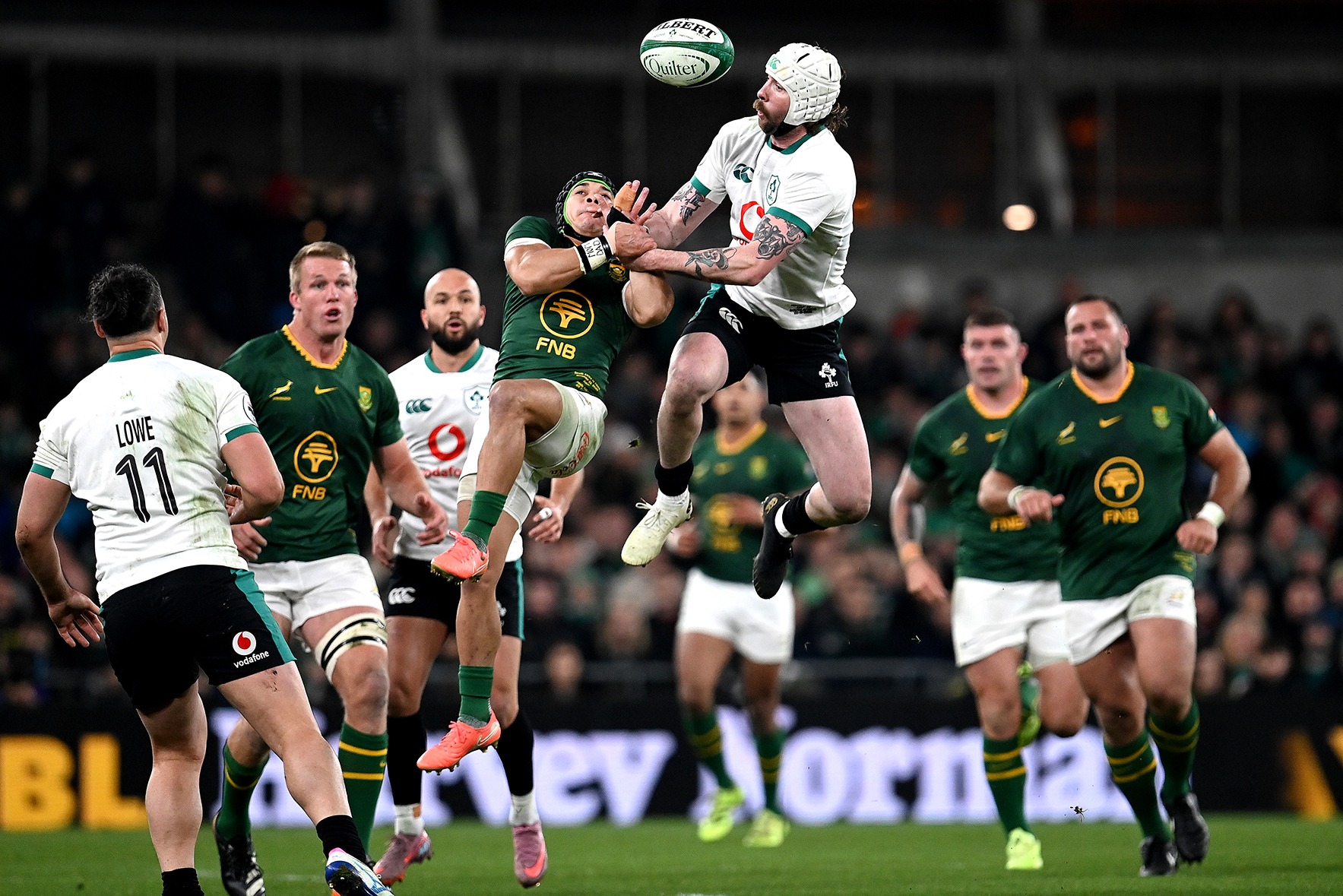
 Mack Hansen of Ireland and Bok wing Cheslin Kolbe compete for the ball in the air when the sides met in Dublin last year. (Photo: Charles McQuillan / Getty Images)
 The mood in the Springbok coaching box has shifted since the South African rugby delegation returned from the Shape of the Game conference in London last week.
Thanks to the arguments made by SA and France, the scrum will remain one of the rugby’s defining features, and no significant law changes will be considered until after the 2027 World Cup.
Rugby as we know it will exist for at least two more seasons.
In one sense, Bok coach Rassie Erasmus and his coaching team know what to expect between now and the end of the global tournament in Australia. They can push forward with their tactical plans and related selection policies over the next 18 months.
On the other hand, they have work to do if they're going to stay ahead of the tactical curve, as some of the recent performances in the Six Nations have shown how France and others have embraced the era of the contest.
France are unbeaten after three rounds, and will retain the Six Nations trophy and clinch the Grand Slam if they beat Scotland in Edinburgh and England in Paris over the next two weeks.
The Boks, of course, will be more interested to see how they play and where they are effective, before the meeting between the two sides in Paris this November.
In fact, the Boks will play all six of the northern-hemisphere juggernauts this season as part of the inaugural Nations Championship.
If the current trends are anything to go by, the high-kick/high-tempo template could make for some big scores and absorbing spectacles over the course of the 2026 schedule.
/file/attachments/orphans/2246409668_223690.jpg "Controlling the aerial kicking contest is a key battleground in modern Test rugby. Here Bok No 8 Jasper Wiese secures the ball in a clash against France in Paris last November. (Photo: Jean Catuffe / Getty Images)")
Kicking the myth into touch
The Bok coaches went out of their way to highlight the importance of the scrum, kicking and aerial contests when addressing the media in Cape Town this past week.
While SA have always been strong in these areas, there’s an objective case to be made for how these contests are at the heart of a free-flowing game.
When a scrum is set, up to 18 of the 30 players are concentrated in a small area of the field, creating more space for the team in possession to attack.
When a box kick is launched from the base of a ruck and the players from both sides are granted full access to the landing zone, there’s often an opportunity to run at an unset defence.
As counterintuitive as it may seem, these structures hold the key to a less structured and chaotic game, and it’s the chaos that serves as the platform for sweeping counter-attacking manoeuvres that culminate in unforgettable tries.
The Boks broke their own points (572) and try-scoring records (81) in 2025, while France have already racked up 123 points and 18 tries in three Six Nations games this season.
Both teams boast strong set pieces and enjoy the gainline battle, but they also favour a kick-heavy approach and look to strike in broken play.
In their recent performance against England in London, Ireland favoured this strategy, with official stats showing they kicked 31 times en route to scoring five tries and claiming a record-breaking 42-21 victory.
/file/attachments/orphans/TL_2487555_965565.jpg "Assistant Box coach Felix Jones enjoys the chaos of the kicking game. (Photo: Brendan Moran / Gallo Images)")
“It came up at the Shape of the Game conference, how great the aerial contest has been for the game, and how it has correlated with more line breaks and more tries, which everyone loves to see,” said Bok assistant coach Felix Jones .
“When a contestable kick goes up, no one says ‘this is going to be boring for the next two minutes’. Everyone knows there’s going to be some sort of athletic contest to win the ball, and a dynamic piece of play afterwards.”
Breaking ball
According to Jones, the Boks retained a large percentage (he did not specify) of these contestable kicks in 2025, and often punished the defence before it had a chance to adapt.
In 2026, more teams viewing a successful kick receipt as an attacking launchpad, with the secondary contest for “scraps” or “the breaking ball”, presents a further opportunity.
“A lot of attack coaches are getting excited about that, and defence coaches are having to think about it, on top of the actual aerial contest itself,” said Jones.
“England have been very good in that department over the past couple of years. A couple of teams are trying break the mould, and others are trying to kick a bit longer and break that cycle.
“We’ve seen some teams using different approaches to what Gaelic football refers to as a breaking ball. How teams are trying to win that – it’s another contest in itself. Transitioning from there is a massive part of the game at the moment.”
France coach Fabien Galthié has taken a page or two out of Erasmus’ playbook over the past few years, using six or seven forwards on his bench, and adopting a squad strategy to develop more players across the respective age profiles.
While France have placed an emphasis on the scrum, lineout and kick strategy, they haven’t forsaken the attacking tempo that has marked them as a world leader at Test and club level.
France are currently leading the Six Nations table, while Bordeaux-Bégles and Toulouse are the frontrunners for the Champions Cup title.
“France have shown that they are willing to play in an unstructured manner,” noted Jones. “Clearly they’ve made some adjustments to their game plan recently.
“It’s a joy to watch, on the back of how they’re investing in the contest. There will always be structured elements in rugby, but when you think about where the game is going, those X-factor players who can convert a loose ball into an opportunity are more important than ever.”
/file/attachments/orphans/TL_2489809_901553.jpg "Assistant coach Mzwandile Stick believes tight forwards have a crucial role to play around the kicking contest. (Photo: Gareth Everett / Gallo Images)")
Forwards at the coalface of chaos
Mzwandile Stick, who has coached the Boks in departments such as the aerial contest since 2018, pointed out that the role of a tight forward had changed in recent times.
“That situation is putting the players’ skillsets under huge pressure, as you don’t have a lot of time to react,” Stick said. “When you look at who is up there when the ball comes down, it’s not just the backline players. The tight forwards need to take the space and look for the scraps. Decision making and body height is so important in those scenarios.”
When it was put to defence coach Jerry Flannery that the move towards more aerial contests had tilted the game in favour of the attack, the Irishman offered an interesting response.
Flannery worked under Erasmus and Jacques Nienaber while the South Africans were at Munster in 2016 and 2017, and used what he’d learned from Nienaber to become a successful defence coach in his own right at Harlequins, who won the English Premiership title in 2021.
What made Harlequins so successful, of course, was their offensive defence, and ultimately their ability to transition from defence to attack and convert their opportunities into points.
Flannery has brought that philosophy across to the Boks, and Erasmus often highlights the close relationship between the Irishman and attack coach Tony Brown.
Despite the move towards a more attacking game, the Boks still boast a fine defensive record, having averaged just two tries conceded per game in 2025.
/file/attachments/orphans/TL_2528714_397653.jpg "Bok defence coach Jerry Flannery is always working on ways to combat the threat of the ‘breaking ball’. (Photo: Ashley Vlotman / Gallo Images)")
“The defence has to look at the different pressure points: how you can pressure the quality of the opposition’s kick, how you align your players around the receiver, and then how you can align the player around the breaking ball,” Flannery said. “Because if the attacking team doesn’t win either of those contests, there may be a chance to counter-attack.
“In the past, teams would try to take a quick tap or a quick throw to catch the defence unstructured. Now it’s every second or third kick that’s leading to those opportunities, and the game is blown wide open.
“It is a challenge for the defence, but it’s been good for the game as a whole.” DM