




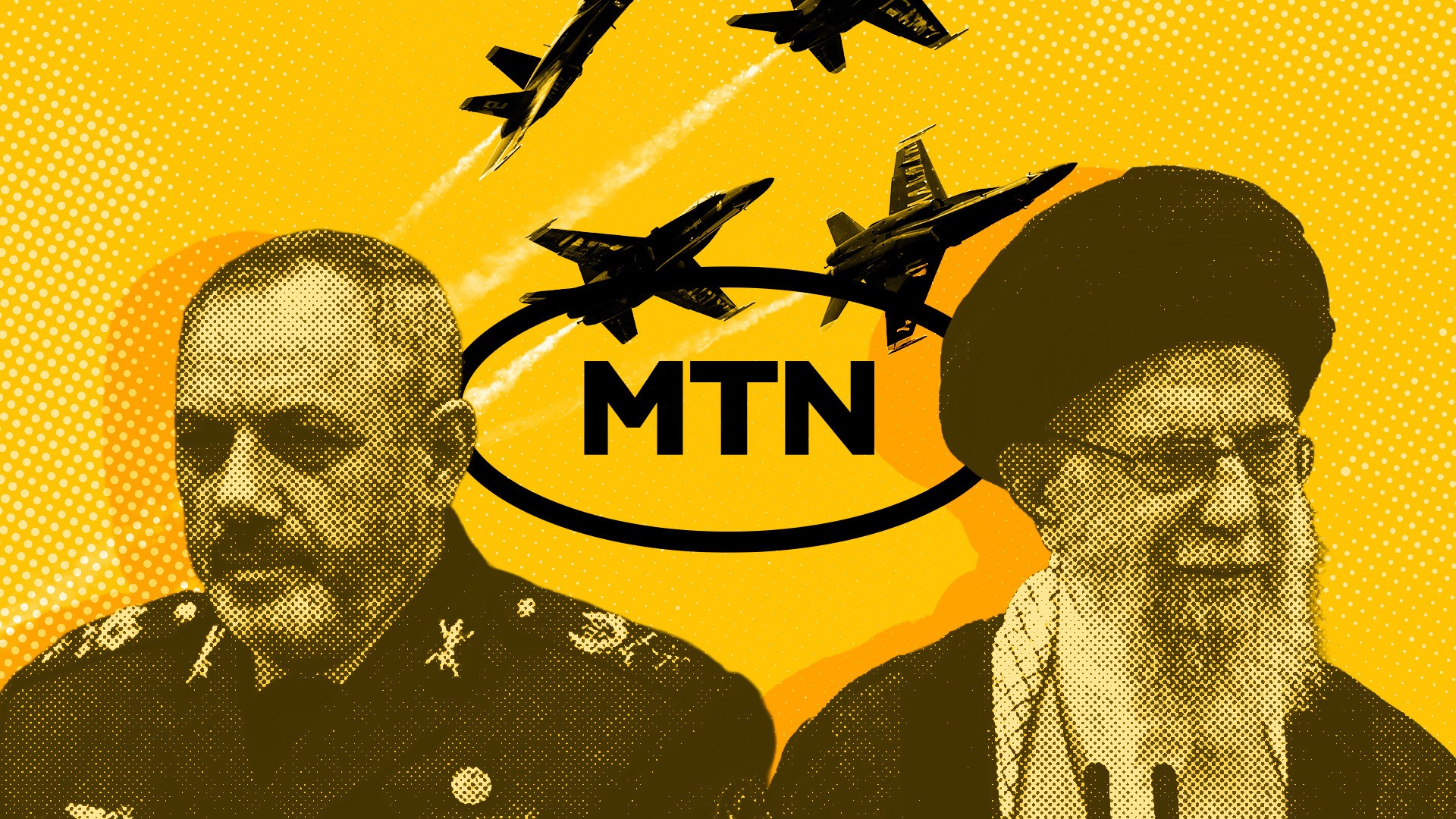
 Deceased Iranian defense Minster Amir Nasirzadeh and Ayatollah Ali KHamenei (Photos: Majid Saeedi/Getty Images) | US fighter jets during a demonstration. (Photos: Gallo Images).
 /file/dailymaverick/wp-content/uploads/2025/10/label-analysis-2.jpg)
The Gulf conflict has made for a rough ride for South African companies with tentacles spread across the globe. Paul Vos, Regional Managing Director of CIPS (Chartered Institute of Procurement & Supply) Southern Africa says this “is not a distant geopolitical issue”.
“It is already impacting freight routes, pricing structures and working capital cycles in southern Africa,” he says. “Businesses that rely on just-in-time models or concentrated supplier bases are particularly exposed.”
But one SA-based company is having a particularly bad time of it. MTN’s 49% stake in Irancell – Iran’s second largest mobile network – has been a constant geopolitical headache, with group CEO Ralph Mupita telling media during a briefing in September 2025 that it is a “frozen asset”.
He explained that due to the reimposition of US sanctions, it became impossible for MTN to repatriate funds or move capital in and out of the country. In fact, MTN told Daily Maverick that it has not been able to extract any gains from Iran since May 2018.
And now with Ayatollah Ali Khamenei and Defence Minister Amir Nasirzadeh both killed in a missile strike on Saturday, Irancell has also been decapitated – at least temporarily, until a new Supreme Leader is announced.
When the state does the capturing
Not only have the unique business relations between MTN and the Iranian government been the subject of a legal challenge by Turkcell and a US Department of Justice grand jury investigation, in January the MTN-Irancell board dismissed CEO Alireza Rafiei for being too slow to shut down the network during the protests.
Technically the company still has an operational CEO because the board did install senior Islamic Revolutionary Guard Corps member Mohammad Hossein Soleimanian in Rafiei’s place, but that doesn’t help MTN right now.
The mobile network company communications team wrote in response to Daily Maverick questions that the “intention is to sell the asset but it is, in effect, a frozen asset”, and that the company “cannot divest until US sanctions are either relaxed or lifted”.
It is a desperate position to be in given the already complex relationship between SA and Iran, as well as the ownership mix on the Irancell side of the partnership.
A state within a state
The 51% on the Irancell side sits with the Iran Electronic Development Company, which is not a conventional commercial enterprise. It is, in effect, a vehicle through which the Iranian military-industrial complex and the theocratic state jointly flexes its muscle over the country’s critical telecoms infrastructure.
The development company has two primary co-owners. The first is Iran Electronics Industries, known as Sairan – a direct subsidiary of Iran’s Ministry of Defence and Armed Forces Logistics, which was headed by Brigadier-General Aziz Nasirzadeh.
The second co-owner is something called the Bonyad Mostazafan, literally the Foundation of the Oppressed, a state-controlled charitable organisation, which has the distinction of being one of the largest holding conglomerates in the Middle East (take that, Saudi).
Old demons, new terror
Established in about 1980 to manage assets confiscated during the Islamic Revolution, the Bonyad is a peculiar legal creature: it is neither a state entity nor a private company. It deliberately plays in the intentionally ambiguous middle space answering to no parliament, no regulator and no board. It falls under the office of the Supreme Leader Khamenei.
Who is now dead.
What now exists is a situation in which MTN’s joint venture partner has, for all practical purposes, ceased to have any authorised or functioning leadership.
Reassuringly, MTN told Daily Maverick that it currently has “no authorised counterparty with whom to negotiate a legal exit” and that (here’s the reassuring part) there had been no South African nationals working in Iran for “some time”.
Into this power vacuum now steps the Islamic Revolutionary Guard Corps, which is widely expected to consolidate formal control over the Bonyad Mostazafan’s sprawling commercial portfolio as internal power struggles within the Iranian state play out.
For MTN, this is a potential legal catastrophe.
Dirt in the vacuum bag
The corps is a designated Foreign Terrorist Organisation under US law. MTN is already the subject of a US Department of Justice grand jury investigation into its conduct in both Iran and Afghanistan. It is also defending a civil lawsuit under the US Anti-Terrorism Act, brought by the families of American soldiers who allege that MTN’s joint venture in Iran funnelled billions to the very organisation that is now running the network.
That Islamic Revolutionary Guard Corps’ prior influence over Irancell was already a serious liability. Its direct operational control – demonstrated in January when it ordered the network blacked out during civilian protests, and confirmed again when it shut down the network entirely during the US-Israeli strikes –means MTN doesn’t just hold a passive minority stake in a company with Revolutionary Guard associations. It holds a stake in a network that an internationally designated terrorist organisation is actively operating as a wartime information control platform.
The frozen asset embarrassment is now an active legal nightmare. DM