



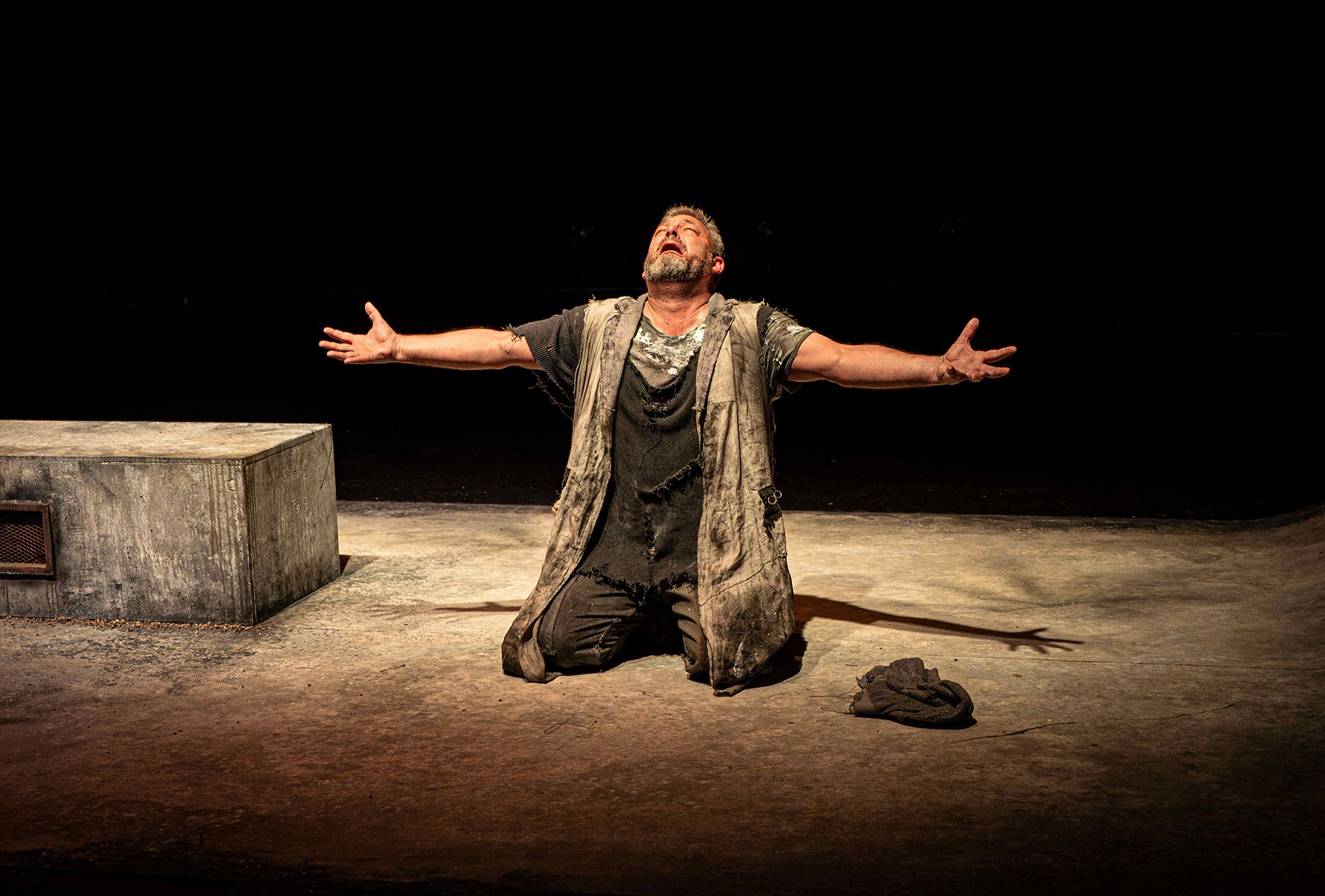
 Alan Committie as The Poet in An Iliad. (Photo: Claude Barnardo)
 The gods are watching from somewhere on high, occasionally interfering, singling out favoured humans, even pulling a few strings. Below them, here on Earth, spears whistle through the air, swords are thrust into soft flesh, blood spurts, soldiers fall and battlefields quiver under the weight of first rampaging and then dying infantrymen.
It’s all happening as vividly as anything Hollywood can throw at us, and yet there’s nothing but a vast, wide-open stage and a solitary actor speaking words minced together over centuries of telling and retelling, the vividness of the descriptions and the heft of the ordeals evoked before us like some terrible fever dream.
Adapted from one of the oldest extant works of European literature, An Iliad presents an ancient, familiar tale, the Greek siege of Troy condensed from Homer’s poem into a riveting account of the battle-ravaged final weeks of a war that raged for almost a decade.
Written with due regard for modern-day vernacular and to convey the timeless relevance of its themes, this adaptation of the great epic (written by Lisa Peterson and Denis O’Hare, who draw on a translation by Robert Fagles) combines elements of the classic saga with the contemporary realisation that we’ve learnt nothing over the intervening centuries of futile warmongering.
The result is gripping and at times harrowingly intense. In other parts, the lid is lifted to allow some steam out, and there are instances of light, even comic reprieve.
Alan Committie plays a poet, bard, raconteur… a wandering storyteller who has evidently roamed the Earth for centuries, recounting this tale of heedless vengeance, relentless violence, bloodletting and death. He may perform his bardic duty with great skill and passion, but it’s clear that he is doomed to do so – it’s his fate rather than a task he ungrudgingly delights in performing.
As the play’s time-ravaged, emotionally battered narrator-poet gathers his memories of the Trojan War, he inserts personal digressions, commentary and contemporary comparisons, adds details in the way a camera might zoom in for close-ups on the battlefield, pauses on intimate moments that alter the scale of the storytelling, intensifying the sense of something monumental that’s forever raging in the realm of collective myth.
/file/attachments/orphans/AnIliadisamodernadaptationthatwascreatedtobeintimateunstuffyanddeeplypersonal_ClaudeBarnardo_813125_457529_500515.jpg "An Iliad is a modern adaptation that was created to be intimate, unstuffy and deeply personal. (Photo: Claude Barnardo)")
Committie, to contend with the burden of a savage task, undergoes something of an emotional and psychological transformation to carry the weight of the terrible tale he must convey. There were moments when I watched him sink into the role, and leaned forward in my seat, unable to recognise an actor I know well, on stage and off.
His burden, apart from sharing a story, is to unequivocally relate war’s noxious nature, and to have us ponder the question: When will we finally evolve beyond our urge for such devastating conflicts?
The adaptation’s purpose is as much to underscore a frank anti-war sentiment (“Every time I sing this song, I hope it’s the last time,” The Poet tells us early on), as it serves to remind us of the human failure to learn from the past. At one point, The Poet lists a breathtaking number of wars, many of them with startlingly strange, unfamiliar, even funny names, others – such as Saturday’s assault by the US and Israel on Iran – painfully close to the bone.
Each named war might have been described by its own harrowing poem, but instead we get a litany of these past and ongoing horrors, breathtakingly long, diverse and quite exhausting. And still the list continues to grow.
Even as Committie performed on Saturday night, new strikes were happening across the Middle East. These new wars, Committie hinted after the show, are reminders of who today’s “gods” in fact are.
Our modern-day “gods” aren’t mystical, mysterious, omnipotent figures who dwell in a place of myth in the heavens. They’re the warmongering politicians, arms contractors and technocrats who pull the strings, finger the red buttons, send soldiers off to battle and watch from a distance as tens, hundreds, thousands die. They are haughty, malicious, power-hungry provocateurs and just as disconnected from reality as the gods of Homer’s ancient world.
Committie, proving himself a consummate rememberer of an insane number of lines, has for some time been collecting great character roles like a thespian trophy hunter in search of enormous challenges – ways to stretch himself and surprise audiences. This role sees him sinking his teeth into a part that could not be more different from his “other job” as a stand-up comedian. For while there are moments of levity, this anti-war, one-man show is rooted in the substrate of some of the worst human impulses.
Peterson and O’Hare wrote An Iliad with the intention of having an ancient work resonate with contemporary meaning. The story which was no doubt told and retold over many centuries before eventually being written down and attributed to Homer, was, according to O’Hare, always meant to be “one-on-one entertainment”. Which is why this modern adaptation has been created to be intimate, unstuffy and deeply personal.
/file/attachments/orphans/Theadaptationspurposeunderscoresafrankanti-warsentiment_ClaudeBarnardo_950420.jpg "The adaptation's purpose underscores a frank anti-war sentiment. (Photo: Claude Barnardo)")
Committie certainly gets it right to make the audience feel as though they’ve joined him for a chatty, one-on-one conversation, informal despite the scale of the story being related. But he also achieves something else: enabling us to witness the wonder and delight of storytelling while sensing the awful burden of being an artist compelled to recount a tragic tale over and over.
For storytellers – poets, playwrights, novelists, filmmakers – war is a great and terrible provider. Countless heroes and tales of heroism have been drawn from the battlefields, along with scenes of blood-soaked violence that, in multiple mediums, hold spectators in their thrall. As much as we rationally abhor war, we nevertheless thrill at the action, get off on the horrific impulses that ripple through tales of military conflict and conquest.
And while there’s plenty in this account that underscores the tragic nature of war, the story’s intrigue is of course heightened by its attention to awful details and hot gossip.
The Poet – our narrator – tells us, early on, that “it’s a good story”. He should know, because he’s witnessed its effect on countless audiences. Its details include all the elements we humans enjoy, from the fearsome war of words between Agamemnon and Achilles, to the bitter final encounter between Achilles and the Trojan hero, Hector.
We get the heroics and the dashing swordplay and the gods watching from above, but we also get contemporary anecdotal comparisons, bringing the action down to Earth. At one point, attempting to convey the huge chunk of time that passed between the start of the war and its conclusion, The Poet conjures domestic scenes featuring soldiers returning from battle to find their wives, now older, fatter, and possibly mothers to other men’s children.
It seems such a waste of life, such a squandering of potential.
Then, in a slightly tongue-in-cheek explanation as to why the Greeks might have endured such a pointless, seemingly endless war, he draws a comparison with being in a supermarket queue: “You’ve been there 20 minutes, and the other line is moving faster. Do you switch lines now? ‘No, goddamn it, I’ve been here for 20 minutes, I’m gonna wait in this line. Look – I’m not leaving ’cause otherwise I’ve wasted my time.’”
Such relatable, humorous side-notes add a layer of freshness to the storytelling, ensuring that we never get too caught up in the soothing sensation of poetry or lost in the loftiness of classical tone. The writers want us to experience the urgency and the immediacy of Homer’s tale, have it feel like something weighing on us in the here and now.
The language feels, if not entirely casual, certainly of the moment, chatty, real.
/file/attachments/orphans/AlanCommittieundergoesanemotionalandpsychologicaltransformation_ClaudeBarnardo_326436_936965.jpg "Alan Committie undergoes an emotional and psychological transformation. (Photo: Claude Barnardo)")
Adding a separate layer of “voice” to the play is The Muse, seen here in the guise of composer extraordinaire Charl-Johan Lingenfelder, who creates a living, breathing soundscape that drives the emotional tone and atmosphere of the show. It’s a beautiful score, laced with expertly crafted sound effects, the impact of which is further enhanced by Luke Ellenbogen’s clever lighting design that, apart from bringing literal electricity to the performance, occasionally adds a hint of otherworldliness as Committie’s shadow is rendered large and ominous against the sides of the stage.
Geoffrey Hyland’s direction is invisible: he has orchestrated a monumental experience and brought it into the psychological realm of the living room – or the cave where our oldest ancestors gathered around the fire to listen to shamanic storytellers; you feel spoken to as if by a reliable, trustworthy friend. Honest, compelling, deeply intimate, you experience the tenderness of the conversational style without losing the thrust of how consequential the underlying meaning of the play is.
Where the direction is in fact noticeable is in the frankly beautiful coup of having opened the entire theatre up, so we see deep into the wings, and far beyond the performance space into the auditorium of another theatre on the other side. It’s there, as if elevated among the gods themselves, that Lingenfelder’s Muse plays his various instruments, adds auditory effects and impulses that reinforce the emotional heft of the story – occasionally, he also nudges The Poet back on course when he momentarily considers taking the tale off-piste.
The result of all of this is 90 minutes of having your attention held, captivated and enthralled by that most primal and wondrously human thing: storytelling. Words masterfully holding us in suspense even when we know only too well how it will all play out.
It is a tale as old as time, but it is has its hooks in us, urges us to listen more carefully than ever before. An Iliad is a reminder of why we humans tell stories – it’s to make sense of the universe even when chaos prevails. When all else fails, you will – for the duration, at least – be utterly transported. DM
An Iliad is playing at the Baxter Flipside in Cape Town until 14 March.