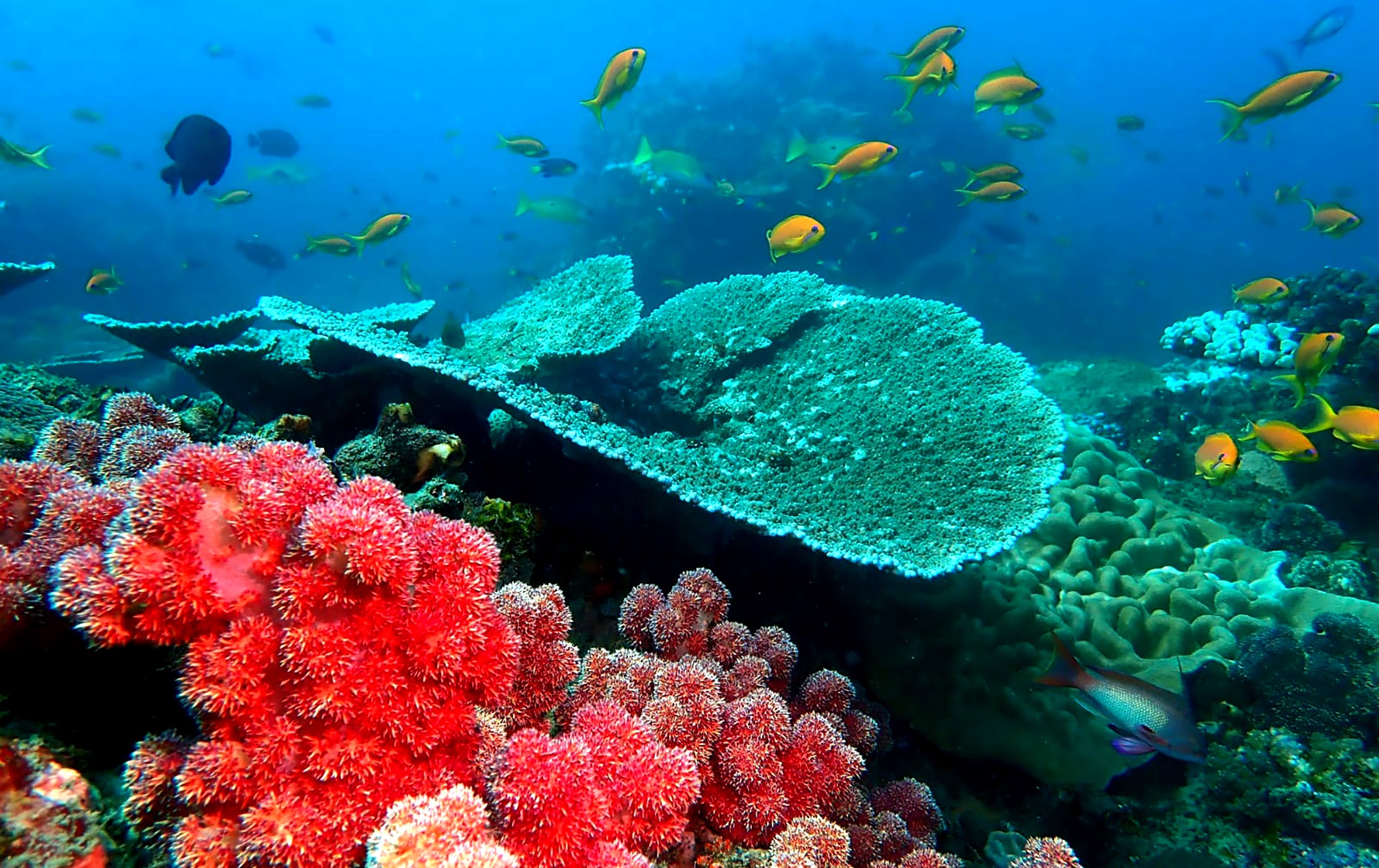
 The coral reefs in the iSimangaliso Marine Protected Area provide vital feeding and breeding spaces for an abundance of marine life, but are threatened by a steady build-up of toxic chemicals. (Photo: Sean Porter / Oceanographic Research Institute)
 High levels of pesticides and herbicides — including several banned chemical compounds — are accumulating in coral reefs in one of South Africa’s largest marine protected areas.
The numerous chemical compounds detected in coral reef animals within the iSimangaliso World Heritage Site in KwaZulu-Natal include residues of DDT (banned in farming in most of the world, but still used in SA for malaria control) as well as several other organochlorine pesticides (OCPs) that have been banned globally because of their long-lasting and harmful impacts on people, wildlife, fish and other aquatic fauna.
The detection of at least 18 OCP contaminants in corals and sponges in several places along the northern KZN coast is part of an ongoing research project by scientists from the Durban-based Oceanographic Research Institute (ORI) and Wits University in Johannesburg.
“The levels of DDT we have found at iSimangaliso are among the highest levels recorded in corals around the world,” said ORI senior scientist Dr Sean Porter, noting that these chemical compounds build up progressively as the corals grow older.
Apart from their role as a major tourist attraction, coral reefs are one of the richest and most valuable marine ecosystems. Home to more than 4,000 species of fish, corals, and other marine life, these reefs cover less than 1% of the world’s oceans, but provide habitat for at least 25% of the marine life. They provide food and breeding grounds for a wide variety of species, while also creating safe hiding places for young fish against predators.
The exact biological impacts of OCP chemicals on reef organisms remain relatively under-researched at a global level, but their presence in iSimangaliso has amplified concern about the health of these reefs. Marine scientists say there has been a consistent decline in soft coral cover, including an overall 20% decline over two decades, at a monitoring site at Nine-mile Reef, next to Lake Sibaya.
/file/attachments/orphans/seapesticide6partofthestudyareasourceORInew_932914.jpg "These are some of the sampling points where a variety of farm herbicides and other more toxic pesticides have been found along the northern KwaZulu-Natal coast.
<br>(Source: Oceanographic Research Institute)")
(Source: Oceanographic Research Institute)
Wits environmental geochemist Prof Marc Humphries and members of his research team have previously found similarly high levels of these chemical toxins in land-based wetland sediments and fish in Lake St Lucia, as well as inland coastal lakes that stretch northwards to the Mozambique border.
Porter and Humphries teamed up almost a decade ago to see whether any of these banned chemicals were finding their way into the sea and coral reefs — and are still busy expanding their research work further along the coast, and into deeper waters.
After measuring the levels of OCPs at several sites between Leadsman Shoal and Regal Reef, they concluded that several of these toxic chemicals were seeping beneath the coastal dunes into the sea and gradually bioaccumulating in the corals.
“We were very surprised. We did not expect to pick them up in corals,” says Porter.
Humphries points out that South Africa is the largest consumer of pesticide products in Africa and recently ranked as the 20th highest user in the world.
/file/attachments/orphans/Seapesticide2CropdusterimageiStock-_293937.jpg "A crop duster sprays chemicals onto farming fields. (Photo: iStock)")
The two research leaders say DDT and other OCPs were used widely in farming and disease vector control projects in South Africa since the 1940s. Although environmental and human health concerns led to their banning in most developed countries in the early 1970s, OCPs were widely used in South Africa until the signing of the Stockholm Convention on Persistent Organic Pollutants in 2004.
Banned
Most OCP compounds are now banned in South Africa, but DDT is still used legally to control the spread of malaria in the northeastern parts of the country.
The discovery of DDT, dieldrin, endrin, endosulfan and heptachlor in local corals is believed to stem partly from decades of pollution. But the researchers also suspect that some of these chemicals are still being used illegally from old stockpiles.
In addition to the OCPs, the researchers have also recorded high levels of several more commonly used herbicides. These include atrazine, alachlor, hexazinone, acetochlor and simazine, with higher levels found in soft corals than in hard corals.
Unlike the OCPs that were thought to have leached into the sea via groundwater flows beneath coastal dunes, the farm herbicides are more likely to have flowed directly into the sea via rivers.
/file/attachments/orphans/Seapesticide3StLuciaestuarymouthinfloodimageChrisRattrayBateleursFlyingfortheEnvironment_790321.jpg "Herbicides from sugarcane fields and other farming operations are carried into the sea from several sources, including the Umfolozi, Msunduzi and Mkhuze rivers. (Photo: Chris Rattray / Bateleurs Flying for the Environment)")
This includes residues from sugar farms, commercial timber plantations and other farms entering the Umfolozi and Mkhuze (via the mouth of Lake St Lucia Estuary) as well as the Phongolo River (via Maputo Bay).
Discharges into Maputo Bay in Mozambique are then driven more than 100km southwards into iSimangaliso via the Agulhas Current.
Porter says there is still very limited information on chemical concentrations in coral reefs worldwide, with most data originating from Florida, US, and the Great Barrier Reef of Australia.
/file/attachments/orphans/Seapesticide4imageSeanPorterOceanographicResearchInstitute_550217.jpg "High levels of several chemicals banned in most parts of the world are accumulating in the coral ecosystems on South Africa’s eastern coastline. (Photo: Sean Porter / Oceanographic Research Institute)<br>")
However, some researchers fear that high levels of chemical toxins and herbicides can harm the corals and seaweeds by interfering with fertility or reducing photosynthesis in the single-cell algae that provide nutrients to the corals.
The other concern is that the corals are being exposed to a wide variety of pollutants, along with rising sea temperatures due to climate change.
“So they are actually facing a cocktail of threats that can have synergistic effects as the combined chemical mixtures may be more toxic than individual chemicals, especially if corals are stressed by climate change,” says Porter.
/file/attachments/orphans/Seapesticide5imagseACEPDeepConnections_534952.jpg "Some of the deep-water sponges in the iSimangaliso World Heritage Site. (Photo: ACEP Deep Connections)")
More recently, as part of the Deep Connections project, the research team has also collected further samples from depths of up to 170m via scuba diving and remotely operated vehicles in the iSimangaliso and Aliwal Shoal marine protected areas, as well as off Port Shepstone.
The most recent samples still have to be analysed for pesticides and heavy metals to determine how deep and widespread these chemicals are in marine organisms off KZN.
Can anything be done?
Porter and Humphries acknowledge that the reefs are legally protected in theory, but the problems originate on land outside the boundaries of the iSimangaliso Wetland Park.
They believe it is probably not feasible or affordable to remediate large areas of OCP-contaminated soils and sediments in Lake St Lucia and other coastal lakes and wetlands.
However, they suggest that farmers, the global agrochemical industry and government regulators also have a major role to play in reducing the volume and toxicity of chemicals used in agriculture, as well as eliminating illegal stockpiles.
Humphries notes that DDT for malaria control is earmarked to be phased out under the Stockholm Convention, but suggests that the National Department of Health has been slow to implement an integrated strategy to control malaria.
“As a result, SA is one of the very few countries worldwide that seeks an exemption to continue using DDT, adding to the environmental contamination problem.”
He believes the department should be pressured to change its current policy on DDT.
“Unfortunately, I don’t think many people realise just how far these toxic chemical residues can travel, eventually ending up in the ocean,” says Porter.
By the time of publication, the National Department of Health had not responded to requests for comment. DM