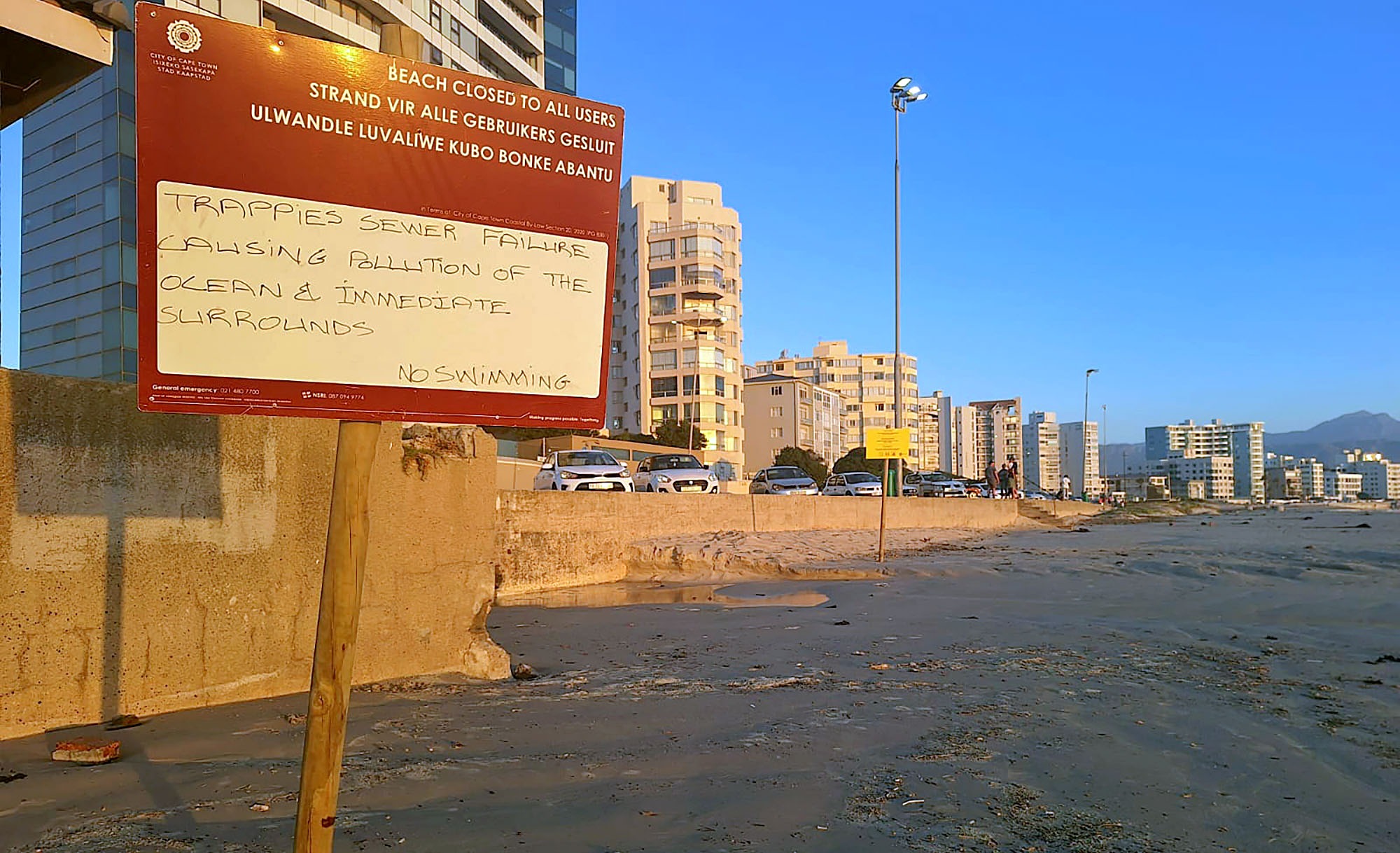
 A sign on Strand Beach near Cape Town notifies beach users about possible water contamination. (Photo: Jamii Hamlin)
 On most days, the Atlantic breeze carries the scent of the sea to residents of Strand, about 50km southeast of Cape Town. However, more recently, as sewage leaks persist, the air smells of “rotten egg” — a signature of hydrogen sulphide — and the usually white beaches are marred by black sediment plumes as a result of an ailing wastewater network.
The crisis has left Helderberg residents at their wits’ end, and the resultant “Stop the Sewage” petition was launched by the advocacy group Bays of Sewage — Helderberg.
The petition states that residents have endured repeated sewage discharges into key recreational areas, with businesses and households grappling with unpleasant odours and ongoing uncertainty about water safety.
“This contamination fuels public anxiety, undermines recreational use and threatens tourism, as the economic repercussions erode property values and local livelihoods,” the petition states.
Jamii Hamlin, a water quality advocate and a member of Bays of Sewage — Helderberg, said the organisation regularly received complaints of illnesses and infections caused by poor water quality.
He described a community plagued by E. coli-linked bladder infections, hepatitis A outbreaks, and other waterborne illnesses allegedly linked to the sewage spills.
“The city is very selective about what it tells the public,” noted Hamlin.
/file/attachments/orphans/ED_427946_203374.jpg "Cape Town Mayor Geordin Hill-Lewis visits Strand Beach on 6 January 2023 after a section of the beach was reopened after water quality testing showed bathing to be safe once again following an electrical fault at a sewer pump station. (Photo: ER Lombard / Gallo Images)")
The public health question
According to the City, enterococci (bacteria found in digestive tracts) readings at Strand’s primary swimming nodes remain within recreational thresholds, with recent samples measuring 93 and 133 Colony Forming Units (CFU)/100ml.
The City also emphasised that long-term “summer category” ratings currently classify Strand sites as “good”
However, Hamlin argues that this sampling regime misses episodic contamination near stormwater outfalls — particularly during rainfall.
Freshwater ecologist Dr Liz Day noted that faecal indicator bacteria were imperfect proxies as E. coli die off in saltwater and are not useful marine indicators of sewage pollution. However, pathogens can persist longer in contaminated sediments.
This distinction matters. Beachgoers may encounter contaminated sand long after bacterial counts drop below the threshold.
/file/attachments/orphans/BlackSedimentonStrandBeach_666097.jpeg "Black sediment spills from a pipe on Strand Beach and flows into the ocean. (Photo: Jamii Hamlin)")
The City states that warning signs are installed when pollution exceeds guidelines and removed once water quality improves. Routine coastal sampling occurs between 8am and 11am.
Hamlin has repeatedly called for a real-time “water quality flag system” akin to shark-spotter warnings, arguing that current communication tools do not adequately protect surfers and swimmers.
However, Eddie Andrews, the City’s deputy mayor and mayoral committee member for spatial planning and environment, said this does not follow global best practice.
“There is not a single city in the world that produces real-time data on the presence and quantity of FIBs [faecal indicator bacteria] in the marine and coastal environment. Globally, lab analysis takes at a minimum 48 hours to generate accurate results.
“Cape Town has one of the most robust, comprehensive and transparent coastal water quality monitoring programmes in the world. Many countries only conduct testing in summer; however, Cape Town conducts testing all year round at a maintained weekly frequency, and all of these results are available online,” he said.
A network under strain
At the centre of the crisis is a mix of ageing infrastructure and rapid urban growth. The Trappies Bulk Sewer, an 8km pipeline built in 1975, which is the primary vessel for waste travelling from Gordon’s Bay to the Macassar Wastewater Treatment Works (WWTW), has reached the end of its lifespan.
Hamlin said the Macassar WWTW was operating under extreme pressure, processing almost double its capacity during peak flow days.
The City’s mayoral committee member for water and sanitation, Zahid Badroodien, said Macassar treats an average of 34 million litres per day (Ml/day), which is the plant’s operational capacity.
Badroodien said the wastewater treatment works was scheduled for a R1.3-billion upgrade that will more than double capacity to 80 Ml/day to cater for population growth over the next 20 years, with completion projected for May 2031.
In the interim, the City says no capacity exceedances are being experienced and that maturation ponds have been cleaned to buffer peak flows.
However, Hamlin disputed this notion, claiming that Macassar had frequently peaked far beyond safe operational limits during heavy rainfall, driven in part by illegal stormwater connections that more than double inflows.
“When you’ve got infrastructure built in the 1970s trying to serve a 2026 population, you’re asking for failure. Until the upgrades are complete, we’re stuck in this cycle of overflows,” said Hamlin.
The Trappies Bulk Sewer is currently undergoing phased rehabilitation. Sections have been relined, with further works scheduled through April and May 2026. Additionally, construction on the R277-million Gordons Bay Pump Station and Rising Main, which are part of the ageing regional network, is roughly 80% complete, with completion expected by June 2026.
The City said these projects will “improve reliability across the broader network that serves Strand and surrounding areas”.
/file/attachments/orphans/Infrastructureupgrades_796277.jpg)
Zeekoevlei: A system on the brink
Beyond the public health risk and the impacts on recreational water use, the consequences of the continued leaks are increasingly evident in Zeekoevlei, one of the city’s largest inland waterbodies in the False Bay Nature Reserve.
Zeekoevlei is a Ramsar-listed wetland of international importance, which was initially closed in December 2024, then indefinitely closed in early 2026.
Andrews said Zeekoevlei remained fully closed due to elevated microcystin (a toxin produced by blue-green algae) levels throughout the system.
As it stands, toxin levels are in the “very high risk” category of more than 30 micrograms per litre (µg/L). To reopen the vlei, the city must see clear signs of improvement, including toxin levels dropping below the “high risk” mark (less than 20 µg/L) in two successive tests.
/file/dailymaverick/wp-content/uploads/2024/12/City-of-Cape-Town-walk-about-the-Zeekoe-catchment-to-identify-all-the-major-pollution-sources-affecting-this-catchment-area.-Photo-Zahid-Badroodien-on-Facebook.jpg "A photograph taken on a City of Cape Town walkabout at the Zeekoevlei catchment to identify all the major pollution sources. (Photo: Zahid Badroodien / Facebook)")
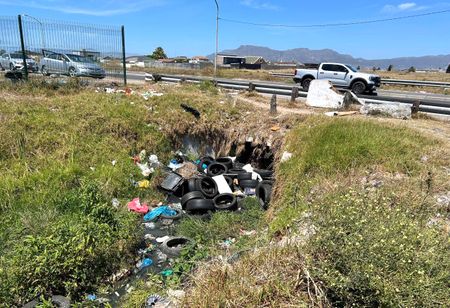
Day warned that the wetland was exhibiting classic early indicators of ecosystem collapse.
“The build-up of organic sediments in parts of the vlei has resulted in deep, anoxic sediments and shallow, low-oxygen waters above, that support limited life and thus have major impacts on the food chain (eg, birds) that would have used these areas. These sediments produce methane and hydrogen sulphide and are extremely poor habitats,” said Day.
According to Day, the blue-green algal blooms that have dominated the vlei since mid-December 2025 indicate a dangerous “system shift” where the vlei has transitioned from being periodically exposed to blooms to being permanently engulfed by them. The blooms are fuelled by a hypertrophic environment (an ecosystem excessively enriched with nutrients), driven by high orthophosphate nutrients and polluted inflows from the upper catchment, such as the Big Lotus River, where E. coli levels remain high.
“Ideally, addressing nutrient sources would help ‘starve’ the bloom, but in hypertrophic systems like Zeekoevlei (still affected by polluted inflows), this is challenging,” said Andrews.
The City has initiated dredging to remove nutrient-rich sediments, but Andrews noted that mitigating nutrient and pollutant inputs from the upper catchment was key to preventing future blooms.
“At present, E. coli readings within the inflowing Big Lotus remain above threshold,” said Andrews.
Day supports the dredging intervention, adding, “Dredging is essential. It buys time while upstream pollution sources are addressed.”
However, she cautioned that without urgent upstream interventions, the positive impacts of dredging would be short-lived. DM