




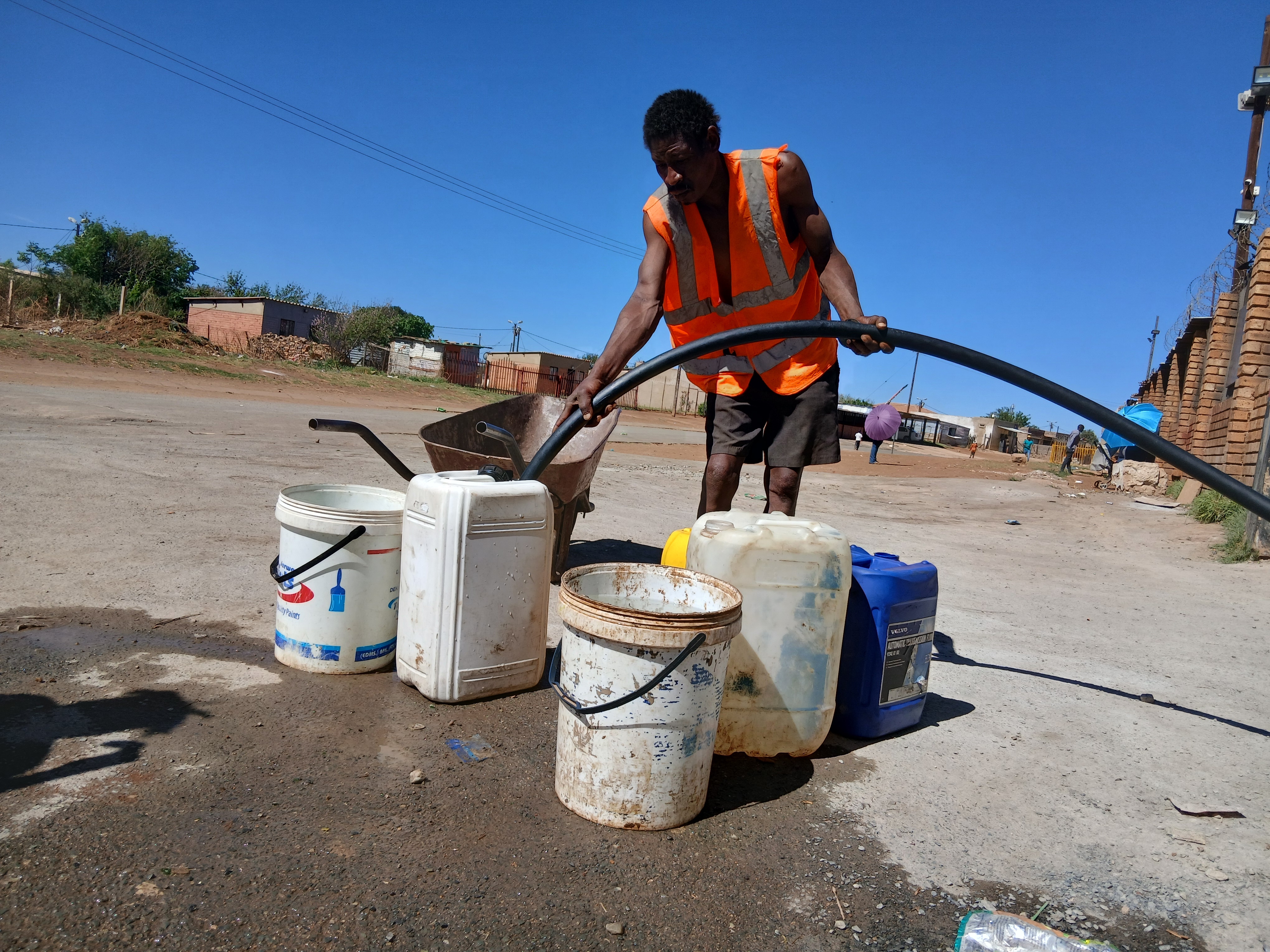
 Residents in Fochville near Carletonville collect water from a borehole installed by a local businessman last week. The community has been without running water for over a month since Rand Water implemented reduction measures against Merafong Municipality. (Photo: Silver Sibiya)
 /file/dailymaverick/wp-content/uploads/2025/10/label-Op-Ed.jpg)
African leaders recently adopted a visionary plan to transform water from a source of vulnerability into a foundation for prosperity. Part of the plan’s success depends on major regions and cities leading the way. But Johannesburg – Africa’s richest city in South Africa’s most populous province – is not coming to the party.
African Water Vision 2063 was adopted at the 39th African Union (AU) summit in February. It was produced by the African Ministers’ Council on Water and the AU Commission, and aligns with Africa’s Agenda 2063 goals.
Johannesburg is mired in water shortages and service delivery protests. These problems plagued former townships and historically black residential areas for decades, but the current creep into wealthier suburbs and commercial centres is unprecedented.
Local conflicts associated with a lack of water supply are imminent and could lead to violent protests and competition between sectors. Many households have no water for basic needs, and businesses often go waterless for days.
The health risks associated with low water supply, poor water quality and inadequate wastewater treatment are rising. The increasingly desperate situation, which also undermines the economy and social cohesion, was emphasised in President Cyril Ramaphosa’s 2026 State of the Nation Address.
Unravelling of Johannesburg’s water history
The crisis represents the unravelling of Johannesburg’s remarkable water history. As the largest city in the world without a major water source that services a mining enterprise dependent on water, it quickly shot to the forefront of global water development.
Joburg’s water security needs led to the development of Rand Water in 1903 – Africa’s largest water utility, ranked in 2024 among the world’s top four by the Global Water Intelligence organisation.
In 1923, the Vaal River Barrage was built as the first major dam in the Vaal region, south of Johannesburg. The dam would eventually become the centre of a multi-dam system to regulate water flows into the Vaal, and especially Johannesburg.
The system redefined inter-basin water transfers. First, by channeling and pumping water uphill from the Tugela River over the Drakensberg mountains and ending in the Vaal, in the direction of the money. Second, through the ambitious Lesotho Highlands Water Project – once one of the world’s largest combinations of dams and pipelines transferring water between countries.
With such infrastructure investment and globally celebrated innovation, why is the City in a water crisis? And how can economic collapse, social unrest and heightened security risks to Johannesburg, SA and beyond be averted?
There are at least four reasons for the city’s water challenges: inadequate technology and investment, poor sustainability planning, low political maturity and corruption.
First, if Johannesburg wants to maintain a reasonable level of water security, a continuous investment in infrastructure maintenance is paramount. A 2025 report to Parliament had non-revenue water pegged at 44.8%. That means the City bills and collects only 55.2% of water revenue – an annual deficit of almost R7-billion. This limits the funds available to repair a leaky water pipeline system while also trying to fix the billing and collections system.
Debt defaults to the bulk supplier have reached the point where Rand Water is now demanding a R2.4-billion deposit against Joburg’s bad debt.
Second, the City’s planning is a matter of serious concern – one that the national government should share. Gauteng province, where Johannesburg is located, has had a 70% population increase since 2002, and is now the most populous province, with 25.5 million people. It is the preferred destination for both international and internal migrants, with 50.2% of migrants choosing Gauteng.
The City’s high-value developments in Sandton, Waterfall and Midrand are all water-intensive. Water budgets associated with this expansion have not been prioritised. Doing so would have offered an ideal opportunity to introduce a suite of efficient water and wastewater technologies developed by the Water Research Commission and its global partners.
The third reason for the water crisis is the high cost of unstable City governance. Both Democratic Alliance- and African National Conference-led coalitions have had only short periods of stability. And the 2026 local government elections are unlikely to deliver an outright majority for any single party in Johannesburg.
Political maturity will be key to any reasonable water outcome. The Department of Cooperative Governance and Traditional Affairs has initiated the development of regulations to help mitigate this risk.
Fourth is corruption. Plans for large-scale infrastructure development, including the Lesotho Highlands project’s second phase, heighten the risk of omnipresent water-sector graft. In the 1999 Lesotho Highlands scandal, for example, the project head received bribes from 12 multinational companies and consortia. What has been called “organised corruption” at the municipal government level in SA is also rife.
‘Toxic triangle’
The Water Integrity Network further identifies the “toxic triangle” of climate, conflict and corruption as a global risk to water security. Johannesburg displays the full spectrum of diagnostics, in which hydrocide (a catastrophic decline of both water resources and water service provision) is a plausible scenario.
Climate change is the great risk multiplier. The University of the Witwatersrand’s Professor Francois Engelbrecht says one of SA’s tipping points is a near-term Day Zero for Gauteng. Not only would this collapse SA’s economic house of cards, it would be the epicentre of a continental downturn, the likes of which could mirror Covid-19 impacts.
Ramaphosa’s announcement in Parliament of a Water Crisis Committee is promising. The financial allocations to deal with SA’s water crisis were outlined in the government’s 2026 Budget speech. Decisive, immediate and innovative action could avert a crisis.
Restoring water security to Johannesburg and ensuring access for residents would boost the City’s socioeconomic fortunes and expand the frontiers of dignity for its citizens. It would also send positive signals across the continent on the achievability of the African Water Vision. DM
Dhesigen Naidoo is a Research Associate, Climate Risk and Human Security Project, at the Institute for Security Studies (ISS) Pretoria.
First published by ISS Today.