




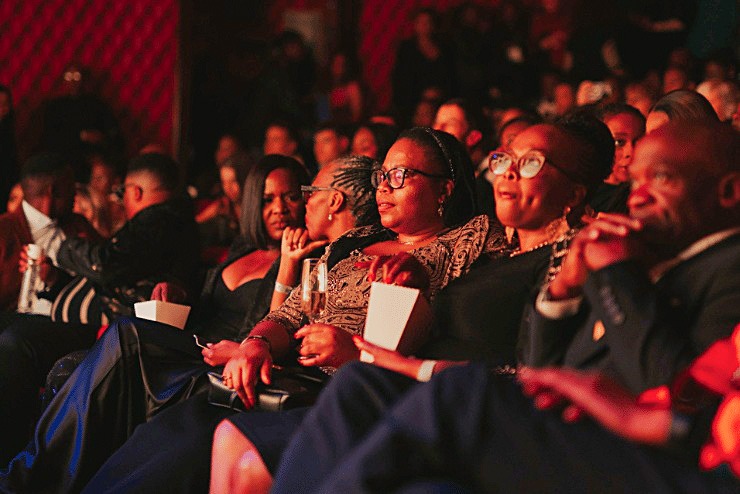
 Joburg Film Festival 2026 spotlights stories in local and international cinema through a diverse selection of films. Here, audience members prepare to watch a feature at last year’s edition. (Photo: Joburg Film Festival)
 There’s a whole world of filmmaking that exists beyond the big-budget features of Hollywood, but often they are stories that we don’t get to see through the usual commercial distribution channels.
It’s widely acknowledged that African filmmaking isn’t afforded the same distribution opportunities as the movies from major production companies that we’re likely to encounter at local cinemas or on global streaming services. In that respect, film festivals become crucial and valuable platforms to experience movies that would be difficult, if not impossible, to access otherwise.
Joburg Film Festival, now in its eighth year, is one such stage where local and international films that you wouldn’t typically find through mainstream platforms are showcased. Its curation brings together films from both near and far, sparking profound connection and conversations between the stories they share.
Local gems unearthing SA history
Joburg Film Festival’s programme includes local gems from South African filmmakers whose work has received critical acclaim from prestigious film festivals abroad.
Filmmaking duo Jason Jacobs and Devon Delmar, based between Namaqualand and Cape Town, were awarded the top honour at this year’s International Film Festival Rotterdam Tiger Competition for their work Variations on a Theme.
Following 79-year-old goatherd Ouma Hettie, Variations on a Theme is a lyrical, essayistic film based on true events of a community in the mountains of Namaqualand that is falsely led to believe they’ll be receiving reparations for their forefathers’ service in World War 2.
Rooted in contemplative solitude and told through static shots, Variations on a Theme captures ghostly, postcard-like vignettes haunted by colonial legacies. Each composition is a recurring visual stained by anticipation – awaiting a promise that is destined to remain unfulfilled.
Like Variations on a Theme, South African feature Laundry, directed by Zamo Mkhwanazi, has seen overseas success after premiering at Toronto International Film Festival 2025.
Set in Johannesburg in 1968, Laundry tells the story of a teenager who’s torn between pursuing his dreams of becoming a musician and fighting against the injustice that threatens his family’s business.
Although there are occasional glaring flaws in the synchronisation of the film’s sound and visuals, Laundry is an aesthetically rich period drama driven by fleshed-out characters and moving performances set against an aural backdrop of vibrant jazz.
International explorations of land and ownership
A unique aspect of watching curated selections of films at events like festivals is seeing how they speak to one another, whether through style, narrative or theme. In the context of SA, stories concerned with land and ownership are particularly inclined to resonate deeply.
In a co-production from the Dominican Republic and Spain called Under the Same Sun, the intersection of colonialism and the silk textile industry is explored through the intertwining lives of a young Spanish heir, a Chinese weaver and a Haitian on the island of Hispaniola in 1819.
Rather than demanding attention through plot, Under the Same Sun is refreshingly patient in its unfolding character dynamics. The ethereal colour grading of the Caribbean landscapes is as delicate and luscious as silk itself, while the foreboding tension writhing in the film’s underbelly is threaded into the film through earthy percussive compositions and sound design.
In contrast to the historical lens of these films, The Voice of Hind Rajab directed by Kaouther Ben Hania, propels us back into the present day. Based on true events and real recordings of emergency calls received by the Palestine Red Crescent Society, The Voice of Hind Rajab documents an emergency call from a six-year-old girl who is trapped in a car that’s under fire in Gaza.
By seamlessly blending dramatisation with real audio, this is a film whose existence speaks for itself as a crucial call to bear witness to events that cannot be held at the comfortable distance of being in the past.
African storytelling brings sense of humour
Joburg Film Festival’s programme isn’t only about narratives stemming from the heavier side of humanity’s experiences.
In The Fisherman, a Ghanaian comedy drama from writer-director Zoey Martinson, a traditional fisherman, after being forced into retirement, heads off on a journey into Accra in an attempt to fulfil his dream of owning a boat.
Alongside him on this adventure from Ghana’s vivid coastal setting to its bustling capital city is not only an unlikely trio of outsiders, but also a sassy talking fish with a penchant for the high life.
Despite drawing on expected tropes, like the interplay between tradition and modernity, gender expectations and the impact of commercialism on small communities, The Fisherman is delightfully light-hearted, balancing laugh-out-loud writing and performances with sentimental resolutions.
Through the theme of “Feel the Frame”, this year’s curation is a testament to film as more than simply a visual storytelling tool, but also as a tangible medium of sensory expression – an invitation to not only watch, but also to feel, in a palpable sense, the textures, soundscapes and emotions brought into being in the cinema. DM
Joburg Film Festival takes place from 3 to 8 March 2026.