



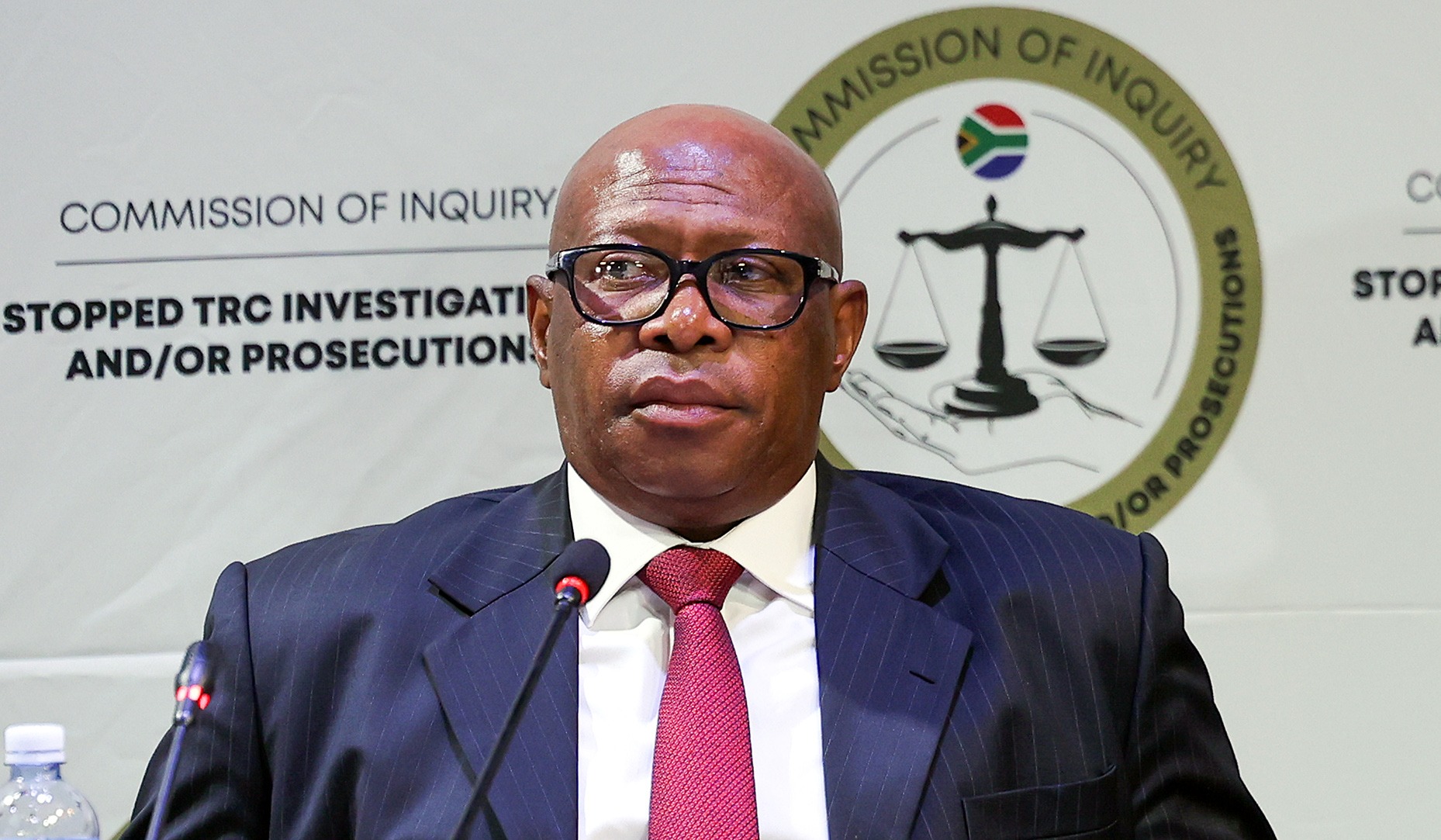
 Former National Director of Public Prosecutions Bulelani Ngcuka testifies at the Truth and Reconciliation Commission Inquiry in Johannesburg on 2 March 2026. (Photo: Gallo Images / Luba Lesolle)
 On Monday, advocate Bulelani Ngcuka, the first National Director of Public Prosecutions (NDPP) in post-apartheid South Africa, appeared before the inquiry into political interference in Truth and Reconciliation Commission (TRC) cases and set out the fate of prosecution dockets under his tenure between 1998 and his resignation in 2004.
An early application on Monday by Ngucka’s legal representative, advocate Rafik Bhana, for his witness not to be cross-examined by representatives of the Calata family was denied by the chair, retired judge Sisi Khampepe.
Executive concurrence
Ngcuka agreed with advocate Kgomotso Moroka, representing the Department of Justice and Social Development, that under Section 179 (5) of the Constitution, the NDPP “must determine prosecution policy in concurrence with the Cabinet minister responsible for the administration of justice”.
This meant that the authority had to “work closely” with the department, Ngcuka told the inquiry and that requests by Mabandla to discuss policy matters did not constitute political interference, but were rather “a necessary part” of the legal relationship.
“It never happened during my time,” Ngcuka categorically told the panel, adding, “You know this thing about political influence, if you allow it as a national director, of course there will be. The decision is yours and yours alone. And you tell people this is how it is going to work.”
Testifying earlier at the inquiry, Dr Silas Ramaite, former special director of prosecutions, said that Mabandla had informed him in 2004 that an “outside mechanism”, the “Amnesty Task Team”, had been established “to investigate TRC prosecutions” and that all cases should be placed on hold.
/file/attachments/orphans/ED_0143240_487320.jpg "Advocate Silas Ramaite, former special director of prosecutions. (Photo: Gallo Images / Phill Magakoe)<br>")
Central figure
Ngcuka was a central figure in the state’s handling of thousands of TRC cases after the commission’s final 2003 report.
Concerning the cases which were never pursued after his exit from the position, Ngcuka said on Monday, “I was very sore about those cases, the TRC cases. Given my relationship with the victims.
“Mrs [Victoria] Mxenge was killed on 1 August [1985], a week before she was the main speaker at the [Mathew] Goniwe and [Fort] Calata funerals in Cradock. And she was killed.”
/file/dailymaverick/wp-content/uploads/2022/03/MC-Tues-15March_7.jpg "The last photo taken of Griffiths and Victoria Mxenge, in February 1981. (Photo: Gallo Images / Sunday Times Archive)")
Mxenge was assassinated in her driveway in front of her three children by four men after returning from a political meeting. Marvin Sefako confessed to her murder. The other suspects have never been found.
Intimate knowledge
Ngcuka completed his articles with the Durban law firm of Griffiths Mxenge after obtaining his B.Proc at the University of Fort Hare in 1977. He completed his articles in 1981, the year Mxenge was brutally assassinated.
The details of the atrocity that was the extra-judicial killing of Griffiths Mxenge are important to recount, to once again place on record the depravity of his state-sponsored murderers.
Mxenge was abducted in Umlazi by a Vlakplaas apartheid death squad led by Dirk Coetzee that included askaris (turned liberation movement operatives) Almond Nofomela, Joe Mamasela, Brian Ngqulungu and David Tshikalanga. Mxenge was stabbed more than 40 times, his throat was slit, his body mutilated, his ears cut off and his stomach ripped open.
Solving these killings, said Ngcuka, “were the things I wanted to do”. He said the building that housed the NDPP at the time had been named the “Victoria and Professor Mxenge Building” in honour of the murdered activists.
Insufficient evidence
Nguka cited the challenges and difficulties of prosecuting cases where there was insufficient evidence. He referred particularly to the haunting September 1977 murder by security police of Black Consciousness leader Steve Biko.
While it was common knowledge that the police had murdered Biko, Ngcuka and his team realised they lacked the “evidential sufficiency” to guarantee a conviction in a court of law.
He said he made the “difficult decision” not to proceed, fearing that failed prosecutions would leave the NPA with “egg on our face” and constitute a further injustice to the victims.
He maintained that prosecutions should have proceeded only where there was a reasonable prospect of success, a policy rooted in constitutional mandates rather than political preference.
Pioneering office
On 1 August 1998, Ngcuka walked into a reality that stood in stark contrast to the weight of his new title: the first National Director of Public Prosecutions (NDPP) of South Africa.
The expectations from the government and the public were monumental; his office was expected to solve the prevailing problems of a country in transition and restore faith in the rule of law in a country that Ngcuka described as essentially “bankrupt” in 1994.
It was advocate Vusi Pikoli, then Director-General of the Department of Justice and Constitutional Development and who was later to replace Ngcuka as NDPP, who had informed him that the budget for his office was a “mere R6-million – just enough for my salary and a handful of staff”. It was predicted that it would take six months just to set up.
No infrastructure or staff
The advocate began his tenure with nothing. There were no offices, no furniture and no infrastructure. He was forced to rely on the generosity of other government agencies, such as the police and intelligence services, to find a room to establish an office.
Even furniture was inherited, said Ngcuka, as he had commandeered desks from his brother-in-law at the Reserve Bank when he learnt that they were being replaced.
The environment outside his fledgling office was one of high-level criminality and social upheaval.
He inherited a landscape of pipe bombs, car hijackings and localised wars in KwaZulu-Natal and Gauteng. In the Western Cape, gangsterism was rampant, and Pagad (People Against Gangsterism and Drugs), which had begun as a community response to crime, had transformed into a perpetrator of violence.
Ngcuka told the commission that he had to “act decisively to restore public confidence” and moved to consolidate power and expertise, creating the Investigative Directorate on Organised Crime and Corruption and bringing in intelligence, analysts and prosecutors under one roof to ensure prosecution-led investigations.
This was a departure from the past, where investigators worked in isolation, causing lengthy delays. These reforms eventually bore fruit, he said, leading to more than 100 arrests and life sentences for those involved in the Western Cape violence.
In KZN, the authority deployed units that successfully prosecuted the “kingpins” behind the Richmond massacres.
However, the most sensitive task remained: the TRC matters.
Profound dilemma
Ngcuka said he faced “a profound dilemma” as the NPA he led was staffed by people he had inherited from the old regime – the very ones who had prosecuted activists such as himself during the struggle against apartheid.
He was “deeply concerned” about having those same people handle TRC cases.
To navigate this, he said, he sought out people he trusted, like Vincent Saldanha [today a judge] and advocate Anton Ackermann, to assess which cases were ready for court and which required further investigation.
To centralise this effort, he established the Priority Crimes Litigation Unit (PCLU) and issued a directive that all TRC-related dockets — many of which were collecting dust in forgotten offices — be brought to his headquarters.
Many cases were decades old, evidence had been destroyed, and witnesses’ memories had faded.
Despite his personal drive, Ngcuka frequently clashed with other state organs. There was palpable tension between his elite “Scorpions” (the Directorate of Special Operations) and the South African Police Service (SAPS), he told the inquiry.
The police felt the Scorpions received better resources and more media attention. At one point, SAPS leadership even refused to provide investigators to Ackermann, suggesting instead that Ngcuka approach President Thabo Mbeki to resolve the matter—a suggestion Ngcuka dismissed as “nonsensical”.
Throughout his tenure, the spectre of political interference loomed large in public discourse, but Ngcuka was adamant that he never tolerated it.
Meeting the ‘outside mechanism’
Ngucka said he had not personally attended a meeting in 2003 convened by the Department of Justice to discuss amending prosecutorial policy for TRC matters.
Two colleagues who did, reported back that there was “no need for the NPA to participate or change its guidelines”. The matter, according to Ngcuka, ended there.
By the time he left office, the NPA had undergone a “significant institutional reform”, said Ngcuka.
While only six of the 21 priority TRC cases had reached court during his tenure, Ngcuka defended the track record as “good work”, given the limited resources and the “complex and constantly evolving” terrain they navigated.
In the end, Ngcuka’s testimony was a defence of his integrity and the independence of the office he helped build. He had arrived voluntarily to account to the commission for his actions, he said, driven by a sense of responsibility to the victims of the past and a commitment to the constitutional mandate of the present.
His story was not just about the law, but about the gruelling, often invisible work of building a foundation for justice in a new democracy, he said. Ngcuka will be cross-examined on Tuesday. DM