




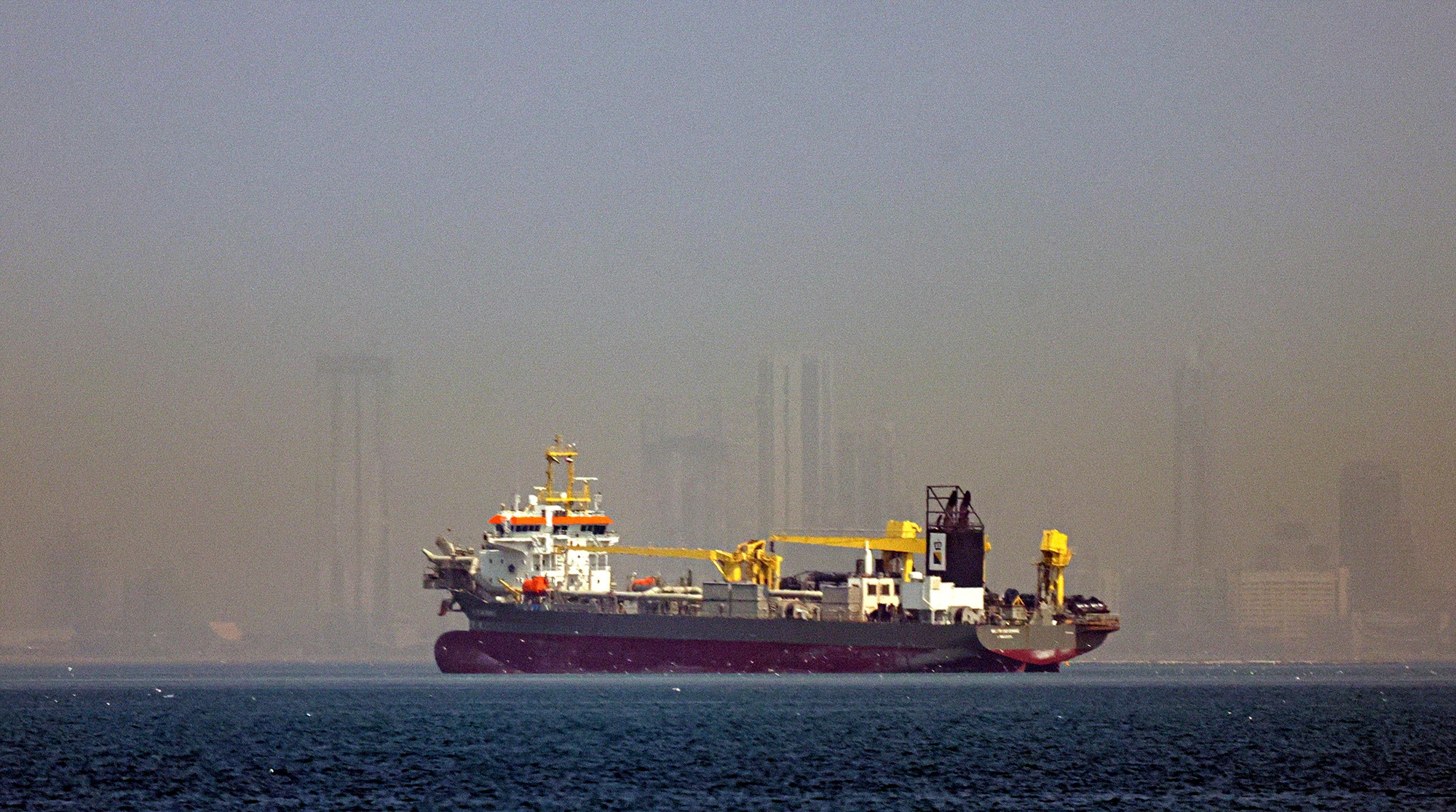
 A vessel is seen anchoring off the coast of Dubai, United Arab Emirates, 01 March 2026. Following a joint Israel-US military operation targeting multiple locations across Iran in the early hours of 28 February 2026 and Iran's retaliatory attacks across the region, many ships are anchored as Iran threatened to close the Strait of Hormuz, where hundreds of ships carrying oil pass daily, potentially affecting worldwide trade. (Photo: EPA / STRINGER)
 The dramatic escalation in Middle East tensions with the US and Israeli offensive against Iran that has killed the Islamic republic’s supreme leader Ali Khamenei is roiling global markets and South Africa’s economy is going to feel the pain while the gold sector and companies such as Sasol stand to gain.
The fallout from the unfolding drama has lit a fuse under the price of oil and gold – “conflict commodities” which, for different reasons, often reflect geopolitical tensions – and this combination is a double-edged sword for South Africa’s economy.
Let’s start with oil. The closure of the Strait of Hormuz, a key artery in the global oil supply chain, triggered a 10% spike in oil prices when markets opened in Asia after the weekend before settling down. The benchmark Brent crude was 4% higher in early Monday trade at $76.16 a barrel but is seen potentially soaring much higher.
“Higher oil and gas prices are certain as the closure of the Strait of Hormuz threatens to disrupt 15% of global oil supply and 20% of global LNG supply, with oil prices potentially exceeding $100 a barrel if tanker flows are not quickly restored,” Houston-based energy consultancy Wood Mackenzie said in a note on Sunday night.
/file/attachments/2989/Oilpricerisetrendsinbarrels_865119.png)
Traffic through the strait has effectively halted as Iran has warned vessels not to pass through and at least three ships have been attacked in the vicinity.
Wood Mackenzie said insurers have withdrawn coverage, sealing the strait’s status as a “no-go zone”.
Interest rate cuts could be under threat
The spectre of oil at $100 a barrel will haunt the South African Reserve Bank’s (Sarb) efforts to contain inflation. At the start of this year, there were high hopes that the Sarb would deliver at least two more 25-basis-point rate cuts this year.
A triple-digit oil price will sink those prospects and – depending on where the oil price and the rand exchange rate go – could even see the Sarb start hiking again as it is steadfast in its determination to anchor inflation around 3%, the midpoint of its effective new target range.
A key reason behind moderating inflation in South Africa has been depressed oil prices, which last year posted their lowest monthly average since 2021.
The inflationary impact
The monthly annual average for South African consumer inflation was 6.9% in 2022 and that cooled to a monthly average of 3.2% in 2025.
Worryingly, the rand has lost ground as the missiles fly, falling to 16.17/dlr in early Monday trade from 15.94/dlr when markets closed on Friday as the turmoil has boosted the “safe haven” status of the US dollar.
It’s too early at this stage to see if this trend will become entrenched, and the rand is famed for its volatility. But so far the omens are not good: a weakening rand and surging oil will fan retail prices at the pump, with inflationary consequences throughout the economic pipeline.
/file/attachments/orphans/13796383_413733.jpg "A stock market indicator board in Tokyo on 2 March 2026. The Nikkei Stock Average plunged 899.51 points, or 1.53%, at the end of the morning trading session. (Photo: EPA / Soichiro Koriyama)")
“If the USD/ZAR stays around current rates, and the oil price near $80 per barrel over March, then about a 9% month-on-month increase occurs in the fuel price,” Investec chief economist Annabel Bishop said.
“Such a rand fuel price elevation over March – 9% higher than in February – could contribute around 0.4% month-on-month to CPI inflation, which would lift CPI inflation to 3.3% year-on-year from the current 2.9% year-on-year forecast for April.”
And that is a material impact on domestic inflation.
This also has implications for inflation worldwide, including food prices, and could curb global economic growth, which in turn will have a negative impact on South African growth – which is not shooting the lights out in the first place.
And if domestic economic growth in 2026 falls short of the modest 1.6% forecast in last week’s Budget, then the projected debt-GDP ratios are likely to exceed the targeted peak of 78.9%, eroding South Africa’s credibility with lenders and ratings agencies.
What this means for SA
The bottom line is that higher oil prices are bad for South Africa, especially if they soar to $100 a barrel, while higher gold prices are good. This is not rocket science: South Africa is a gold producer that imports most of its oil. But escalating uncertainty and risk overall is bad for the global economy and investment, and South Africa cannot dodge this shrapnel. Last week’s Budget may be among the many casualties of the weekend’s events in the Middle East and the drama that is sure to follow.
Silver lining
It’s not all doom and gloom. Sasol’s share price – which often dances to the tune of oil prices – soared as much as 10% in early trade on Monday.
/file/attachments/orphans/13794128_219404.jpg "A goldsmith displays gold ornaments at the Hua Seng Heng gold shop in Bangkok, Thailand, 01 March 2026. Thailand's gold shop announced a temporary suspension of gold bar sales and online trading systems due to the escalating conflict and reported attacks between Israel and Iran. The situation has caused extreme gold price volatility, and with international gold markets closed over the weekend, there is no clear global reference price. (Photo: EPA / NARONG SANGNAK)")
The share prices of gold producers were also red-hot on Monday: Gold Fields advanced over 4%, Harmony Gold over 5%, Sibanye-Stillwater added more than 3% and DRDGold shot up close to 8%.
The weekend strikes by the US and Israel on Iran and its retaliation across the region have sparked a renewed stampede by investors seeking safe havens into the precious metal.
Gold’s price was more than 2.0% higher at more than $5,400 an ounce in Monday morning trade, within easy striking distance of its all-time high of $5,589.38 per ounce reached in January.
Given the thickening layers of uncertainty from the smoke clouds rising above the rubble across the Middle East and the mounting prospects for the conflict to explode into a regional war, gold could be propelled into record territory above $6,000 an ounce.
And the sky is the limit for a commodity that thrives on chaos and has been on a breathtaking run the past couple of years.
For the South African economy, that provides a measure of support for the rand and a boost to Treasury from the higher taxes and royalties that the gold producers will pay.
South Africa, long by far the world’s top gold producer, is no longer even in the top 10 on this front. But the precious metal remains a key export earner and employer and such prices are leading to renewed projects and investment. DM
MORE THAN THE NEWS
If you want breaking news on the war in the Middle East, you can get your headlines anywhere.
But when empires posture and presidents gamble, who carries the cost? Who gets to write the story? And what does that mean for South Africa: your economy, your politics, your fuel price?
That takes insight.
Real journalism. Real context.
Fund the newsroom that unpacks the global power games through a South African lens.
From as little as R75 per day you can help write our history. Cancel anytime — but please, join us today.