
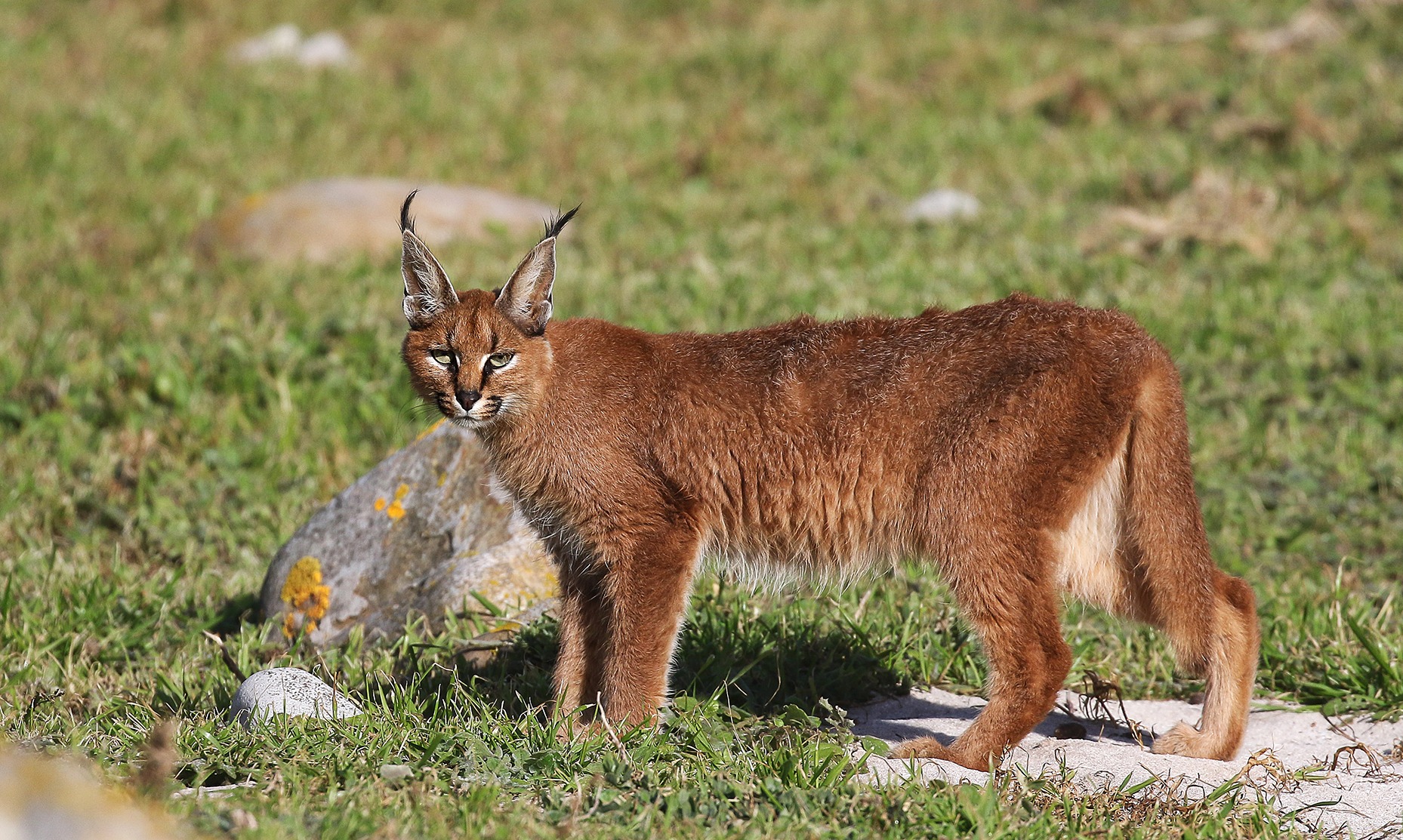
 Elusive caracals patrol the slopes of Table Mountain. (Photo: Table Mountain National Park)
 /file/attachments/orphans/storiedmountain_745794.jpg)
From a distance, Table Mountain plays the part of something permanent. It stands there, impassive, as if it has signed a long-term lease with geology itself. It appears in logos, postcards, tourism videos and weather forecasts. It looks like the sort of thing that does not require management.
Up close, however – especially if you’re the person tasked with keeping its ecosystems functioning – the Table Mountain chain is less a monument than a beautiful, high-profile, constantly interrupted balancing act.
“It’s the last bit of wildlife at the end of the continent,” says ecologist Marna Herbst. “They can’t go anywhere else.”
/file/attachments/orphans/Dassies_SANParks_956019.jpeg "Dassies in a cosy huddle. (Photo: Table Mountain National Park)")
Herbst has been working for South African National Parks (SANParks) for nearly 18 years, which is long enough to know how things should work, how they actually work, and how – just when you think you’ve figured it out – everything comes back around slightly rearranged.
Before Table Mountain, she did her PhD on African wildcats in the Kalahari, a landscape that could not be more different: open, vast, quiet, indifferent to foot traffic. “The best time ever,” she says. “Little cats. Big space. Few people.”
Then she moved closer to cities, and things got complicated.
Table Mountain National Park is small. Shockingly small, given how famous it is. Ecologically speaking, it functions like an island: no corridors, no escape routes, no gentle migration pathways in response to climate change. Surrounding it is an uncrossable barrier made of roads, houses, floodlights, dogs, drones, mountain bikes and brunch plans. This is not wilderness conservation, it’s conservation with spectators. Us.
/file/attachments/orphans/WaterMongoose_DORSE7_315364.jpg "Water Mongoose. (Photo: Table Mountain National Park)")
“We can’t keep it as it is forever,” Herbst says. “Everything is changing. The environment is changing. The vegetation is changing.”
Which raises the uncomfortable questions that modern ecologists now have to ask out loud. Fifty years from now, what will still be here? Penguins, for example, are already starving. Biodiversity is thinning. Climate change is not a future problem – it’s a current certainty.
Should conservation focus on species that are more likely to survive future conditions? Or do you fight to hold the line, even as the line itself begins dissolving?
There are no clean answers, but scientists are expected to supply them anyway. “As a scientist, it’s a huge responsibility,” Herbst says. “You’re the person they turn to and say: what should we do?”
Fortunately, no one carries this burden alone. SANParks operates through networks – small teams, international collaborations and a culture of shared decision-making. There are workshops. There are disagreements. There are retreats where scientists deliberately disconnect from reception and spend days reading, writing and thinking. “That’s part of your job,” Herbst says. “Thinking.”
Thinking, however, does not stop people from wandering off-trail.
From the air, the Table Mountain system still contains pockets of genuine wildness. Herbst remembers her first aerial survey, surprised by how inaccessible some areas remain. From that height, the city feels briefly held at bay.
But on the ground in seemingly inaccessible places, camera traps tell a different story. They capture more people than animals – people where they shouldn’t be, creating paths where none existed, slowly widening trails through repetition.
In a hypothetical time-lapse of the past few decades, the most dramatic visual change wouldn’t be disappearing animals. It would be the sudden multiplication of trails. In wet seasons, paths become muddy, so people walk to the side. Then the side becomes the muddy path, and it widens again.
This is a problem, because species like the ghost frog – tiny, camouflaged, dependent on clean, fast-flowing streams – cannot cope with sediment stirred up by constant foot traffic. You might never see one. You might step on one. Habitat turns muddy. Populations decline quietly.
The proposed solution is modest: a small wooden bridge, clear signage, gentle redirection. Conservation, at this scale, often looks like carpentry.
Despite the pressure, there is still remarkable wildlife on the mountain. Caracals patrol its slopes. Genets and mongooses slip between shadows. Dassies flourish to the point of becoming social-media darlings – round, unbothered, strangely photogenic.
Porcupines use stormwater drains as underground highways. Raptors circle overhead: fish eagles in Tokai, jackal buzzards, gymnogenes and black eagles riding thermals – sometimes right above the central city.
/file/attachments/orphans/JackalbuzzardWikipediaCommons_371236.jpg "Jackal buzzard. (Photo: Wikipedia Commons)")
/file/attachments/orphans/Verreaux_EagleWikipediaCommons_417969.jpg "Verreaux eagle, also known as a black eagle. (Photo: Wikipedia Commons)")
There are also ghosts. Cape foxes leave tracks but are rarely seen. A honey badger appears once and then becomes a rumour. These are ancient populations, isolated and poorly understood. “We don’t know enough about them,” Herbst says simply.
Some animals, however, were never meant to be here. Himalayan tahrs and sambar deer arrived long ago, former citizens of the disbanded zoo. Attempts to remove them failed. They are now beautiful, problematic residents – ecologically disorderly but publicly adored. Management becomes a matter of counting, monitoring and sighing deeply. They’re not leaving anytime soon.
Predators introduce harder dilemmas. Caracals sometimes raid penguin colonies. Penguins are critically endangered. Caracals are native. Both are protected. Which do you save? Herbst describes these moments as bruising. “You get hammered from both sides.”
Genetics complicates things further. On an island – and to all but birds, the mountain is an island in a sea of people – populations become isolated. Inbreeding creeps in. Nutritional limits appear.
/file/attachments/orphans/eugenevs_540020.jpeg "Eland. (Photo: Table Mountain National Park)")
/file/dailymaverick/wp-content/uploads/2023/10/don-wildlifeprotections-5.jpg "A blesbok in the veld. (Photo: Jean Michel / Flickr)")
Some species – especially antelope – were never meant to be permanent residents. Historically, they would have moved in and out. Now they can’t. Humans have to intervene: move animals, supplement genes, manage numbers. “It’s up to people to solve all of those genetic issues,” Herbst says.
If the animals could file a formal complaint against humans, she suspects it would mention urban sprawl, noise, light and pollution.
Massive floodlights blaze across the mountain face every night. Great for tourism, but what do they do to insects? To bats? To nocturnal rhythms? Scientists raise these questions and are often cast as obstructionists. “Every time you compromise,” Herbst says, “you go a little bit backwards.”
/file/attachments/orphans/Baboons_SANParks_209639.jpg "The Peninsula’s much contested baboons.
<br>(Photo: Table Mountain National Park)")
(Photo: Table Mountain National Park)
Some species adapt well – perhaps too well. Baboons have mastered urban opportunism, though at great risk to themselves and to people. Birds exploit edges. Rodents thrive. But adaptation is not necessarily success; it’s often survival under pressure.
/file/attachments/orphans/StripedmouseduringasurveyinTokai_TonyRebelo_379663.jpg "Striped mouse. (Photo: Tony Rebelo)")
Herbst has a soft spot for the overlooked. Rodents, she notes, are ecosystem workhorses – seed dispersers, pollinators, prey. They don’t need more pressure, but people regularly release city rats and house mice on to the mountain, thinking they are being kind. These invasive species do real harm. “Don’t do it,” she says, flatly.
What would happen if fences disappeared and the park was left unmanaged? Animals wouldn’t flood into suburbs. People would move into the park. Garden extensions, informal paths land invasions. The real work of conservation, it turns out, is defending wildlife boundaries from us.
Herbst’s view of animals is grounded, not sentimental. Her wildcat research convinced her that animals have personalities – preferences, habits, quirks. She hesitates around the word sentient, but recalls mothers calling for lost kittens, unwilling to dismiss emotion simply because it lacks language.
Her best time on the mountain is early morning, when things are waking up and the city hasn’t yet leaned in.
If there is one behaviour she would stop immediately, it’s simple: stay on the path. Let some places remain untrampled. Let wildness exist without witnesses.
Table Mountain will change. Species will vanish. Others will arrive. The future will not resemble the past, and nostalgia will not save it.
What will matter is attentiveness, restraint and a willingness to accept that caring for nature – especially when it sits inside a city – is not about freezing time, but about making careful, sometimes imperfect decisions, again and again, on an ancient island that refuses to float away.
The park is home to about 22 mammal species, 22 amphibian and 250 bird species.
Read the full Table Mountain series:
• The flat mountain that wouldn’t behave
• What is Table Mountain? A story of Deep Time
• Hotter, drier, wilder: reinventing conservation for a changing climate
• Table Mountain’s green cloak that took 60 million years to weave
• The fluid intelligence of Table Mountain’s rivers
• What it takes to keep Table Mountain wild
• Rough sleepers: The mountain keeps us
• Cormac Cullinan: thinking like a mountain, listening like a river