




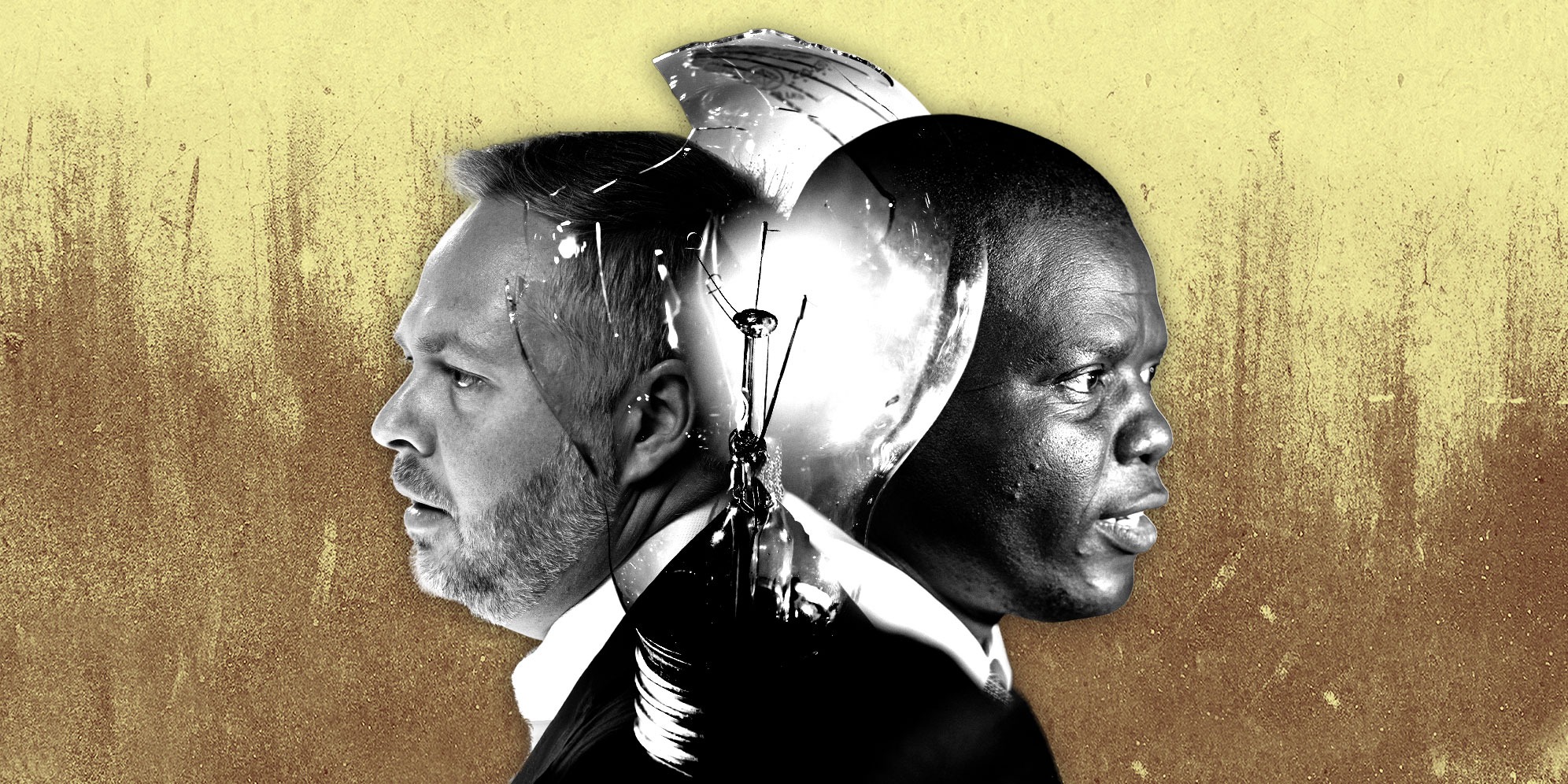
 Illutrative Image: Dr Leon Schreiber (left). (Photo: Jaco Marais / Gallo Images) | Ronald Lamola (right). (Photo: Per-Anders Pettersson / Getty Images) | Broken lightbulb (Photo: Istock) | (By Daniella Lee Ming Yesca)
 With so many arguments and dynamics swirling through our politics it can sometimes feel depressing to see there are so few new ideas. Instead, our politics still seems to be in the grip of past events, which still exert huge influence over the conversations that we really have.
Last week Daily Maverick profiled a group of young political leaders, people who appear to be breathing some new life into our politics.
In a society where many of our political leaders tend to be of fairly mature years, it is exciting to see younger people coming through. It suggests that there is real change and that perhaps, there may well be a new way of doing things.
Unfortunately, these new, young leaders do not appear to be accompanied by fresh, new ideas. To be fair, it is true that some, such as the Minister of Home Affairs, Leon Schreiber, have brought new governance techniques to important offices. And others, such as Minister of International Relations and Cooperation Ronald Lamola, bring a fresh view to some issues.
But generally, all of the younger leaders belong to parties that do not bring anything fresh to the party.
Even the Patriotic Alliance’s (PA) Ashley Sauls, as young and energetic as he may be, espouses the views of a party claiming to be founded on religion, including support for Israel.
/file/attachments/2988/ED_582650_784915.jpg "PA member Ashley Sauls at the parliamentary ad hoc committee inquiry into alleged corruption and political interference in the criminal justice system in 2025. (Photo: Brenton Geach/ Gallo Images)<br>")
The uMkhonto Wesizwe (MK) party’s Sibonelo Nomvalo may be a tough interrogator, but he also represents a party that is a political death cult founded on ethnicity and the personality of one “supreme ruler”.
There are important reasons why our politics is so bereft of new ideas.
‘There are no new ideas’
The first is that indeed, “there are no new ideas”. Just as “there is nothing new under the sun”.
While this is not true in reality (if it were, there would be no point to universities, science or even political journalism…), it does show how difficult it is to have a fresh insight.
There is a reason that so many scientific breakthroughs are remembered. It is because they represent a genuine change and they happen relatively seldom.
In politics, the practice of gathering power and managing society, there can be breakthroughs. But one should not expect them to happen every day. Or even every decade.
The second reason, and this might be more important, is that there is a very long road from the first idea or insight, and then that being in a position for it to be implemented. Or even publicised as part of a political party campaign.
Consider two situations which have seen genuinely new ideas.
In the 1990s, before the 1994 election, there was a period in which new ideas seemed to emerge every day. Parties could campaign simply on a promise to “Keep It Straight and Simple” or simply to legalise dagga and support football (the famous Soccer Party).
But that was because the moment helped to create such an environment. One group of people and all of their ideas were leaving power.
A new group of people and their ideas were coming in, but they had not taken over yet.
Over time, as that once-new party has come into power and then consolidated its hold, so the space for new ideas has ebbed away.
More recently, in the City of New York a young leader formed in Cape Town with genuinely fresh ideas has emerged as the new mayor.
Zohran Mamdani is implementing an entirely new way of governance as well as programmes that have not been seen before.
/file/dailymaverick/wp-content/uploads/2025/11/GettyImages-2221276467.jpg "Zohran Mamdani during an election event in New York in June 2025. (Photo: Christian Monterrosa / Bloomberg via Getty Images)")
However, consider the events that created the space for him to do it.
First, Donald Trump had to be the president. New York voters, being heavily Democratic, were always going to turn out in high numbers for someone who could take the fight to Trump. And two other politicians had to disgrace themselves.
Eric Adams, the previous mayor, was at the centre of corruption investigations. He then struck a deal with Trump’s justice department, which dropped the charges. In return he had to help Trump.
And another big political contender, the former governor of the state of New York, Andrew Cuomo, was also in the running for the position of mayor.
Had he not previously sexually harassed women in his office, it is likely he would have beaten Mamdani.
Even political moments that appear to be genuine breakthroughs can end up being overridden.
The 2008 election, in which Barack Obama showed that “Yes we can” overcome racial divisions, ultimately led to Trump being elected twice.
History’s long hand stifles new ideas
For the moment, it seems that while our politics is clearly in a process of change, it does not yet enable new ideas. And in fact, it may well strangle any new ideas long before they can see the light of day.
There are several important reasons for this. The first is the long hand of history. Our racialised inequality still dominates our politics.
Two weeks ago, the MK party’s Des van Rooyen (previously a brief Zuma-era finance minister) used his time in Parliament to attack President Cyril Ramaphosa for appointing a white person to lead Eskom.
Why he would feel the need to bring this up when André de Ruyter left Eskom three years ago is not clear. But it does reveal how he understands our politics.
Parties are also, in many ways, focusing on apartheid-era identities. They are doing this for a reason.
Because, in an era in which fewer people vote, those who are able to use identity along these lines are able to get a higher turnout for them. This dynamic is unlikely to go away soon.
Then there is the fact that the national government, several provinces and more and more councils are being run by coalitions.
Normally, a fresh new idea becomes policy first by becoming popular within a party. This is usually driven by a band of activists or leaders.
Then, when that party wins power, the policy can be implemented.
In coalition politics this is much harder, because the leadership of more than one party has to, at least, accept the fresh new idea. This simply makes it less likely to ever be adopted.
A final reason might be that in uncertain times, leaders, parties and voters, cling to what they know. An inherent conservatism can almost take over, making it harder still for a fresh new idea to see the light of day.
We should celebrate younger leaders, welcome them and give them space to grow and bring something new to our politics. But we should be even more nurturing and supportive of new ideas, and the space in which to create them. DM