




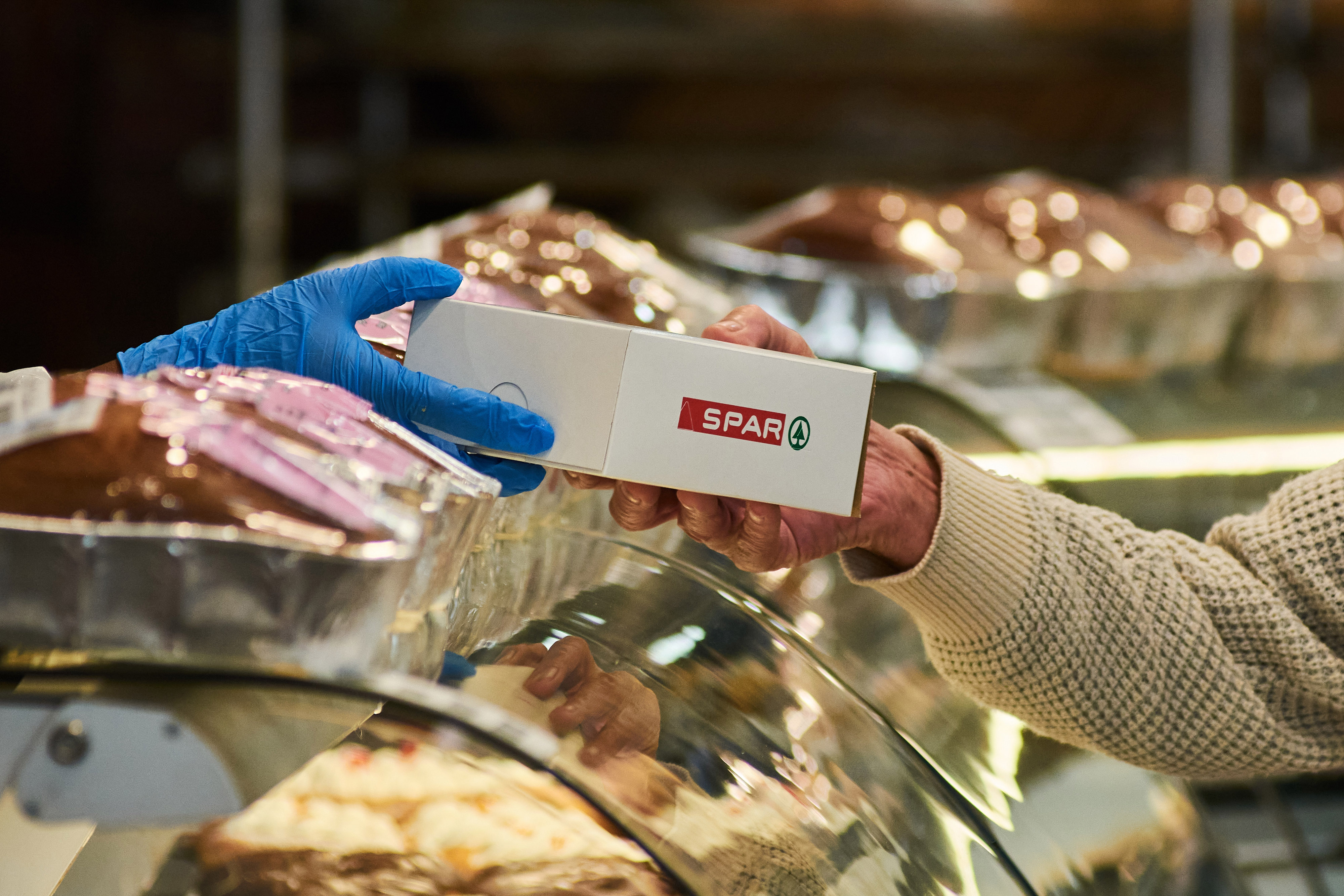
 A worker hands a branded bakery item box to a customer inside a Spar Group supermarket in the Die Wilgers suburb of Pretoria, South Africa, July 14, 2022. (Photo: Waldo Swiegers / Bloomberg via Getty Images)
 If you have friends who have built B2C (consumer-focused) businesses, then ask them about just how hard it is to achieve meaningful scale.
B2B (business-focused) operations tend to have a longer sales cycle (making the early-stage traction more difficult), but they usually enjoy stickier clients and better pricing power. In B2C, every repeat sale is a battle – and the pricing environment is a competitive bloodbath.
In other words, it’s typically harder to build a B2B operation in the initial phase, but it can often be a better long-term business that is more difficult to disrupt than a B2C play. Then again, the AI phenomenon is calling that into question, with global technology giants suffering nasty share price drops as the market considers whether Salesforce, Adobe and similar products have a place in our future.
In consumer-focused business land, big share-price moves are nothing new. Corporate failures are common. There are many examples of retailers that have landed up in business rescue or shrunk into obscurity. There are also examples of retailers that have thrived, winning market share from the weaker players and cementing a leading position.
And as tempting as it might be to assume that food retailers are immune from this pain because they sell a basic human need, I’m afraid that this just isn’t the case.
In fact, grocery chains tend to suffer even more in a turnaround scenario, as price competition is ruthless and much of the product basket is homogenous across different retailers – a 2l Coke is a 2l Coke, regardless of where you buy it.
Clothing retailers at least have a chance to differentiate their product offering and push an omnichannel strategy that uses a smaller store footprint.
In the past week, we saw updates from two South African retailers that are struggling. Spar reeks of Eau de Pick n Pay, a cologne that nobody finds sexy. And at Truworths, the weak performance in the South African business is leaving the retailer vulnerable to the fortunes of its UK operation.
Spar is down 47% over 12 months, while Truworths has shed 23% of its value. Sometimes, it really is better to have your money under the mattress. We may as well begin with Truworths, and end off with the new problem child in grocery retail.
Truworths: hope is not a strategy
Truworths released results for the 26 weeks to 28 December 2025 that reflect more of the same: a disappointing performance in Truworths Africa, accompanied by a decent performance in Office UK that offset the local results. In this case, the offset was nearly perfect.
The 3.6% revenue decline in Truworths Africa and the 7.1% growth in the smaller Office UK business averaged out to flat group sales. This is a concerning picture, as any investor who has followed the retail sector will know how quickly the offshore results can turn negative. Hoping that the performance in the UK will continue is not a strategy – Truworths needs to achieve meaningful improvement in Truworths Africa.
/file/attachments/2989/truworthsafrica_838584.jpg "Source: Truworths interim results 2026")
The group doesn’t seem to have an answer for the sales pressure in Truworths Africa, but at least it has implemented steps to protect group margins. Gross margin increased from 53.6% to 54.0% in the segment, while excellent cost control led to a 2.6% decrease in trading expenses (excluding forex losses). Despite some pressure on gross margin in Office UK, this was good enough to take group trading profit higher by 2.8%.
Headline earnings per share (Heps) increased by 1.3%. It’s in the green, but not by much. The announcement included an update on the trading conditions in the first seven weeks of the second half of the year. Sales in Truworths Africa increased by 0.6%, a decent turnaround versus the decline in the first half of the year, but still a growth rate that is way below inflation.
In case you feel tempted to hit the “buy” button on this one, be aware that Office UK’s sales are down 1.7% in rand (despite growing 3.4% in local currency). Currency risk adds an important layer of volatility to the Truworths numbers. This is exactly why it needs a solution for sales growth in Truworths Africa.
Spar: even the hope is fading
The Spar story is going from bad to worse. Despite having such a strong brand that all South Africans know (and many love), the listed company has managed to fumble just about everything it has touched in recent years.
It’s important to remember that Spar is a franchise group, so the listed company is a wholesaler to a network of retail stores with independent owners. A further nuance is that the stores aren’t compelled to buy from the wholesaler, so Spar has to perform to a decent standard to win franchisee loyalty. This is where the wheels have come off.
The catastrophic SAP implementation in the supply chain continues to haunt the retailer. In the latest update, Spar noted that loyalty in KwaZulu-Natal sits at just 71.5% vs 84% in the rest of South Africa. After Spar left its franchisees high and dry through an inability to supply their needs, those franchisees found alternative supply channels. This tends to be sticky behaviour, as the trust has now been broken between Spar and the franchisees. There’s even an ongoing lawsuit in this regard, with a franchisee claiming damages related to the SAP implementation.
Sadly, this isn’t the only issue in the group. Spar’s European strategy turned out to be just as successful as the SAP project, with ugly outcomes in Poland and Switzerland. The group is now selling AWG in the UK, with the strategy being to get out before things become bad.
And just when the market thought that some stability might be coming to this story, CEO Angelo Swartz resigned. He’s in his early 40s, yet he has decided that this is all too difficult.
That tells you something about the enormity of the task to steady this ship.
For the 18 weeks to 30 January 2026, turnover from continuing operations was up just 2.1%. Spar Southern Africa was awful, with growth of just 0.9%. And to add insult to this considerable injury, the group has flagged that gross margins are under pressure.
Therein lies the key difference between Truworths and Spar. The former can stomach sales pressure and focus on margins instead, whereas Spar just doesn’t have that option. When you’re competing against the likes of Shoprite, you just don’t have any pricing power. Pick n Pay has already learnt this lesson, while Spar is in the process of learning it. DM