




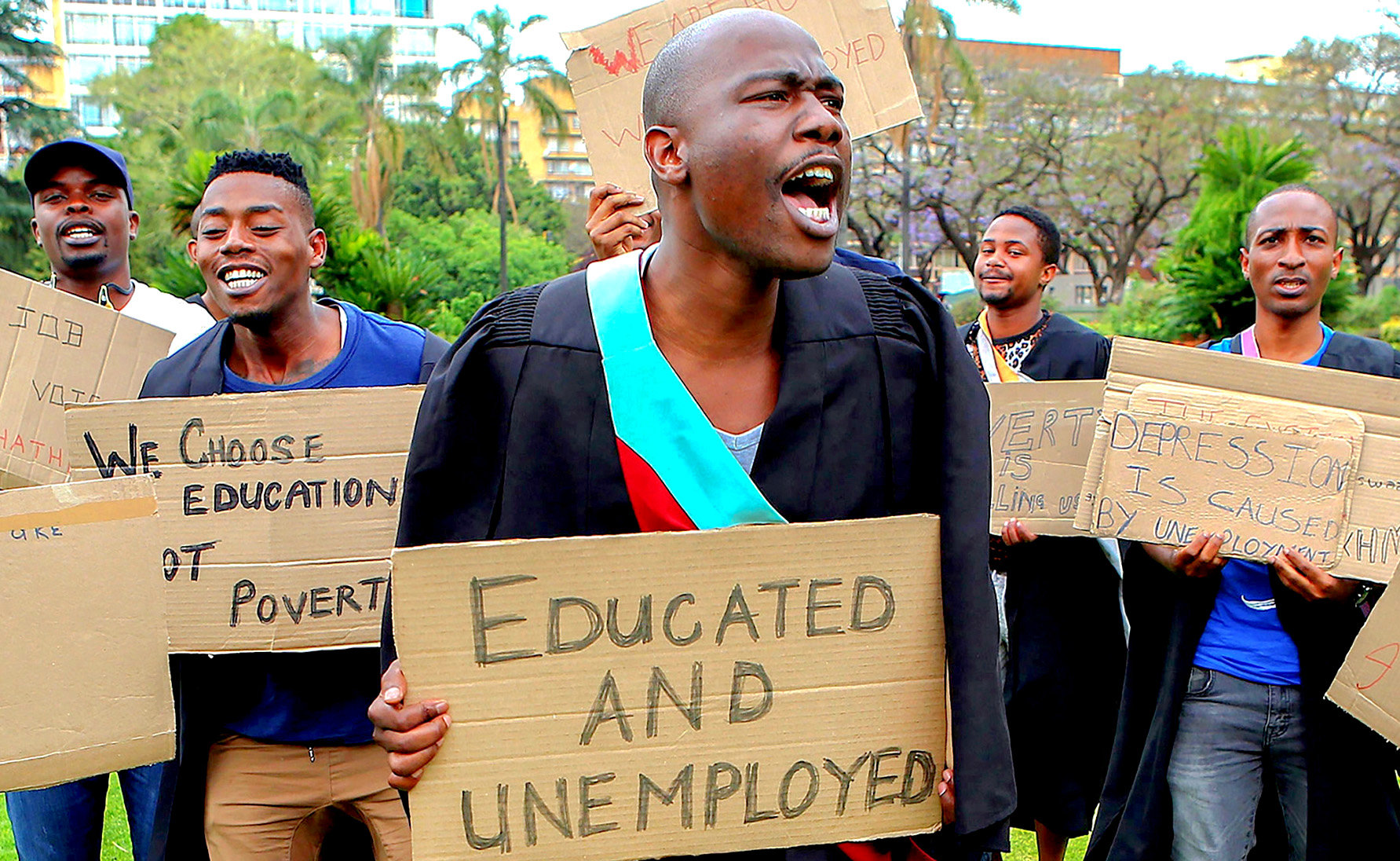
 Unemployed graduates from KwaZulu-Natal and Pretoria gather at Burgers Park before marching to the Union Buildings. The graduates handed over a memorandum to officials demanding that the government to come up with solutions to tackle rising unemployment. (Photo: Gallo Images / Phill Magakoe)
 /file/dailymaverick/wp-content/uploads/2025/10/label-Op-Ed.jpg)
From 23 to 25 February, beneath the vaulted ceilings of St George’s Cathedral, grassroots organisations from across the country will gather for a People’s Assembly on Unemployment, Austerity and the Fight for Decent Work. Convened by the Assembly of the Unemployed and Cry of the Xcluded, this meeting comes on the eve of yet another anti-poor, pro-capitalist Budget – one that is likely to deepen austerity in a country already buckling under crisis.
Just weeks later, a high-profile unemployment conference hosted by News24 and opened by Cyril Ramaphosa will bring CEOs, policymakers and experts together to debate the same issue. The contrast is stark. At the people’s assembly, the microphone shifts from boardrooms to breadlines. From policy abstractions to lived reality. Because unemployment should not be discussed about us, without us.
South Africa’s official unemployment rate is at crisis levels, and the expanded rate – counting discouraged work seekers – is more than 40%. This is not a temporary downturn. It is not a statistical anomaly. It is the predictable outcome of decades of liberalisation, privatisation and neoliberal restructuring that have hollowed out the productive capacity of the economy.
For years, mainstream commentators have insisted that unemployment is the result of a “skills mismatch”, excessively high wages or rigid labour regulations. These myths are repeated so often that they acquire the veneer of truth. Yet they collapse under scrutiny. Millions of people with qualifications cannot find work. Young graduates join the ranks of the unemployed alongside those with incomplete schooling. Wages for the majority remain poverty-level, and labour protections are weakly enforced. The problem is not that workers cost too much; it is that an economy built on financialisation, extraction and crony capitalism does not generate decent work.
Trade and financial liberalisation decimated the local industry. Privatisation and outsourcing stripped the state of its capacity to drive development. Austerity budgets have cut public employment and reduced social spending precisely when it is most needed. The result is a stagnant, enclave economy that accumulates wealth for the few while excluding the many.
The people’s assembly will confront this reality directly. It will reflect on how mass unemployment has widened inequality, fractured communities and entrenched despair. But it will also move beyond diagnosis to alternatives – debating state-led reindustrialisation, expanded public employment and a decisive break with policies that prioritise ratings agencies over residents.
Crucially, the assembly foregrounds a dimension often relegated to the margins of economic debate: gender. Mass unemployment is not gender-neutral. When jobs disappear and incomes collapse, it is women who absorb the shock. Women stretch shrinking household budgets, care for the sick and hungry and subsidise the crisis through unpaid labour. In communities wracked by joblessness, the social fabric frays. Rates of gender-based violence and femicide rise within conditions of stress, economic dependency and patriarchal backlash. The burden of survival – feeding families, holding households together, providing emotional and material support – falls mainly on women.
An unemployment crisis at more than 40% is therefore also a social crisis. It fuels migration, crime born of desperation and deep psychological trauma. It undermines democracy itself when millions are locked out of meaningful economic participation. And it intensifies the unpaid care economy that props up the formal economy without recognition or remuneration.
If we are serious about addressing unemployment, we must reject the convenient fictions that blame workers for structural failure. We must abandon austerity that shrinks the state in the name of fiscal prudence while expanding profits for the connected elite. We must confront corruption not as an isolated moral failing, but as a feature of a crony capitalist system that diverts public resources from development to accumulation.
The assembly aims to forge a programme of action uniting popular movements and labour formations in sustained resistance – particularly against budget cuts, privatisation and policies that entrench inequality. It seeks to build power from below, insisting that those who bear the brunt of unemployment shape the solutions.
As South Africa enters another Budget cycle and another round of elite dialogue about jobs, the message from St George’s Cathedral is clear: decent work will not be delivered by market fundamentalism. It will be won through organised struggle, democratic planning and a decisive shift in whose voices matter.
If conferences on unemployment are to mean anything, they must grapple with this truth. The crisis is structural. The pain is lived. And the solutions will not come from repeating the orthodoxies that created the disaster in the first place. DM
Vuyokazi Made, Motsi Khokhoma and Siyabulela Mama are members of the Assembly of the Unemployed and Cry of the Xcluded.