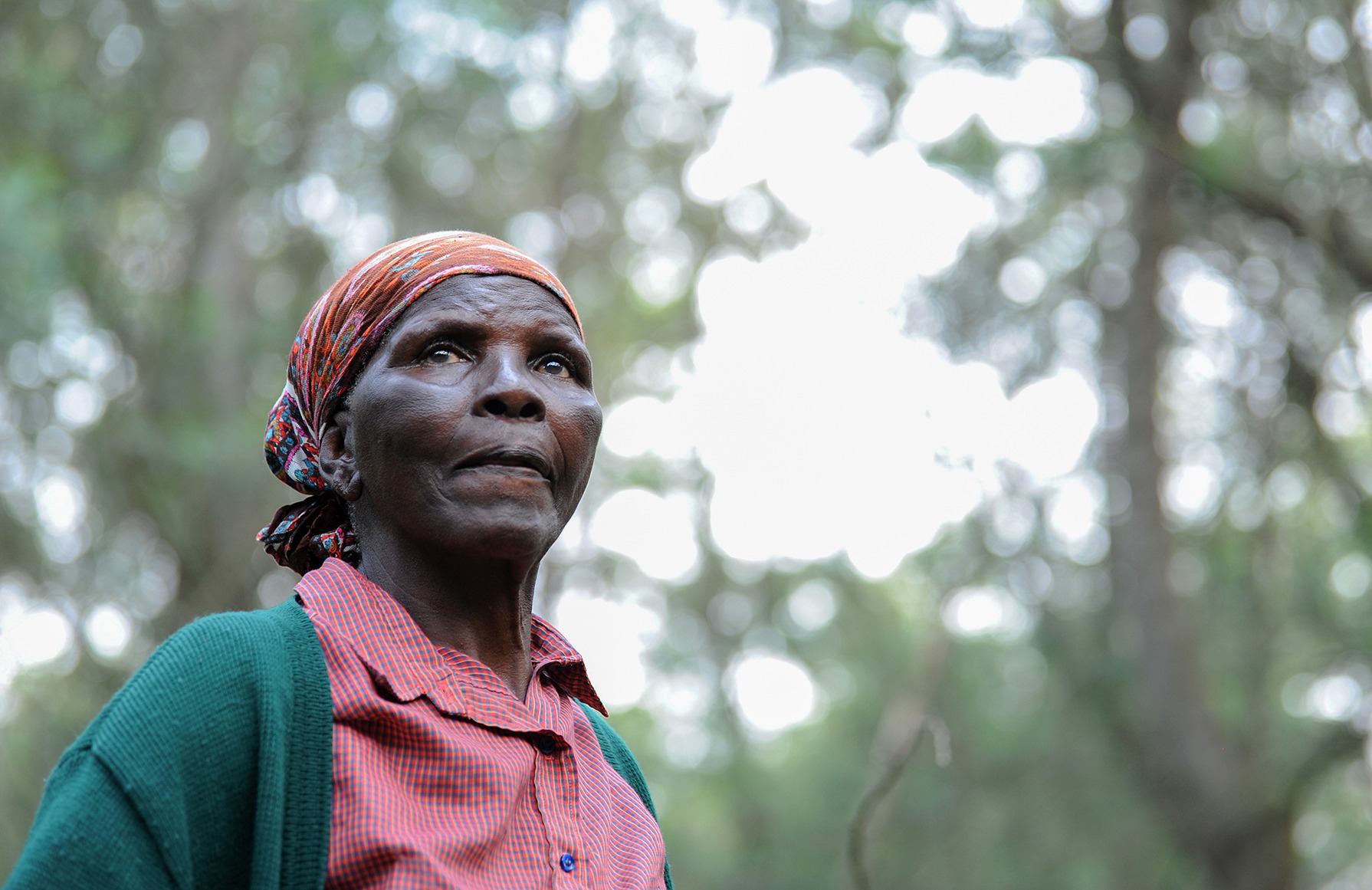
 Phumzile Dlamini at her home in Mhlambanyatsi. She was born in 1956 on land her family had been on for generations. (Photo: Cebelihle Mbuyisa)
 On land just north of the Mhlambanyatsi River, Phumzile Fruit Dlamini was born in 1956, in a home her grandfather built during King Somhlolo’s reign between 1815 and 1836. “We had imihlambi yetinkhomo (herds of cattle), milk in summer and winter and the occasional meat,” she said.
It was vast and water-rich highveld land dominated by sour pasture on hilly lands, and patches of indigenous forest – some dense, some clumpy – in ravines and in deep valleys. The locals call this region inkhangala.
“Though there were indigenous trees dotting the place in some areas, they were not enough to be firewood for everyday use. So, to cook and warm our huts in winter, we burnt dry cow dung and dry maize cobs,” Dlamini said.
In this part of the world they had encountered white settlers earlier and knew some had mineral concessions and claimed grazing rights on the land, but the boundaries and the laws that governed these arrangements were not that clear to them. All they knew was that they were subjects of the king and that they were governed at the local level by the Lamgabhi traditional authority.
/file/attachments/orphans/55_282383.jpg "Phumzile Dlamini’s home. She stays with her daughter and a grandson. (Photo: Cebelihle Mbuyisa)")
In 1948, Englishman Evelyn Baring, the high commissioner for Botswana, Lesotho and Eswatini from 1944 to 1951, commissioned a study to determine whether establishing an industrial tree plantation in the fertile lands of the Usutu Valley would be feasible.
The study – conducted by forester Ian Craib, who already managed a large forestry plantation near Piggs Peak – green-lit the planting of trees on about 55,000 hectares. For the undertaking, the Colonial Development Corporation (an agency of the British government) provided the funds.
In early 1950, the first plantings began.
“In the period up to 1958, 42,000 [hectares] were afforested, with the main plantings taking place between 1951 and 1957, creating the largest area of man-made forest in one contiguous block in Africa,” wrote one Julian Evans in the January 1988 issue of Unasylva, a forestry journal published by the Food and Agricultural Organisation of the UN.
/file/attachments/orphans/141_102248.jpg "A view of a section of the Usutu Valley in Eswatini before pine and eucalyptus forests were planted. (Photo: Supplied)")
The land on which the trees were planted had not been empty. On it, for generations, had lived Dlamini’s family and many others, according to historian Dr Sifiso Hlanze.
And before and after the South African War, or Second Boer War, there were already white people in all corners of Eswatini, existing under myriad legal arrangements.
But the British had won the war. So, British administrator Thorne Coryndon led the partitioning of the surface area of Eswatini through Proclamation 8 of 1907, giving white settlers freehold title to about two-thirds of the country. Only 37% of the land remained under the control of Queen Regent Labotsibeni Mdluli and chiefs, academic Richard Levin wrote in his 1997 book, When the Sleeping Grass Awakens.
Labotsibeni ruled over the people of Eswatini until Sobhuza II came of age and was crowned king in 1922 (fresh from his studies at Lovedale College in South Africa).
Make way for the trees
But Sobhuza was, to the British, only a paramount chief, not a king. It still fell to him as the so-called ruler of his people to tell them to move and make way for the trees.
“In 1949, Sobhuza told our parents to move away from our homes, our fields and pastures, to make way for the planting of the trees because they would be like the gold fields of Swaziland, our very own Johannesburg,” Dlamini said.
Her father, Silowu Dlamini, took his family to a piece of land near the Mhlambanyatsi River when they left their home at the foot of Ndzanyana Mountain. There, alongside his wife, he began building another home, where they would raise six boys and three girls.
“A few years after the family settled at the new place, my father went and bought an ox-drawn plough from a white settler in Lundzi, a Samuel Littler. And then he and my brothers cultivated the land here and planted those wattle trees,” said Dlamini, pointing to a forest surrounding her home.
Silowu and his sons were also hired by the forest company.
“They planted pines and, using old tools and oxen, they opened some of the sections that have become gravel roads, dividers of parts of the plantations, and link roads.”
In 1962, Usutu Pulp finished building a pulp mill in Bhunya. And, in later years, the family would cut, measure their wattle trees in kilograms and sell them to the company. Dlamini said she did not know if the wood was thrown into the machines and turned into pulp, or used as fuel.
/file/attachments/orphans/17_388136.jpg "A receipt issued by Montigny to Phumzile Dlamini after she sold them wattle wood from her forest. (Photo: Supplied)")
“All I know is that we sold our wattle trees from this forest here at home to them. And that they knew that it is our forest, growing on our land. We continued selling to Sappi too when they took over, and to Montigny when they took over operations.”
The plantations and mill in Bhunya have since been under the management of three companies: Usutu Pulp Company from 1948 to 1988, Sappi from 1988 to 2013 and Montigny Investments currently. The latter reportedly bought the business in 2013 for R1-billion.
Under Sappi, Dlamini said, the forests expanded so much that they began to eat into her family’s land.
“We have been moved about five times. And pine trees have been planted on what used to be our land.”
To force her to move to her current home, she said people from Sappi opened a drain a few metres from her old house, which redirected floodwater into her yard. The supporting wattle logs of her stick-and-mud house gave way, and the house fell on 31 January 2006. All her furniture, which she bought back when she had an office job in Mbabane, was destroyed. When she asked the company for compensation, she was refused.
‘No compensation’
“Prince Mandla Dlamini, who was forest manager at the time, told me straight when I went to their offices that I would not be compensated,” Dlamini said. But they did send a grader to break the soil and prepare a yard for her to start a new home at a new site. She had been pushed to a narrow strip of land that was a fraction of the original land on which her family had settled and worked.
“Watsi-ke lomlungu lowakaSappi, lokwelihlatsi lengikushiyako sewutawakha ngako (I would use the little piece of forest they left me to build a new home, the white man from Sappi then said),” Dlamini continued. “And it is this strip of land, and the last of the wattle trees, that Montigny now wants. This very land that Sihle [Mavuso] said is theirs now.” (Mavuso is the community and risk manager at Montigny Investments.)
Dlamini said she and other residents of the area had, throughout 2024 and 2025, been called to meetings in which Mavuso had asked them to leave their homes and lands.
But lately, Mashumi Shongwe was leading the campaign to expel the residents, she said. Shongwe, a former policeman and former mayor of Nhlangano town, was accused of murdering his wife in 2022 and is out on bail. He is a long-time employee of Montigny Investments and was previously based in Nhlangano, where the company already had operations before buying Sappi’s plantations in 2013. Shongwe’s official title is group community relations manager.
He told residents in a 12 March 2024 meeting that their removal would be handled in terms of the law. He then took out a copy of the Farm Dwellers Control Act of 1982 and read it out to them.
“He told us that the piece of paper containing the law he was reading to us is sold at a store called Webster’s in Mbabane. Leliphepha lelo bekatifundzela yena. Azange silibone ngemehlo, nekutsi lalakufundzako kungiko yini (He read the paper himself. We never saw its contents closely and could not confirm if he was reading the right thing),” said Shadrack Dlamini (70), one of the residents the company is trying to evict.
In October 2025, the Times of Eswatini sought comment for a story about the proposed evictions. Mavuso said that if residents refused to leave, the company would proceed anyway, guided by the Farm Dwellers Control Act.
/file/attachments/orphans/16_204066.jpg "A section of road being built in the early years of the Usutu forestry plantation’s life. (Photo: Supplied)")
There is also a contract, issued by Shongwe on 1 November 2024, that stipulates “terms of relocation and compensation”. In the contract, the residents are addressed as farm dwellers. And the company undertakes to pay R150,000 to those whose homes were built with sticks and mud. Those with concrete-and-brick structures would be compensated with a value determined by an evaluator. For both groups, there would be “no compensation for resettlement [;] including homesteading/kukhonta in the new plot”.
/file/attachments/orphans/102_832985.jpg "An orange tree laden with fruit at James Dlamini’s home. Dlamini says he planted many of his trees in the 1980s. Montigny Investments has indicated that they will not pay for trees when they evict residents. (Photo: Cebelihle Mbuyisa)
<br>")
James Dlamini, who chairs a committee set up in 1996 by the community to deal with the companies that have managed the pine and eucalyptus plantations surrounding their homes, said that what Shongwe now proposed contradicted what it originally said it would do.
“Even though Montigny became owners of the tree plantations in 2013, it was only in 2018 that we were told we would be evicted. It was a white man called Jurgens [Kritzinger] who told us that he wants our land,” said James Dlamini. “But we never had to sign anything until Mashumi came by in early 2024.”
‘Company responsible for relocation costs’
James said that when Shongwe addressed the community for the first time, he said the company would be responsible for relocation costs. He said that Shongwe further said the company would acquire land under traditional authorities, and that they would build houses for them, “and that we would be compensated for all we would leave behind, including our trees. And only then would the residents be relocated.
“Kuhambe yabese iyajika lenkhulumo (the story has since changed),” said James. “Now Shongwe said the people must go and look for land themselves and build new structures themselves. And it is Shongwe who insists that we are farm dwellers.”
James said he did not know how he was a farm dweller when his parents were not. He added that the company lied when it said the residents were leaving their homes voluntarily.
“Kute umuntfu lokhetse kususa umuti wakhe (no one here has elected to leave their homes). This talk about evictions came from the company. They should not trick us into saying that we are leaving voluntarily,” said James.
He was no longer allowed to talk in meetings because he was one of the people who refused to sign the company-issued contracts. And the only reason he was allowed to attend and participate at all was that he was the chairperson of the community committee, he said.
Not one of the families threatened with evictions had had legal representation, including those who had signed company-issued documents. James said they did not really know what they were getting themselves into by signing.
Phumzile, too, said she had never signed any papers. Not even when Sappi tried to brand them farm dwellers in 2013. And not when Montigny attempted to have them sign papers that she said diminished their rights to the land in 2024.
/file/attachments/orphans/151_526133.jpg "A road being built in the early 1950s in preparation for the planting of pine and eucalyptus trees. (Photo: Supplied)")
James said, however, that he would be willing, albeit reluctantly, to leave his ancestral home and land if compensated properly. He said that fair compensation would be the company building a house on land it had acquired for all those concerned, and land big enough for his cattle to graze, and enough to grow crops for his family. He would also like to be compensated for his fruit and ornamental trees. This was a sentiment Shadrack Dlamini and a few others in the community shared.
But Siketi Sukati, 93, said her home was all she knew and that she would not know how to begin building a new life anywhere else. Also, when the time came for her to die, she would like to be buried at the graveyard near her house, where most of her people were. Beauty Shiba, 89, said she was not willing to leave and called on King Mswati III to intervene on their behalf.
Bonisile Shongwe, whose husband fell to his death on his first day working at the Montigny mill in Bhunya in September 2024, said her family was not willing to move. The grave of her husband, Jabula Shongwe, was in a field that was a stone’s throw away from their house. She was not willing to leave him behind and had therefore not signed any papers.
The residents have never been allowed to install systems that bring tap water to their homes. They formed a collective once and tried to bring electricity to the community. Sappi would not let them do that. Montigny has followed in Sappi’s footsteps and refused to let them connect their houses to the national electricity grid, too.
‘Not allowed to rebuild concrete and bricks’
Several residents told this journalist that they were not allowed to build with concrete and cement bricks any more. They say that if their stick-and-mud houses collapsed in the rain, they were only allowed to repair them with temporary materials like pine planks. In early November, this journalist was shown a strip of land on the floodplain of the Mhlambanyatsi River that was dotted with pits that awaited the planting of trees. Some of these pits are very close to people’s houses.
/file/attachments/orphans/83_943365.jpg "Beauty Shiba, 89, told this publication that she is not willing to move. (Photo: Cebelihle Mbuyisa)")
The other side of the river used to be pasture for their cattle, too. That side has, for more than 10 years, been covered with growing pines. Beauty said she and members of the community went to the traditional authority in Lamgabhi to complain about the expansion of the forest, but received no help.
To try to fend off the company, they had been to all the region’s authorities – including the king’s office – and had received no assistance, they said.
James said they knew that the company was owned by the Rijkenberg family and had therefore sought an audience with the two brothers at the helm: Neal Rijkenberg (who is also Eswatini’s finance minister) and Ward Rijkenberg, the general manager at Montigny.
“When we try to go see these white owners, our very own people form a wall and block us,” said James. “I have the phone number of Ward’s personal assistant. Every time I have called him with a view to talking to his boss he declines sending me through. He instead reports me to Shongwe, the man in charge of the work of evicting us.”
The community has also sought an audience with the Lamgabhi traditional authority and has received no help. However, in August 2021 Phumzile did receive a stamped letter from the authority confirming her ownership of the wattle forest.
And between 2013 and 2018, when Phiwayinkosi Mabuza was the MP in Mhlambanyatsi, he was sent by the community to the deeds office in Mbabane to check the status of the area.
“Mabuza came back carrying papers. He gathered my committee and the community at a now-defunct restaurant at the company’s village called Chilex. He told us that the land was never bought by Montigny Investments. He said the land was now under the control of the king,” said James.
Mabuza told the Daily Maverick that he checked a long time ago and did not know how things stood today with regards to land ownership in the area.
Phumzile said she had hardly any faith in the system now. She said the very people who ought to protect and support her against the company are urging her to leave.
On 2 August 2025, Mavuso, the chief of Lamgabhi, Prince Ngongolozi Dlamini, and Prince Muzi Dlamini, who serves as Ndabazabantu (an officer, unique to Eswatini law and custom, who mediates in disputes between the company, workers and the community), visited Phumzile at her home.
“They wanted me to sign their papers. I refused,” said Phumzile.
Montigny, according to the company website, is the “largest private timber owner-operator in southern Africa, with a turnover in excess of R1-billion. We service approximately 40% of the regional wet-off-saw timber market, and have diverse timber-trading interests in South Africa, Eswatini, Mozambique, Namibia, Angola, Zambia and Japan”.
Mavuso told Agribusiness Media on 22 January that, “on a normal day, the company produces and transports about 40 truckloads of timber”. The company also “transports and processes more than 1 million tonnes of timber per year”, according to their website.
The residents have since written a letter to Petros Mavimbela, the chairperson of an entity called The Land Management Board.
“We are not hopeful he will help us, however, as he has known about our struggles for a long time and has not done anything in the past,” said James. Mavimbela was previously a member of parliament for the Mhlambanyatsi constituency.
‘Voluntary relocation programme’
Daily Maverick wrote to Montigny to seek a response. Mavuso wrote back and said they were not evicting anyone; that the company was instead implementing “a voluntary relocation programme”.
About how the company was going about the programme, he repeated the contents of the company’s November 2024 “terms of relocation and compensation letter”.
When asked about seeking land and building houses for the families, Mavuso said that it was not a promise they had ever made. He said the company instead engaged chiefs “two years ago, about the possibility of land for their community members who live in Maplazini and Mambazo, and all chiefs agreed to relocate them”. He did not say which chiefs.
/file/attachments/orphans/112_147893.jpg "A section of forest owned by Montigny Investments near Mhlambanyatsi, Eswatini. (Photo: Cebelihle Mbuyisa)")
All but one of the seven residents the Daily Maverick interviewed said they did not know about this and doubted that it was true. James, for example, said that in all of 2025, he went as far as the Kupheleni chiefdom looking for land. He said all the company told them was to look for land elsewhere. And that although it had initially promised to engage chiefs on their behalf, the company later changed its tune.
Phumzile, however, said that while being pressured (by the company and the area’s traditional authority) to sign the company papers, she was promised some land in Lamgabhi, which she refused “because I already have land and a home”.
In his email response, Mavuso said the residents had no legal claim to the land to begin with.
“History tells us that in the early 1950s King Sobhuza relocated LaMgabhi Royal Kraal to its current position and there were less than five homes that were allowed to remain behind,” wrote Mavuso. In their dealings with the residents so far, the company had, however, made no distinction between the five homes they claimed were allowed to remain and those that were built over the years.
In his response, Mavuso further claimed that all of the land was on a farm owned by Montigny, and that the following state-linked institutions could confirm his story: the Land Tribunal, the King’s Liaison Officer, the Lamgabhi chief, the Human Rights Commission and Liqoqo (the king’s advisory committee).
/file/attachments/orphans/131_613961.jpg "Harvested timber from plantations owned by Montigny Investments near Siphocosini. (Photo: Cebelihle Mbuyisa)")
Bonginkosi Dlamini, the MP for Mhlambanyatsi, also said that the residents’ homes were on the company’s farm. When pressed on the point, he changed his story and said that the land was in fact under the control of the king. He said that its administration was like that of the Ingonyama Trust in SA, but offered no information on the legislation that legitimises such a scheme.
Mavuso also said that the company refused to let the residents connect their homes to the electricity grid because “putting electricity lines over the plantation may not be ideal, especially during winter. The risk of losing the entire plantation from fire ignited by the spark is very high. This was explained to the people, and it is for that reason that the company has encouraged them to find alternative places (not eviction),” said Mavuso.
James said the company’s reason was laughable. He said that if electricity really posed a fire risk, then the entire Mhlambanyatsi village owned by the company would not have electricity. The Foresters Arms Hotel, which is in the same area, would be in the dark too.
Meanwhile, on 21 January 2026, Montigny started planting trees in the pits they dug in late 2025, without consultation with residents. When one Ndzabuko Sithole protested, he was arrested and taken to the holding cells at the Bhunya police station where he was charged with three counts of assault. He told this publication that he only hurled insults at the workers who were planting the trees on what he said was the community’s grazing grounds.
He is expected to appear at the Bhunya Magistrate’s Court on 26 March 2026. He has not, so far, had legal representation.
/file/attachments/orphans/91_777601.jpg "Ndzabuko Sithole protested when the company planted trees on the community’s grazing grounds on 21 January 2026. He was, as a result, arrested and charged with assault. He is currently out on bail while he awaits a 26 March 2026 court appearance. (Photo: Cebelihle Mbuyisa)")
Company’s aggressive expansion
Chris Lang of the World Rainforest Movement, in a 5 December 2007 article, said that he learnt from Peter George, an Eswatini farmer whose property was on the margins of the tree plantations in Makhwane, that Sappi’s plantations had pushed out families as they expanded.
“He pointed out the remains of a wall to us, all that is left of a homestead, now completely surrounded by the rows of Sappi’s pine trees. The hills ‘had been pastures and plough lands for the local people as long as anyone could remember’,” George said.
The residents of Maplazini and Mambazo in Mhlambanyatsi say they fear a similar displacement under Montigny Investments.
In October 2025, when announcing a sponsorship for a local football league, Mavuso talked about being tasked with expanding the company’s forests to help grow the country’s economy.
The company has also announced a community initiative where “as part of our forestry extension programme, Montigny is working toward transforming 30,000 [hectares] of invasive wattle jungles into plantations”. This points to an aggressive policy of plantation expansion.
Another initiative the company is currently running and marketing is what they call Vukani Maswati Project. Farmers in rural areas bordering Montigny’s plantations are being given wattle seedlings to plant on their lands. And more people are being encouraged by the company to join the scheme.
At present, Montigny claims to own more than 80,000 hectares of land, where 55,000 hectares is under active “timber management”. Inquiries about these figures were sent to the ministry of agriculture, but they had not responded by the time of publication. DM
Cebelihle Mbuyisa is an Eswatini-born journalist and documentary filmmaker based in South Africa. He was, in 2022, joint winner of the Nat Nakasa Award for Courageous Journalism.