



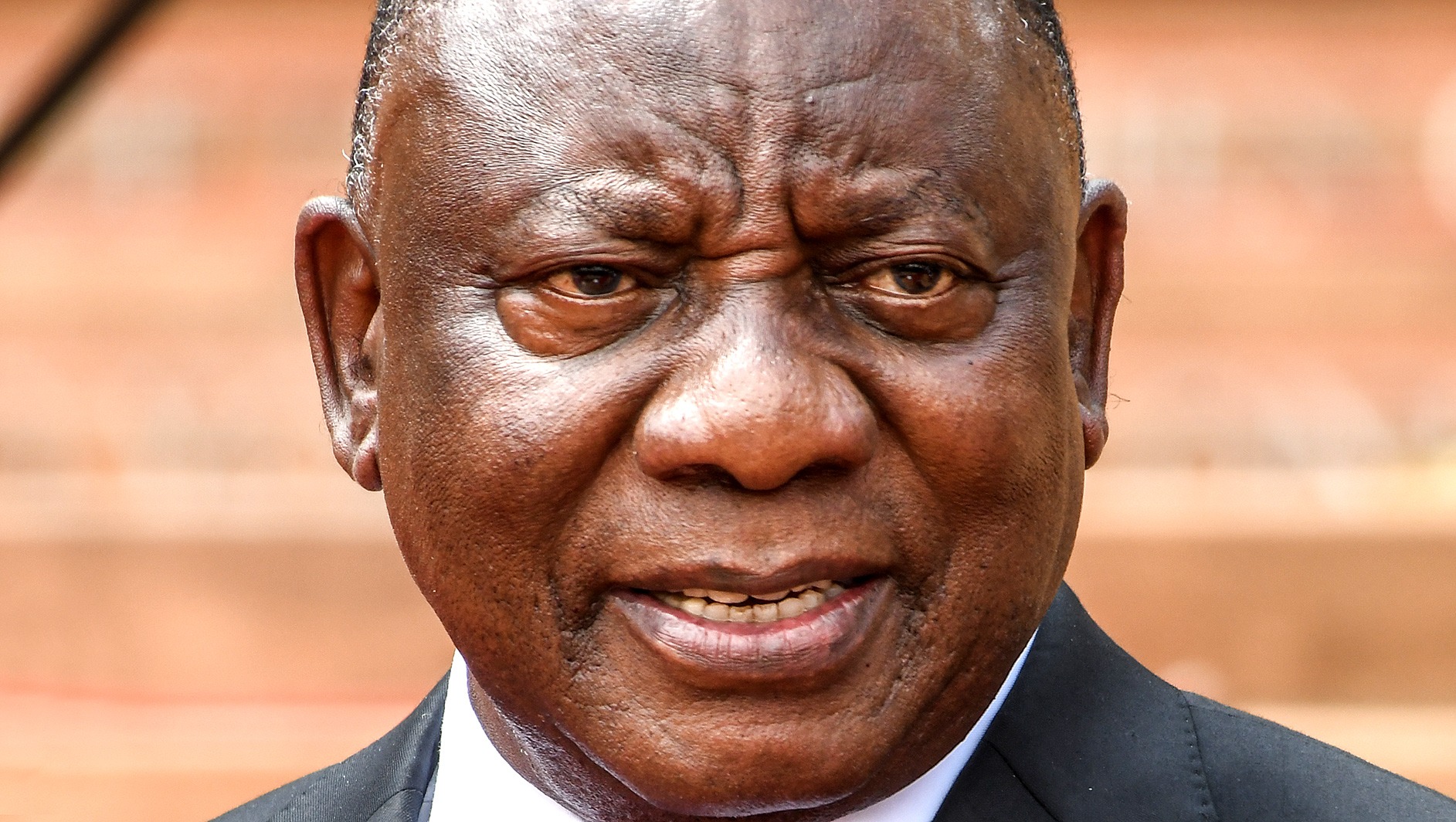
 President Cyril Ramaphosa. South Africa’s alliance with Iran has come at a cost to the country’s relations with the West. (Photo: Gallo Images / Frennie Shivambu)
 /file/dailymaverick/wp-content/uploads/2025/10/label-analysis-2.jpg)
For the South African government, the US/Israel attack on Iran and the death of Ayatollah Ali Khamenei is more than just a violation of international law, as President Ramaphosa has called it – it is a potentially lethal blow to an ally. And that alliance has come at a cost to SA’s relations with the West.
“Article 51 of the UN Charter provides for self-defence only when a state has been subjected to an armed invasion,” Ramaphosa said in a statement, dismissing the US justification that it was pre-empting the building by Iran of nuclear weapons.
“Anticipatory self-defence is not permitted under international law and self-defence cannot be based on assumption or anticipation.”
He said experience had shown there could be no military solution to fundamentally political problems and called for intensified diplomacy to resolve the conflict.
Iran has been a friend to the African National Congress since the revolution of 1979, when it supported sanctions against apartheid. It was admitted to the BRICS Forum in 2023, at that organisation’s annual summit in South Africa.
SA — Iran’s UN ally
The SA government, mainly under exclusive ANC control, has in turn faithfully stood by Iran over the years, consistently voting over many years in the United Nations against, or at least abstaining from, all resolutions which condemned Tehran for its persistent human rights abuses against its own people.
Even this year, under the government of national unity, as Tehran brutally cracked down on a new surge of demonstrations against the government, sparked in December 2025 by an economic crisis following the crash of the Iranian rial, Pretoria refused to condemn it.
/file/attachments/orphans/AFP_20260108_MEI-IRN-Km-PIIJ8-20260108-002_v1_HighRes_ProtestsInIranJanuary8_783340.jpg "Iranians block a street during a protest in Kermanshah, Iran, on 8 January 2026. The nationwide protests began in late December in Tehran’s Grand Bazaar, against failing economic policies. (Photo: Kamran / Middle East Images via AFP)")
In January, South Africa opposed attempts to call a special emergency session of the United Nations Human Rights Council in Geneva to discuss the crisis.
When the session was held anyway, on 23 January, South Africa abstained from voting on the resolution condemning Tehran for its crackdown, which has caused more than 3,000 deaths, according to Tehran itself, and up to tens of thousands of deaths according to many civil society organisations.
In its statement, South Africa supported the right to peaceful protest, freedom of expression and freedom of association, and said it was disturbed by reports of violence, including the deaths and destruction of property during the demonstrations.
It called for “maximum restraint”. But it abstained anyway, on the technical ground that the resolution also extended by one year the mandate of the special rapporteur on human rights in Iran – whereas SA said the council rules stipulated that such mandates should only last for one year in total.
Pretoria has consistently voted against or abstained from similar resolutions in the UN Human Rights Council on the same grounds every year, while also voting against or abstaining from the annual resolutions in the UN General Assembly condemning Iran’s human rights violations.
Apart from this political solidarity, SA has also had good commercial relations with Iran, and up to 2012 was importing about 25% of its oil from there. That year, it stopped buying Iranian oil completely to avoid US third-country sanctions designed to compel Iran to abandon its nuclear programme.
Ramaphosa has a personal connection with Iran as dhe was chairperson of MTN when it bought a 49% stake in MTN Irancell, the second-largest mobile operator in Iran, in 2005-2006. It proved a controversial investment as a rival Turkish firm accused MTN of paying bribes to secure the deal, and US sanctions have prevented MTN from repatriating profits.
Military co-operation
South Africa has also maintained a controversial military cooperation with Iran. Last year, Chief of the SA National Defence Force General Rudzani Maphwanya led a delegation of senior officers to Tehran to meet their Iranian military counterparts.
In remarks reported in Iranian media, Maphwanya expressed full support for Iran, including its international positions. These include military and other backing for Hamas and Hezbollah in their military campaigns against Israel.
/file/dailymaverick/wp-content/uploads/2025/08/GyNErbLXAAExjQq-1.jpeg "Chief of staff of the Iranian Armed Forces, Major General Abdolrahim Mousavi (centre right), and SANDF chief General Rudzani Maphwanya (centre left) during a meeting in Tehran. (Photo: Ofentse Donald Davhie / X)")
When controversy erupted, both President Ramaphosa and International Relations and Co-operation Minister Ronald Lamola publicly criticised Maphwanya for presuming to make South African foreign policy on his own, both stressing that only they could do that.
Notwithstanding this rebuke, in January this year, another controversy erupted when three Iranian warships arrived at Simon’s Town harbour for a so-called “BRICS-Plus” joint naval exercise called Will for Peace, along with warships from SA, Russia, China and the United Arab Emirates, fellow members of the 10-nation Brics-Plus bloc.
According to diplomatic sources, the Presidency maintained Ramaphosa had not authorised the participation of Iran. Ramaphosa then ordered the withdrawal of the Iranian ships just before Will for Peace began.
But his orders were ignored. Ironically, just this past Friday, 27 February – one day before the US/Israeli attack on Iran – Ramaphosa announced an investigative panel, comprising three ex-judges and one ex-rear admiral, to examine why his orders for Iran not to participate in Exercise Will for Peace had been disobeyed.
/file/attachments/orphans/iranianships3349_450447.jpg "The three Iranian navy ships in False Bay on 13 January 2026. (Photo: Brenton Geach)")
The naval exercise fiasco illustrated how ambiguous South Africa’s friendship with Iran has been and how costly to its relations with Western nations, especially the US, which had warned Pretoria against conducting naval drills with Iran while the country’s government was killing protesters.
Those ties, along with Pretoria’s friendly relations with Russia and China, were already a bone of contention with the US during the presidency of Democrat Joe Biden. They had provoked bipartisan statements and resolutions in the US Congress threatening to downgrade Washington’s relations with Pretoria, including possible exclusion from preferential trade access under the African Growth and Opportunity Act (Agoa).
Under President Trump, SA’s relations with Iran, Russia and China, as well as grievances about some SA domestic policies, precipitated a significant worsening of relations, including termination of aid and the imposition of punitive 30% import tariffs.
GNU tensions
The ANC’s alliance with Iran has also caused significant tensions and divisions within the GNU, especially with the Democratic Alliance.
When South Africa’s ambassador to the UN in Geneva opposed the emergency session of the UN Human Rights Council in January this year, DA international relations spokesperson Ryan Smith said, “ This act of rank moral hypocrisy is yet another example of the ANC’s total subversion of the principles enshrined in the South African Constitution, and a violation of the Government of National Unity’s (GNU) statement of intent, to serve its party-political interests in the global arena.”
After the weekend attack on Iran, Smith said, “Iran is a rogue state which has repeatedly defied international law, violated nuclear treaties and funded proxy organisations which have divided and destabilised societies around the world.
“The current theocratic dictatorship in Iran is also responsible for the most brutal massacre of innocent civilians in recent history. These countries are the single biggest threat to the international rules-based order and liberal democracies such as our own.
“In light of the US attacks on Iran, however, South Africa must abide by the GNU’s statement of intent and maintain strategic non-alignment. Our main focus should be upholding the Constitution in our foreign endeavours and maximising trade through non-aligned economic diplomacy.”
Pretoria’s Iran stance has also further soured the government’s relations with the South African Zionist Federation, which said the government’s response to Iran reflected a departure from the universal human rights principles that once defined South Africa’s international standing.
“Once, South Africa championed human rights as indivisible and absolute,” the organisation said. “Today, they are applied selectively, depending on political alignment.”
More than the news
If you want breaking news on Iran, you can get headlines anywhere.
But when empires posture and presidents gamble, who carries the cost? Who gets to write the story? And what does that mean for South Africa: your economy, your politics, your fuel price?
That takes insight.
Real journalism. Real context.
Fund the newsroom that unpacks the global power games through a South African lens.
From as little as R75 per day you can help write our history. Cancel anytime — but please, join us today.