




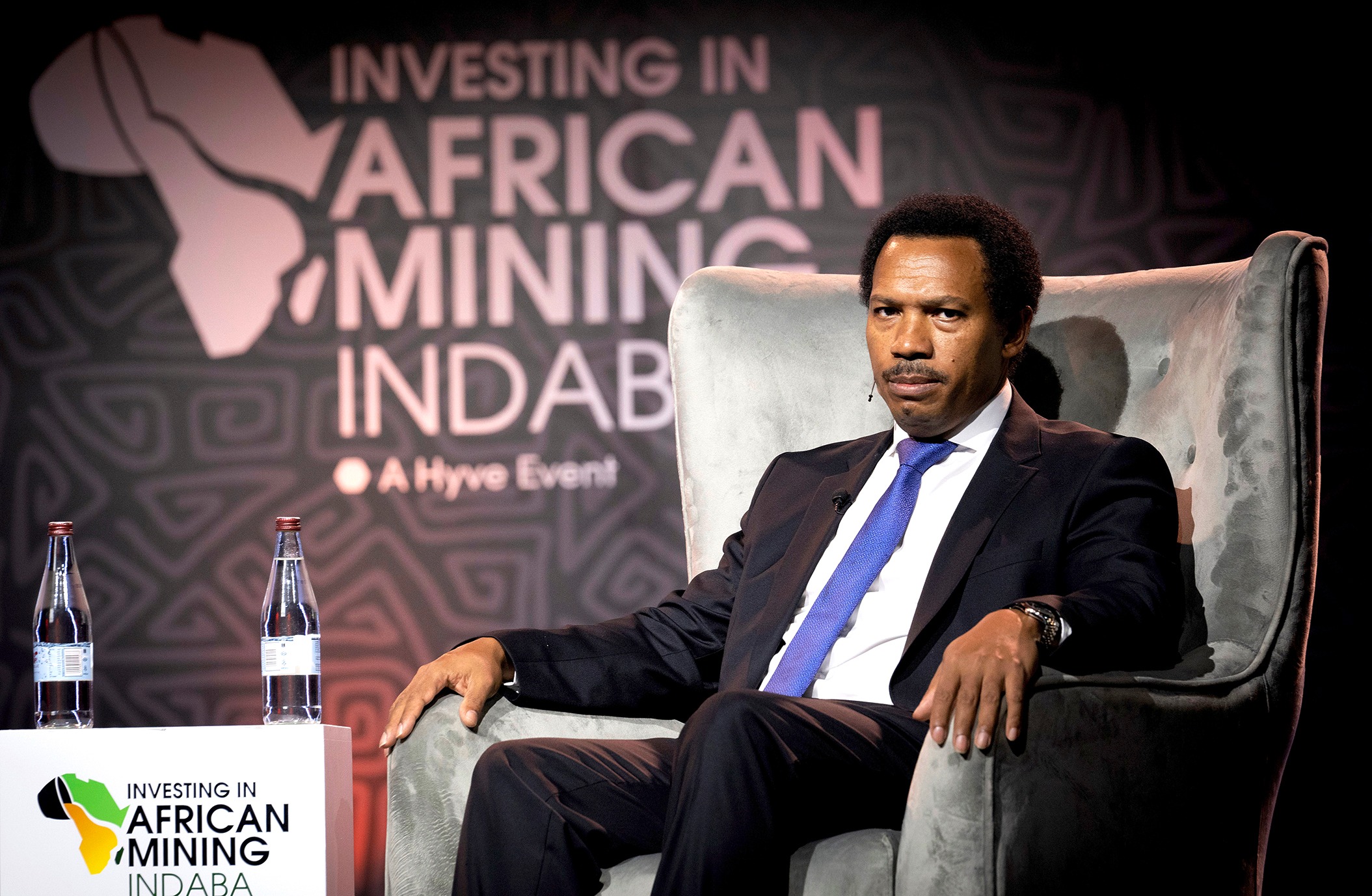
 Moses Madondo, CEO Of Thungela, at a discussion on coal fundamentals at the Investing in Africa Mining Indaba 2026 on 10 February in Cape Town, South Africa. The meeting is the world’s largest, most prestigious annual conference dedicated to the African mining industry, which aims to drive investment into African mining, fostering economic growth, and discussing the future of the industry. (Photo: Gallo Images / Die Burger / Jaco Marais)
 /file/dailymaverick/wp-content/uploads/2025/10/label-Op-Ed.jpg)
The coffee was strong, the room was tense, and the choreography of politeness was slipping. At the Investing in Africa Mining Indaba 2026, during a co-hosted breakfast by CNV Internationaal and the Initiative for Responsible Mining Assurance (IRMA) on customary governance and accountability, one question refused to stay quiet: Who truly speaks for the land?
It is the question South Africa has tried to dodge for three decades. It unravels the politics of mining, land, legitimacy, identity and justice. It exposes what many communities, activists and even some traditional leaders have long known: our land governance system is collapsing under pressures it was never built to withstand.
Across our panel spanning traditional authorities, mining executives, labour, community foundations and social auditors, a rare consensus emerged: the crisis is not technical. It is political. It is structural. It is about power. But amenable through dialogue.
This echoes the persistent warning from land activists, who have illuminated the core problem: South Africans cannot meaningfully negotiate mining, conservation, or development without secure, democratic governance over land. Without land rights, communities do not participate; they plead.
A system built on outdated assumptions
SA’s land and mining governance framework still carries the imprint of a 20th-century logic: centralised authority, extraction-first economics, and a technocratic state that presumes legitimacy without earning it.
Meanwhile:
- The Mineral, Petroleum and Resources Development Act privileges mineral access over tenure security.
- The Interim Protection of Informal Land Rights Act is invoked far more often than it is enforced.
- Traditional structures have been reshaped by colonial and contemporary politics, carrying representational burdens beyond breaking point.
- Free, Prior and Informed Consent is routinely reduced to a signature, not a system.
- Mining companies celebrate Environmental, Social and Governance scores while communities fight for basic recognition.
This is unjust and obsolete in a world defined by rising community expectations, AI-powered transparency, climate-driven land pressures, and global solidarity networks. Largely, this is why SA’s land and mining debate remains trapped in a zero-sum struggle: commodity versus identity, traditional authority versus democracy, white majority-owned multinational mining house (except Patrice Motsepe and a few others) versus black community. This binary is not a failure of policy. It is a failure of imagination.
To break the stalemate, we must flip the script entirely and build a new system in the cracks of the old.
/file/dailymaverick/wp-content/uploads/2024/09/gi_0289944.jpg "A miner climbs down a ladder joining two underground working levels. (Photo: Graeme Williams)")
Four innovations that could transform SA’s land future
These aren’t policy tweaks. They are deep systemic redesigns, which are practical, ambitious, and aligned with the urgent demands for land justice voiced across the country.
1. The “Living Land Title”: A legal hybrid that ends the false choice
SA’s land debate has been trapped between two inadequate options: individual freehold (land as commodity) and insecure communal tenure (land as identity without protection).
The Living Land Title creates a third way. It is issued to a democratically constituted community entity, such as a trust, cooperative or certified Traditional Council, and guarantees perpetual, secure tenure. Embedded in the title is a Community Consent clause, requiring a supermajority for any lease or sale, protecting against elite capture.
A mandatory Intergenerational Commons, including a school, cooperative garden, grazing land, or renewable energy microgrid, ensures shared benefit and intergenerational equity. This title makes land generative commons, not an elite possession.
This land reform strengthens democracy, not weakens it.
2. The “Soil & Soul Fund”: Financing land justice without a bankrupt fiscus
Land reform is trapped because it relies on state budgets and commercial banks, both incapable of funding transformation at scale. The Soil & Soul Fund breaks this dependency. It is capitalised through:
- A time-bound Common Good Levy on agricultural exports, mining revenues and commercial farming profits.
- Diaspora bonds inviting global South Africans to invest in land justice.
- A mandated allocation from large pension funds, especially those built on the labour of communities that lost land.
The fund finances land acquisition, post-settlement support, regenerative agriculture and cultural restoration, such as memorials, heritage sites and renewal centres.
It shifts the narrative from “state must pay” to a shared national social contract, acknowledging historical debt while investing in collective futures.
3. The “Customary Constitution”: Renewing ancestral governance in a modern era
One of the deepest tensions in rural SA lies in the gap between imposed forms of traditional authority and the lived expectations of communities whose governance practices have always been collective, relational and accountable.
The Customary Constitution draws directly from these indigenous principles. It offers a community-driven, culturally grounded process through which people can affirm, in their own language, customs and values, the rules that guide their shared life. Through inclusive dialogue, the community defines:
- How leaders emerge and are entrusted with authority, based on service, lineage, merit and community confidence.
- How land is held, shared and allocated, reflecting ancestral practices of custodianship rather than ownership.
- How disputes are resolved, using restorative and consensus-based mechanisms.
- How consent for mining or development is given, through collective deliberation rather than individual signatures.
Once affirmed through broad community agreement, the Customary Constitution becomes a recognised expression of the community’s will, binding on all, including companies seeking access to land.
This approach renews the oldest African governance principle: authority flows from the people, not over them.
It moves power away from individuals acting without accountability and restores it to the collective, where Free, Prior and Informed Consent becomes a living practice rooted in tradition, not a bureaucratic ritual imposed from outside.
4. The “Generational Tribunal”: A living archive of land and renewal
SA operates a mixed legal system, a hybrid of Roman Dutch civilian law, English common law, customary law and religious personal law, yet cannot process the full weight of historical land dispossession. Many claims are lost, undocumented or buried in trauma.
The Intergenerational Tribunal is a non-judicial, statutory body that:
- Investigates and publicly witnesses past and ongoing land injustices.
- Collects oral histories and genealogies.
- Maintains a public digital archive.
- Issues Certificates of Moral Claim that communities can use in land negotiations.
- Protects the intergenerational wealth and wellbeing of future generations.
It transforms buried pain into visible knowledge. It creates a national memory too powerful for policymakers to ignore. More importantly, it allows healing, not forgetting, to shape the future.
These innovations matter because each disrupts a different layer of the system:
- The Living Land Title rewrites the rules of property.
- The Soil & Soul Fund rewrites the financing logic.
- The Customary Constitution rewrites the power dynamics.
- The Intergenerational Tribunal rewrites the national narrative.
Together, they form the foundation of a new land governance regime, embedded with pluralistic, generative, democratic principles.
They answer the question that echoed in that Mining Indaba room: Who speaks for the land?
The response should be: The people rooted in it. Democratically. Collectively. With dignity and power.
It is clear that SA’s mining crisis is not technical; it is a crisis of governance and imagination, a land crisis, a democracy crisis.
The land is speaking. Communities are speaking. History is speaking. The future is calling. The only question left is: Will we finally listen? DM
Letitia Jentel is the programme manager and a researcher in SAIIA’s Futures Programme at the South African Institute of International Affairs (SAIIA).