




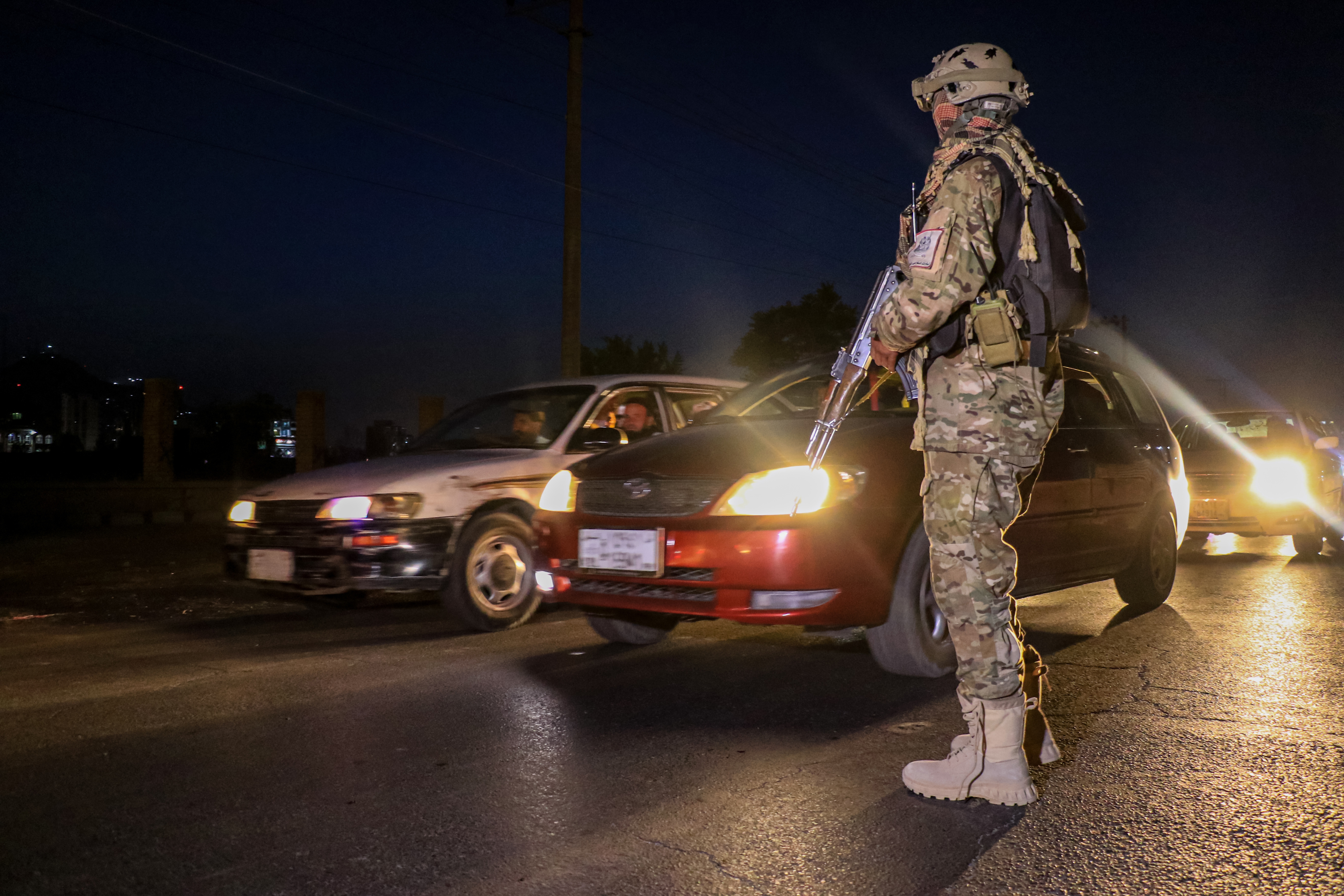
 A Taliban security checks a vehicle at a checkpoint in Kabul, Afghanistan, 26 February 2026. Clashes erupted along the border as Taliban authorities said Afghan forces attacked Pakistani military posts following recent Pakistani air strikes in Nangarhar and Paktia. Both sides reported heavy fighting and casualties, escalating tensions between Afghanistan and Pakistan amid worsening diplomatic relations. EPA/SAMIULLAH POPAL
 The Pakistani air strikes are the first time Islamabad has directly targeted Taliban installations rather than militants allegedly backed by them, a stark rupture in ties between the Islamic neighbours, once close allies.
Security sources in Pakistan said the strikes involved air-to-ground missile attacks on Taliban military offices and posts in Kabul, Kandahar as well as Paktia province. There were ground clashes in multiple sectors along the border between the Islamic nations.
The Taliban said it launched what it described as retaliatory attacks on Pakistani military installations.
Both sides reported heavy losses, issuing sharply differing figures that Reuters could not independently verify.
"Our cup of patience has overflowed. Now it is open war between us and you (Afghanistan)," Pakistani Defence Minister Khawaja Muhammad Asif said on Friday.
The strikes threaten to unleash a protracted conflict along the 2,600-km (1,615-mile) frontier with relations between Kabul and Islamabad shattered by a long-running dispute over Pakistan's accusation that Afghanistan harbours militants carrying out attacks across the border.
The Taliban have denied the charge and said Pakistan's security is an internal problem.
Taliban spokesperson Zabihullah Mujahid confirmed Pakistani forces carried out air strikes in parts of Kabul, Kandahar and Paktia but did not give details.
Kandahar is the headquarters of the Taliban and the city where supreme spiritual leader Haibatullah Akhundzada is based.
FEAR IN KABUL
Videos shared by Pakistani security officials showed flashes of light in the night from firing along the border and the sound of heavy artillery. A video of strikes on Kabul, for which Reuters was able to verify the location, showed thick plumes of black smoke rising from two sites and a massive blaze in part of the capital.
Kabul taxi driver Tamim said he was asleep when he heard the sound of an aircraft, which was followed by strikes on what appeared to be a weapons depot.
"We woke up, and the plane came and dropped two bombs, then flew away again. After that, we heard explosions," he said.
"Everyone, in panic, ran down from the second floor of the house. The ammunition inside the depot kept exploding on its own."
Reuters witnesses in Kabul said many ambulance sirens could be heard following loud blasts and the sound of jets.
Mosharraf Zaidi, a Pakistani government spokesperson, said in a post on X that the action as a response to "unprovoked Afghan attacks", adding 133 Afghan Taliban fighters were killed and more than 200 wounded, with 27 posts destroyed and nine captured.
Mujahid, the Taliban spokesperson, said 55 Pakistani soldiers were killed and 19 posts seized, while eight Taliban fighters were killed, 11 wounded and 13 civilians injured in Nangarhar province.
HIGH SECURITY
Pakistan's military capabilities are vastly superior to Afghanistan. However, the Taliban are adept at guerrilla warfare, hardened by decades of fighting with U.S.-led forces, before returning to power in 2021.
Clashes between Pakistan and Afghanistan in October killed dozens of soldiers until negotiations facilitated by Turkey, Qatar and Saudi Arabia brought an end to the hostilities.
Pakistan and Saudi Arabia's foreign ministers spoke on Friday to discuss reducing tensions, Riyadh's foreign office said without providing details on whether it was involved in brokering a ceasefire.
Russia, the only country to formally recognise the Taliban government, called for an end to hostilities and said it would consider mediating talks if asked by both parties, state media reported citing Moscow's foreign ministry.
China's foreign ministry said it had been mediating in the conflict through its own channels and was deeply concerned about the escalation.
Pakistan has been on high security alert since it launched air strikes earlier this week that Islamabad said targeted camps of Tehreek-e-Taliban (TTP), or Pakistani Taliban, and Islamic State militants in eastern Afghanistan.
Kabul and the United Nations said the strikes killed 13 civilians and reiterated it does not allow militants to operate from its territory. The Taliban also warned there would be a strong response.
The government of Pakistan's Punjab province said it was on high alert for militant attacks on Friday and had conducted a series of security operations, taking 90 Afghan nationals to holding centres for deportation.
A state-run media outlet from Afghanistan’s Nangarhar, Bakhtar News Agency, shared an image of what it said was a battalion of suicide attackers, and quoted an Afghan security source as saying the bombers were equipped with explosive vests and car bombs and were prepared to strike major targets.
Pakistani officials have said in recent days they feared an escalation of militant strikes in urban centres.
Airstrikes in major Afghan cities https://reut.rs/4se3RKb
(Reporting by Mohammad Yunus Yawar and Sayed Hassib in Kabul, Asif Shahzad in Islamabad, Ariba Shahid in Karachi, Mubasher Bukhari in Lahore, Mushtaq Ali in Peshawar and Saud Mehsud in Dera Ismail Khan; Additional reporting by Vinaya K and Fernando Robles; Writing by Saad Sayeed; Editing by Stephen Coates and Raju Gopalakrishnan)