




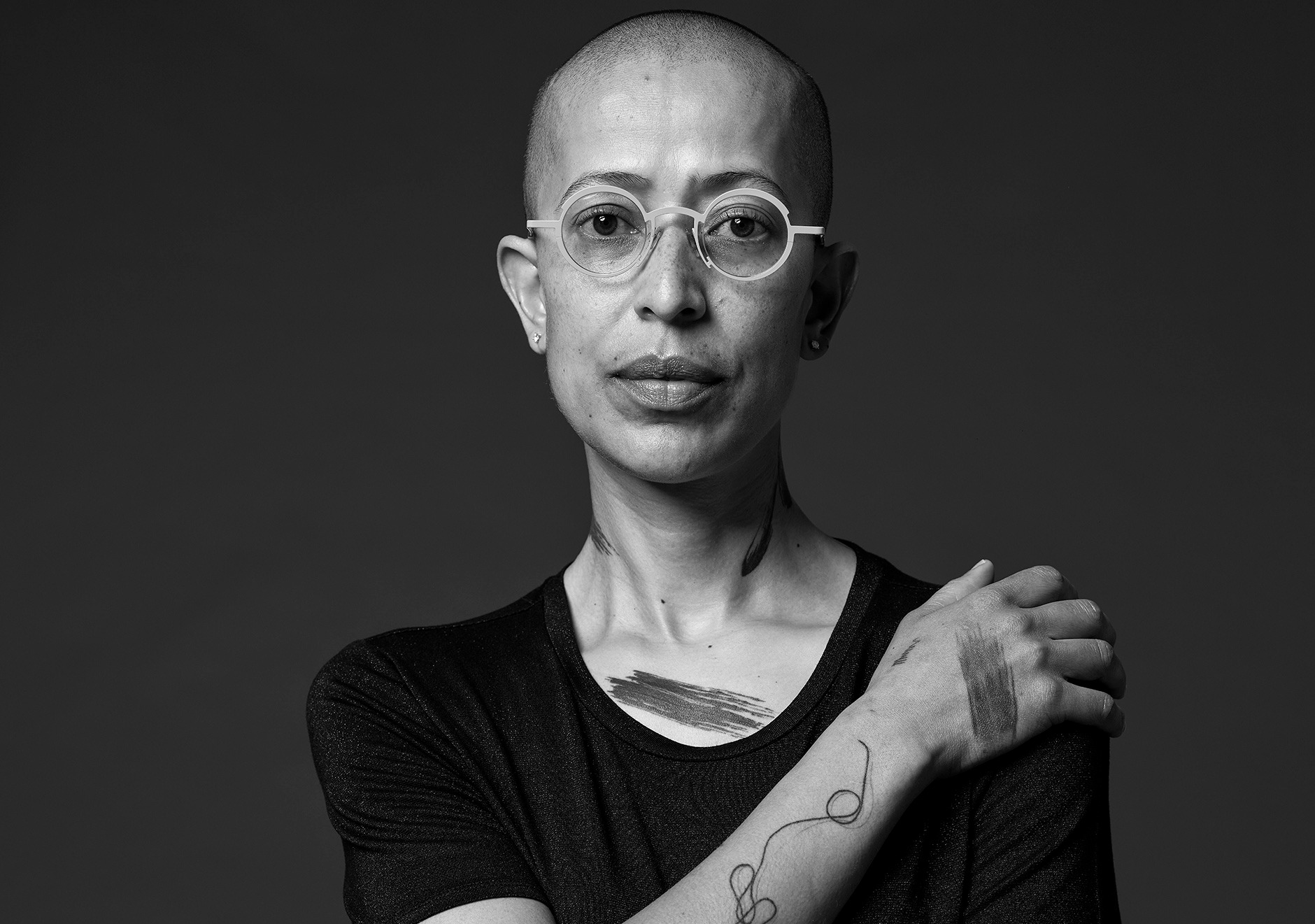
 Artist Gabrielle Goliath. (Photo: Anthea Pokroy)
 The Arsenale, which would have hosted the South African pavilion at the 2026 Venice Biennale, will be empty this year, but lawyers for artist Gabrielle Goliath are challenging the high court judgment that stymied her attempts to have her participation reinstated following its apparent cancellation by Arts and Culture Minister Gayton McKenzie.
/file/attachments/orphans/ED_594202_404185.jpg "Minister of Sport, Arts and Culture Gayton McKenzie. (Photo: Frennie Shivambu / Gallo Images)")
Goliath’s attorney, Dario Milo, confirmed to Daily Maverick that his team are working on an application for leave to appeal against the judgment by Judge Mamoloko Kubushi, which was handed down on 18 February, with reasons for her ruling becoming public on 22 February – well after Biennale deadlines had passed, shutting the door on an urgent appeal and the possibility for Goliath to get in at the last minute.
Kubushi’s judgment found that the dispute centred on an ordinary private agreement between two parties – the Department of Sport, Arts and Culture and Art Periodic, a nonprofit set up to run the selection of artworks and their exhibition in Venice – and did not, contractually, involve Goliath and her team, which consisted of curator Ingrid Masondo and studio manager James Macdonald.
An urgent application to stop McKenzie, a self-confirmed Zionist and leader of the Patriotic Alliance, from interfering in the selected work, Elegy, was heard on 11 February. Elegy is a “work of mourning” engaging with femicide in South Africa, colonial Germany’s genocide in Namibia and the Israeli Defence Forces genocidal killing of women and children in Gaza.
A deadline to submit Biennale catalogue materials for the selected work passed on 13 February. Kubushi handed down her judgment without reasons, finding against Goliath on the afternoon of 18 February, which was the deadline for South Africa to confirm with the Biennale Foundation which works would be exhibited.
Following the initial hand-down without reasons, Goliath’s attorneys had urgently written to Kubushi asking for reasons, to which she responded on 19 February, saying that it had been submitted to the court’s researchers for “proof-reading”.
/file/attachments/orphans/GabrielleGoliathIngridMasondo_photobyZUNIS_1_387985.jpg "Ingrid Masondo (left), curator of the cancelled exhibition, with artist Gabrielle Goliath. (Photo: Zunis)")
According to the letter, the researchers had notified Kubushi that “as much as they appreciate the time sensitivity, they cannot have the proofreading finalised by the end of business today [19 February]. This, as they say, is in keeping with the level of standard of accuracy and professionalism put into their work to avoid reputational concerns.”
So it was surprising to find Kubushi’s reasoning containing errors. These included incorrectly stating that the initial letter of “concern” sent by McKenzie to Art Periodic on 22 December was sent on 22 January. McKenzie had, in that letter, claimed to be “deeply concerned” that Elegy dealt with issues related to the genocide in Gaza, which is “known to be highly divisive in nature and relates to an ongoing international conflict that is widely polarising”.
There was also a repetition of another paragraph lower down in the judgment.
Judgment ‘constitutionally ignorant’
A legal mind who asked for anonymity so as not to jeopardise relationships with the judiciary, described the judgment as “constitutionally ignorant”.
For Kubushi, the nub of the matter was whether McKenzie’s termination of the contract with Art Periodic on 2 January – after the organisation had not responded to his demands for clarity about Elegy and that the artist change the nature of the work – had adversely affected the rights and interests of Goliath and her team.
“I do not think so,” Kubushi said. “I say so because the only decision that the minister withdrew is the contractual relationship in terms of which Art Periodic was granted access to the pavilion by the minister. Such a decision, in my view, did not interfere with the selection or cancel the selection of the applicants’ artwork. This, it could not do, because there was no relationship between the minister and/or the department and the applicants. Because there was no relationship, contractually or otherwise, between the respondents and the applicants, the minister would not have the authority to interfere with the relationship between Art Periodic and the applicants, which was a relationship or agreement separate from that of the respondents and Art Periodic.”
She maintained this view when dismissing arguments made by Goliath’s lawyers that the artist’s selection through an open call process administered by Art Periodic amounted to administrative action under the Promotion of Administrative Justice Act. Art Periodic was not acting on behalf of the government, and the selection committee it set up, which chose Elegy, was not performing an administrative function, Kubushi also found.
Kubushi bolstered her findings by quoting the Supreme Court of Appeal judgment in Government of the Republic of South Africa v Thabiso Chemicals (Pty) Ltd, where it found that “a contractual relationship between the parties is not affected by the principles of administrative law”.
“Once this principle has been established, it stands to reason that the applicants’ case, which is formulated from that perspective, must fail,” Kubushi found.
The case, Kubushi reiterated, was about “an ordinary private agreement between two parties”.
She further found that there was “no evidence on the papers […] that the conduct of the minister, in terminating the agreement with Art Periodic, directly and adversely affected the applicants’ rights of expression or any of their rights and interests”.
Goliath and her team’s failure “to demonstrate that their rights or interests are directly affected by the alleged unlawful conduct of [McKenzie and the Department of Sport, Arts and Culture]” meant the applicants had “no locus standi in these proceedings”, according to Kubushi.
In a decision that is certain to cool litigation by creatives, Kubushi also awarded punitive costs against Goliath.
While Goliath’s legal team continue to pursue the case on its constitutional merits, the Venice Biennale announced a list of 111 artists who will present work at Venice that is in keeping with its central theme, In Minor Keys.
In Minor Keys, which explores themes of “care, resilience and the resonance of under-heard cultural expressions”, was conceived of by the late Koyo Kouoh, the former director and head curator at the Zeitz Museum of Contemporary African Art in Cape Town. Kouoh died unexpectedly last year.
Among the list of artists, mainly from the Global South, are seven South Africans: Nolan Oswald Dennis, Nicholas Hlobo, Senzeni Marasela, Johannes Phokela, Bernie Searle, Helen Sebidi and Kemang wa Lehulere. These artists are not funded by McKenzie’s department. DM