



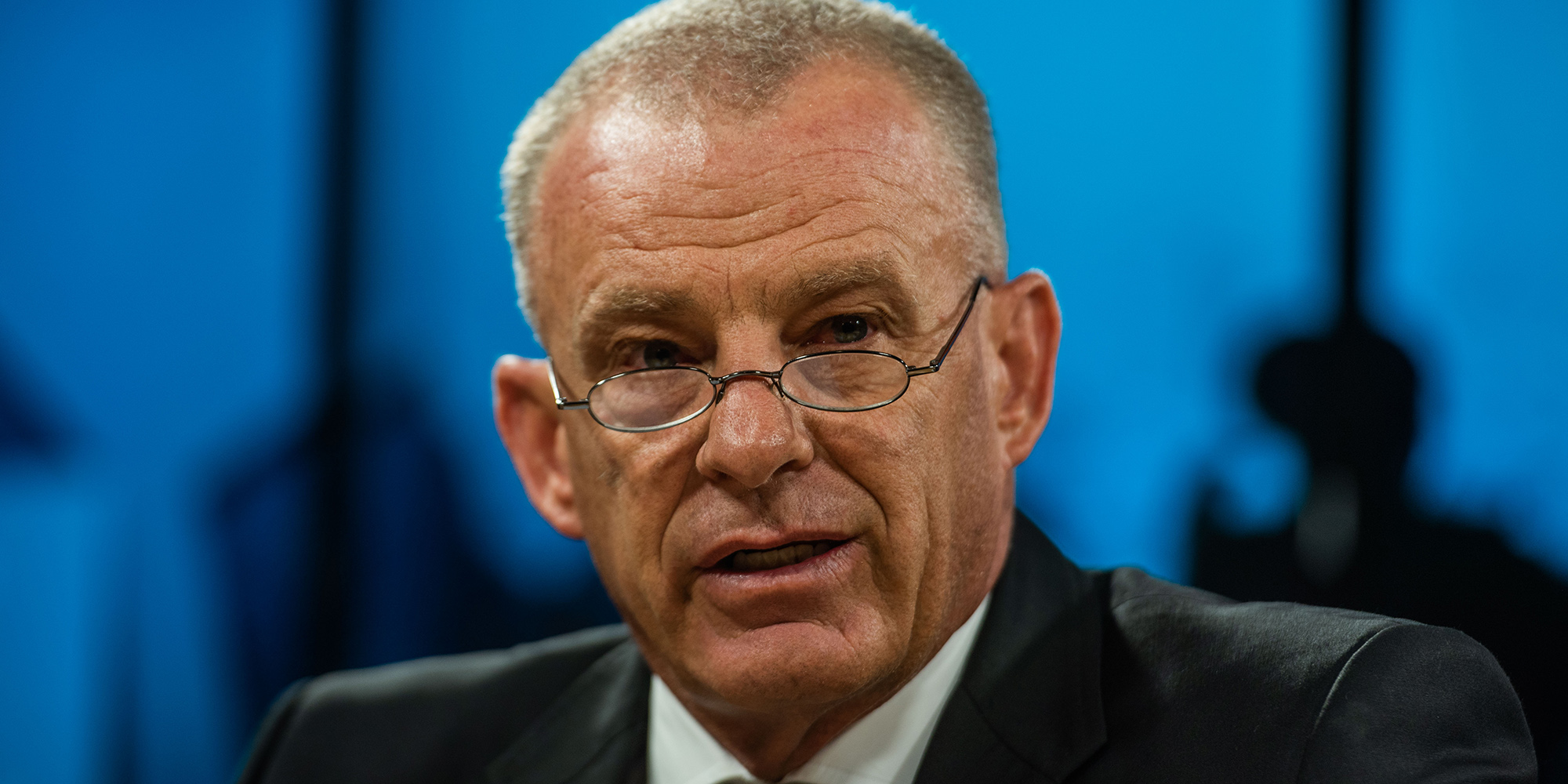
 Adv Gerrie Nel, of AfriForum’s private prosecutions unit, represented Jacob Gabriël Cilliers van der Merwe, the son of a farmer slain by MK operatives in November 1978, at the Khampepe Commission in Johannesburg. (Photo: Alet Pretorius / Gallo Images )
 In November 1978, Jacob Gabriël Cilliers van der Merwe was 16 and in high school when his father, Jacob Gabriël van der Merwe (57) stopped to offer a lift to two hitchhikers on a lonely road a near Thabazimbi, in then Northern Transvaal (Limpopo).
On Thursday, 26 February 2026, at the Khampepe Commission into delayed Truth and Reconciliation Commission (TRC) prosecutions, Van Der Merwe Jnr (now 64) told the panel that the men who had hopped onto his father’s bakkie were in fact part of a team of four armed uMkhonto we Sizwe (MK) operatives.
An investigation by police at the time had revealed that the team had been infiltrated into South Africa by a MK commander, a Mr X, from Botswana and were on a reconnaissance mission to find suitable spots to bury weapons and set up bases. There had been had no instructions to target civilians, he said.
No amnesty application
Represented by Advocate Gerrie Nel, of AfriForum’s private prosecutions unit, Van der Merwe said that the four men, whose identities were known, had not not applied for amnesty.
“Moving forward cannot mean excusing the deliberate killing of an innocent civilian, outside the ambit of the law and the process created through the TRC,” Van der Merwe said.
“We must be mindful of the lessons we teach our children and the example we leave for those who come after us – that such acts, whenever they fall outside the ambit of the law must have consequences.”
At the end of his testimony on Thursday, Van der Merwe revealed to the panel that former Minister of State Security, Ronnie Kasrils, had contacted his mother wanting to discuss cases “outside the TRC”.
The man responsible for the killing of his father is still alive, Van der Merwe said, but cannot be identified as he still works for state security.
/file/dailymaverick/wp-content/uploads/Kasrils-augean-stables-of-state-security.jpg "Former intelligence minister Ronnie Kasrils. (Photo: Cornel van Heerden / Beeld / Gallo Images)")
Kasrils provided a critical supporting affidavit in the Calata matter detailing the political interference of the executive branch in an attempt to obstruct apartheid-era prosecutions.
The former MK commander confirmed the existence of a “political agreement”, first identified by advocate Paul Fick, who headed an early unit probing TRC cases.
Kasrils noted that this was done as the government of the day had prioritised “political stability and the protection of its own members over the constitutional duty to provide justice for victims of apartheid-era crimes”.
Looking into a mirror
Van der Merwe said his family “sympathised and identified with the trauma, heartache and prejudice the families of those who had fought for the liberation of South Africa”.
/file/attachments/2988/yates-calataInterview_400430.jpg "Lukhanyo Calata has accused the ANC of betraying victims’ families by halting prosecutions due to a ‘secret agreement’ with apartheid-era leaders. (Photo: Supplied)")
He said listening to Lukhanyo Calata, son of Fort Calata, one of the “Cradock Four” murdered by security police, and who has been instrumental in seeking justice for neglected TRC cases, was “like looking in the mirror”.
A vegetable farmer, Van Der Merwe Snr’s vehicle was found six days later at the Derdepoort border with Botswana. The occupant was nowhere to be found.
“Forty-seven years later, his body remains undiscovered, nor has anyone been prosecuted for his murder, despite police reports indicating that he was shot and killed by four members of MK,” Van der Merwe said.
Teacher Susan van der Merwe, the wife of Jaap, as his father was known, and the mother of their five children, was left a widow that night. She testified to the TRC in 1996, but has since died.
Back then she asked: “Would these people that were responsible for the deed, now that the liberation struggle has been completed, be able to answer us what was achieved by this, who benefited from this and what purpose did it serve?’
A drop in an ocean of suffering
Van der Merwe Jnr read out his mother’s testimony on Thursday. He said her sentiments remained the same until the day she died.
And then he read his mother’s words: “My story and that of my children is but a minor story in comparison with the others for whom we feel sympathy. Our pain is but a mere drop in the ocean of South Africa’s suffering.
“My story is the story about a woman with five children, whose husband was a peace-loving citizen, a man who was killed unnecessarily in a cowardly and cruel manner, while he was helping his murderers. They abused the best of humanity.”
Van der Merwe said his father’s death had left his family financially stranded, as his mother only earned a part-time income as a teacher. A further bureaucratic struggle awaited the family for the next four years as without a body, a death certificate could not be issued. The family were crippled, with Susan unable to operate banking accounts.
The inquiry heard that the family found out what had happened to Jaap van der Merwe only in 1982 after their mother’s long legal struggle to obtain the death certificate.
Shot in the back and forehead
In 1979, security police officer, Captain Jan Karel Coetzee, who operated in the Thabazimbi area had had “direct contact” with a member of MK, a Mr X, who had been involved in orchestrating the infiltrations into South Africa.
Susan van der Merwe then learnt from Coetzee, as she told the TRC, “he [Jaap] stopped for them and they forced him at gun-point to go back in the opposite direction from which he had come to load some things.
“Thereafter they led him into the bushes, whereafter two of them who were known in the MK unit as Pedro and John Msibi, shot him from behind.”
Pedro had turned over her husband, she said “and shot him in the forehead”. After these findings, the Supreme Court had certified that her husband was dead.
Van der Merwe said his mother was 91 when she died and had “remained true to my father even though she had to bury my two brothers who passed away from cancer”.
“My story is but a story of a woman who could not bury her husband because there was no corpse,” he read from his mother’s testimony.
Evidence leader advocate Baitseng Rangata addressed Van Der Merwe on Thursday saying the commission was “mindful and we record the pain your family has gone through. Your mother slept at 91 with a sore heart.” DM