




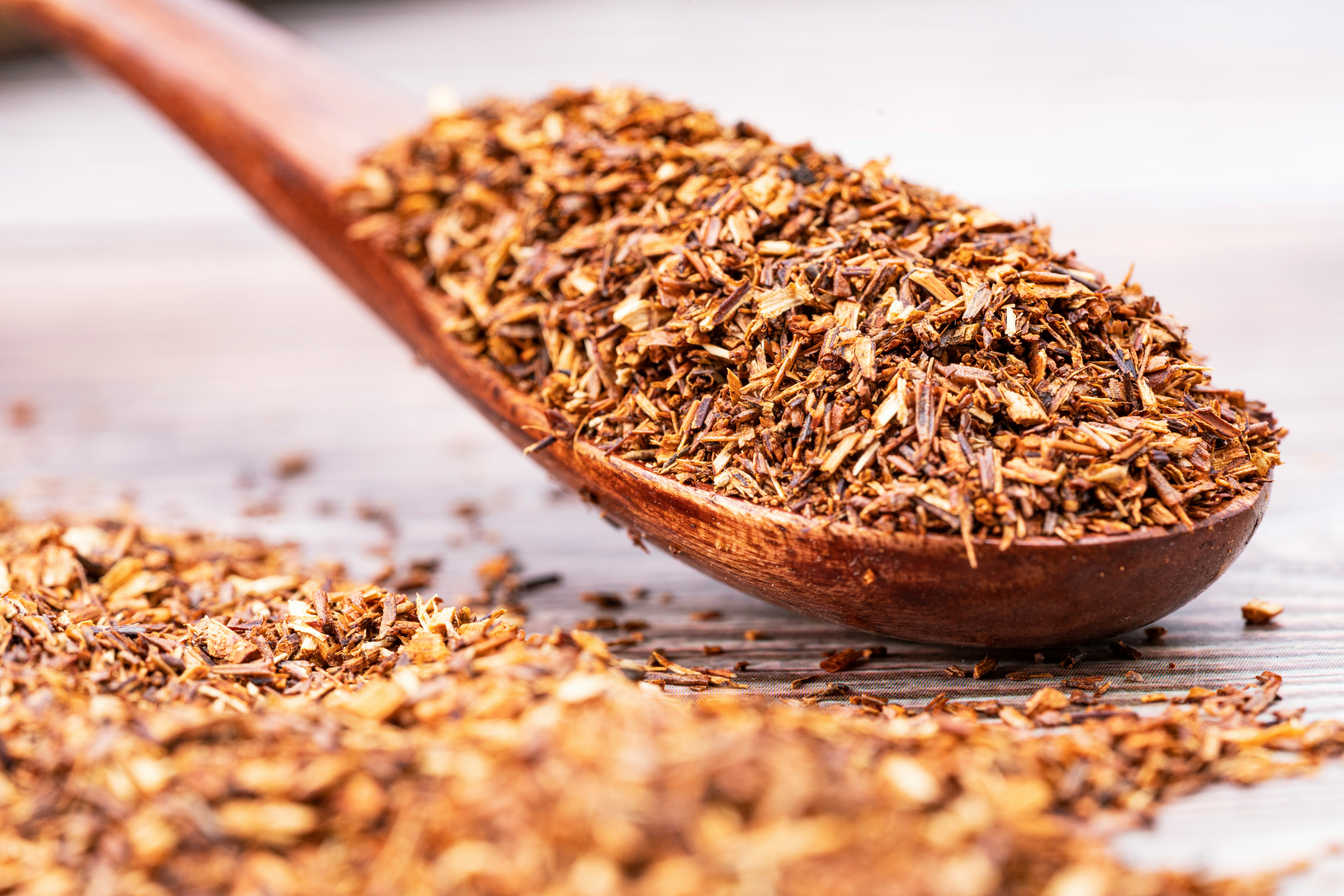
 South African Rooibos enjoys the advantage of being single origin and does not encourage other countries to grow the naturally sweet, caffeine-free Rooibos. (Photo: TeaCora Rooibos on Unsplash)
 Rooibos reached milestone exports in 2025. The South African Rooibos Council (SARC) reports that exports passed the 10,000-tonne mark for the first time last year, now reaching more than 50 international markets with Japan retaining its position as the biggest overseas buyer of the South African tea. Emerging markets, such as Indonesia, Sri Lanka and China, are also showing promising momentum. Reaching approximately 10,930 tonnes up from 5,900 tonnes in 2015, Rooibos continues to prove its steady-growing international relevance.
/file/attachments/2988/19Gemini_Generated_Image_7amqu17amqu17amq_179863.jpg "Graphic created by Neesa Moodley using Gemini.")
These are export darling numbers – showing consistent year-on-year growth and breaking previous volume records. However, production dropped from 17,000 tonnes in 2023 to 15,000 tonnes last year. This, combined with climate uncertainty, potentially presents some tension for the industry.
The story of Rooibos
Rooibos can only be grown in one place on earth: the Cederberg region in South Africa’s Western Cape. It is legally a tisane, or botanical drink, but is mostly grouped with other teas. Grown elsewhere, it would not hold the same quality or flavour profile. With deep roots in the region’s rural communities, Rooibos is beloved both locally and abroad.
While the tea market forms a relatively small share of the country’s agricultural sector, it is still on par with the broader sector in that it focuses heavily on exports, according to Wandile Sihlobo, Chief Economist at the Agricultural Business Chamber of SA.
“The SA agricultural sector, now including fruit, grains, meat and tea, exported in 2025 a record $15.1-billion,” said Sihlobo. “That is up 10% from 2024; we now as a farming sector are exporting about half of what we produce in value terms.”
The opening of new markets certainly benefits the tea industry. And with its distinct taste and quality, lower volumes are not necessarily a threat to Rooibos.
“Rooibos is not a volume-driven commodity,” says Dawie de Villiers, chairperson of the SA Rooibos Council. “Its long-term value lies in quality, origin integrity and responsible stewardship.”
Sihlobo agrees with this sentiment and says that lower production does not mean people will seek alternatives.
“South African rooibos is distinct, and I think that its supply constraint at particular points is not necessarily a hindrance to an extent that people could move into other markets,” says Sihlobo. “But we do need consistency.”
SA enjoys the advantage of being single origin and does not encourage other countries to grow the naturally sweet, caffeine-free Rooibos, but this can be a bit of a double-edged sword.
“On the one side, it’s nice to be [the] supplying country of Rooibos,” says De Villiers. “But on the other hand, someone with a brand who’s considering putting rooibos into their brand might think twice because of their exposure to one particular area.”
But the industry has ways of dealing with demand, says De Villiers. Traditionally in times of oversupply, Rooibos is stockpiled. These stockpiles come into play when necessary during periods of short supply. He adds that while Rooibos is a resilient crop, harvestable on a small amount of moisture per year, research and farmers experimenting with the plant are critical to softening the climate effect in the long run.
Unique crop calls for unique farming solutions
For Richard Bowsher, managing director at the family-owned Klipopmekaar Rooibos farm and co-founder of BOS Brands, which brought us Bos Ice Tea, his focus from the beginning of his 18-year-long Rooibos farming career has been soil health. As one of the largest organic Rooibos farms in the industry, Klipopmekaar makes use of ethical and organic farming practices. They are also a carbon net-negative Rooibos producer.
This means that Klipopmekaar has drastically reduced carbon emissions across its entire value chain.
“Our focus when we started building our farm has been soil health, increasing organic matter and carbon in our soils to improve soil water retention, and to improve soil health in general and therefore crop health and crop yield over the long term,” says Bowsher.
He says they began measuring their soil’s nutrients and carbon levels using third-party soil analysts, and came to the conclusion that a large amount of carbon was trapped in their soil.
/file/dailymaverick/wp-content/uploads/2025/05/Red-Espresso_20.jpg "A farmer uses a tractor to spread piles of fermenting rooibos across the surface of large drying courts on a farm in the Cederberg Mountains in South Africa. Photo: Supplied")
“We included in our footprint not only the production on farm, but the downstream secondary processing, which includes pasteurisation and packing, and then the onward transportation and shipping of our bulk pack rooibos containers to our clients worldwide,” he says.
Bowsher adds that by changing farming methods to regenerative and organic agricultural methods, they could scientifically prove that they had trapped enough carbon to theoretically trade as a carbon net-zero supplier of Rooibos for the next 80 years.
This is attractive to international clients, he says, particularly the European market.
Why is carbon net-zero important?
The European Union’s Carbon Border Adjustment Mechanism (CBAM)forms a key component of its sustainability legislation that became fully operational in 2026.
CBAM is an EU policy that:
🌿Imposes a carbon price on certain imported goods.
🌿Mirrors the carbon cost EU producers already pay under the EU Emissions Trading System (ETS).
🌿Ensures imported products face a similar climate cost to EU-made goods.
Read more: EU carbon price on imports ‘violates’ WTO rules, says Patel as SA heads for clash with bloc
Sihlobo says while climate change presents a level of risk for the agricultural industry at large, the industry must also evolve in its production methods in order to adapt. DM