




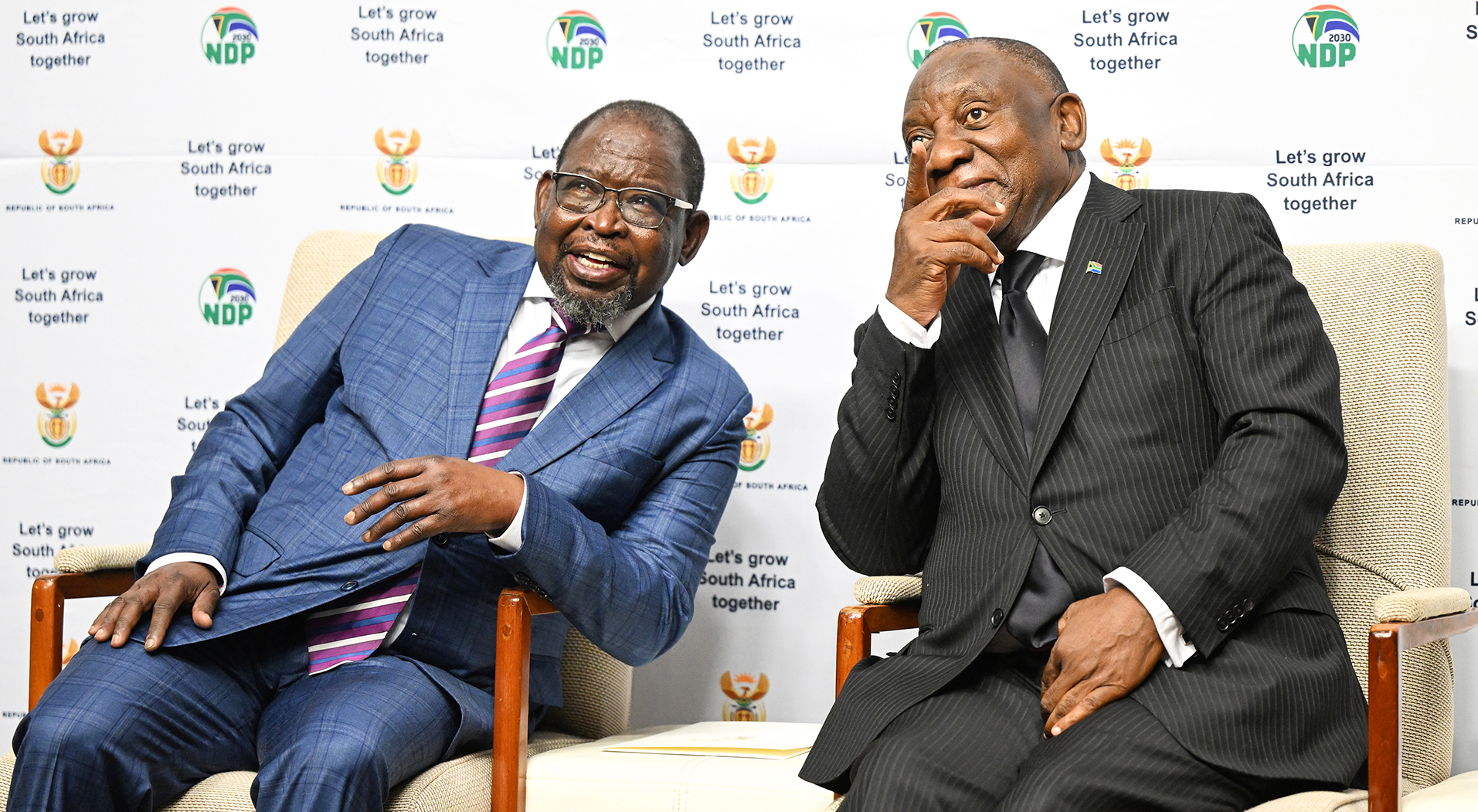
 President Cyril Ramaphosa and Finance Minister Enoch Godongwana at the launch of the G20 presidency. (Photo: Phando Jikelo / Parliament of SA)
 The 2026 State of the Nation Address (Sona) set a high bar for transformative change and task forces, focusing on massive infrastructure leads and an expanded social safety net.
However, the National Treasury’s chequebook has a way of grounding political ambition in fiscal reality. Daily Maverick has conducted an audit of the President’s promises against the numbers revealed in this Budget 2026.
The biggest surprises
While the President told South Africa that the government would commit more than R156-billion in public funding for water and sanitation infrastructure over the next three years, Treasury allocated 18.7% more for the same period.
These funds could prove to be a vital lifeline for the crumbling infrastructure found in metros like Johannesburg, where Finance Minister Enoch Godogwana said the national government has “no option but to go” and intervene.
The intensified focus on active structural intervention in failing local governments and metropolitan trading services in both the Sona and the Budget might signal some hope yet for those tired, sluggish municipal services and high rates.
Not that this is a surprise, but if you’re a woman living in South Africa, having your frustrations heard, acknowledged and then receive funding might leave one a little shocked given our history with gender-based violence (GBV).
After declaring GBV a national disaster in 2025 following widespread outcry and protest across the country, Ramaphosa began his Sona speech commemorating the Women’s March of 1956. The 2026 Budget allocates an additional R135.8-million to the Department of Women, Youth, and Persons with Disabilities over the medium term.
The execution
The Treasury does a good job of providing the capital. But, as always, the capable state remains a bottleneck.
The R1.07-trillion for public sector infrastructure expenditure over the medium term is ambitious, but with the state managing 88,000 buildings and five million hectares of land, the risk of mismanagement is high because of historical project delays, weak contract management and poor construction quality.
Funding for failing municipalities is now tied to performance-linked reforms for metro trading services (electricity, water, sanitation and solid waste). The implementation thereof depends on political will that money can’t buy. In his speech, Godongwana issued a warning on this condition.
“The reform, however, goes beyond the performance-based grant structure,” he said. “It entrenches operational and financial management reform. Under the new system, failure to meet reform and operational targets will result in budgets being reduced. This will strengthen accountability and governance, enabling long term infrastructure investment.”
Operation Vulindlela
“Through Operation Vulindlela [OV], we have made significant progress in accelerating economic reform and opening the way for investment and competition,” Ramaphosa said on 12 February.
Included in the 2026 Budget Overview document, the financial buffs working for the Treasury did their own overview on exactly how OV is progressing.
Some of the impact of the completed reform activities mentioned above include:
- Private sector contributions have unlocked more than 23,900 MW of new capacity, primarily through renewable energy projects.
- A notable turnaround in the functional efficiency of Eskom’s power generation.
- A downward trend in freight rail throughput will be halted, leading to a more consistent flow of goods.
- The market price for a 1.5GB data package could be slashed by more than half.
- Regulatory hurdles for water use licences could also be streamlined, cutting the typical processing time from 300 days down to 90.
The missing pieces
In his address, Ramaphosa also mentioned the establishment of specialised courts for commercial matters. This did not receive a dedicated line item in the 2026 Budget.
Godongwana acknowledged this delay and explained that once the costing is finalised, allocations will be considered later in 2026.
After recent protests in Cape Town and Pretoria by workers in the film and TV industries about failing and stalled incentive schemes, the director-general of the National Treasury, Dr Duncan Pieterse, addressed the issue with the media.
Pieterse explained that it’s been a long time since government incentive schemes were reviewed, but that Treasury is developing new mechanisms to earmark underfunded and underperforming incentives to reorganise the budget. DM