
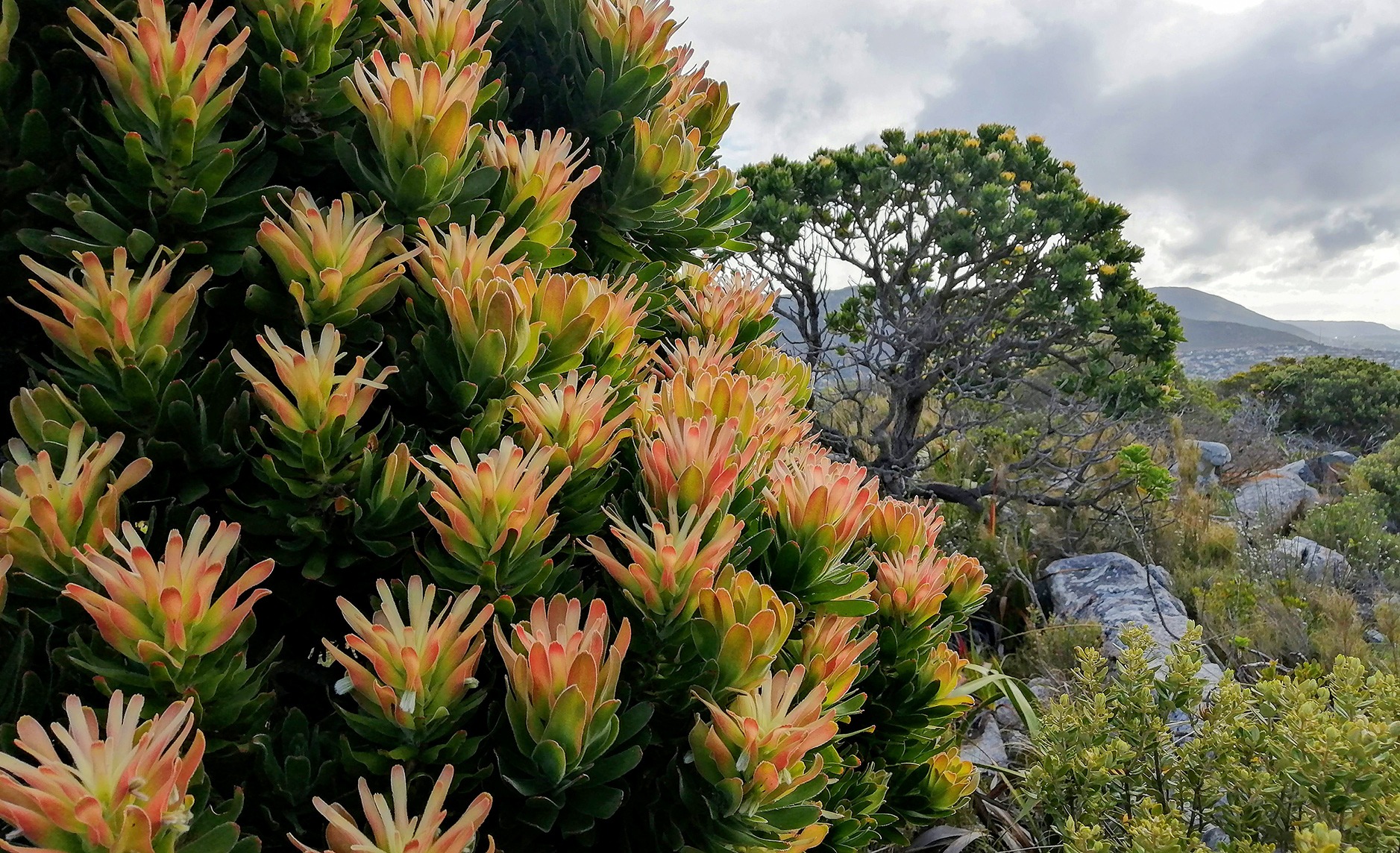
 Mimetes fimbriifolius, a large and charismatic Cape Peninsula endemic. (Photo: Jasper Slingsby)
 /file/attachments/orphans/storiedmountainlogo_692149.png)
If you walk Table Mountain often enough, it starts to feel familiar. You recognise the turns in the path, the reliable views, the way the wind always seems to arrive five minutes before you do.
And yet, according to Dr Jasper Slingsby, a botanist at the University of Cape Town, this sense of familiarity is mostly an illusion. The mountain you think you know is only showing you a thin, polite surface layer.
Below that is a system that has been quietly negotiating survival for tens of millions of years.
Slingsby grew up walking mountains — his father is the legendary mapmaker Peter Slingsby — but that detail is less origin story than background. He doesn’t remember a clear moment when plants stopped being “green stuff” and became individuals. They simply always were. Names were supplied. Questions were answered. Curiosity had something to grip onto.
What fascinates him now is not just what grows on Table Mountain, but why it’s able to grow this way at all. And the answer, almost always, comes back to time.
/file/attachments/orphans/IMG_20210102_163351_556016.jpg "The King. Flowering Protea cynaroides never fail to leave an impression. (Photo: Jasper Slingsby)")
/file/attachments/orphans/IMG_0037_800979.jpg "Gethyllis kaapensis, endemic to the Cape Peninsula. (Photo: Jasper Slingsby)")
The Table Mountain chain is staggeringly old. The rock beneath your feet is more than 500 million years in the making. The plants are younger — but still ancient by ecological standards. Crucially, this entire system has enjoyed a rare privilege: it has never been wiped clean by ice.
While huge parts of the Northern Hemisphere were bulldozed by glaciers as recently as 12,000 years ago, resetting ecosystems and erasing evolutionary experiments, the Cape escaped. No glacial scorched earth. No biological reboot. Just long stretches of relative continuity, punctuated by climate shifts, fires, and droughts — but never obliteration.
That absence of ice is one of the quiet superpowers of fynbos.
Because nothing was reset, life had time to specialise. And specialise it did. The result is a flora that looks understated at first glance — small leaves, muted colours, wiry forms — but turns out to be wildly sophisticated. This is not minimalism born of scarcity. It’s refinement born of patience.
One of the most misleading things about fynbos is how complete it appears. You walk through a patch, admire what’s flowering, and assume that’s what’s there. In reality, you’re seeing only a snapshot in a long, looping cycle.
/file/attachments/orphans/IMG_20210801_094829_568143.jpg "New shoots of Maurocenia frangula, a small tree common in areas such as Kroon se Bos and Spes Bona forest above Kalk Bay and St James. (Photo: Jasper Slingsby)")
A hidden archive
Many species spend most of their lives invisible, waiting underground as seeds. Some only appear briefly after fire. Others arrive years later. Many don’t show up at all unless the timing is perfect.
Ecologists sometimes call this the “seed bank”, but that’s like calling a university library a bookshelf. Slingsby prefers to think of it as a huge hidden archive: a subterranean library of potential, stocked over millennia. Entire species can be present at a site without leaving any visible trace for decades.
This makes fynbos both magical and maddening to manage. You can send a botanist out to survey a site, tick off every plant they see and still miss half the story. Come back a year later, or after a fire, and the cast has changed. Environmental impact assessments, which generally rely on single visits, struggle badly with this. What looks empty may be waiting. What looks stable may be on the verge of disappearing.
Fire, of course, is the great editor of this library. In popular imagination, fire is either villain or hero – catastrophe or cleansing. In fynbos, it’s neither. It’s more like punctuation. Most species evolved with fire as a regular event, but not an arbitrary one. Timing matters. Frequency matters. A fire at the wrong interval can wipe out species just as effectively as no fire at all.
/file/attachments/orphans/IMG_0004_818750.jpg "Cyrtanthus ventricosus, a fire-lily species most commonly seen in the first few weeks after a fire. (Photo: Jasper Slingsby)")
/file/attachments/orphans/20260222_074206_340065.jpg "Glittering silver trees have an amazing ability to spring back after fires. (Photo: Don Pinnock)")
Humans, unfortunately, have become enthusiastic but clumsy editors. We introduce too many ignitions in some places, suppress fire entirely in others, and fragment the landscape so fires can’t move the way they once did. The result is a slow distortion of the system.
Fynbos quietly gives way to forest in damp valleys where fire no longer reaches. In drier areas, invasive plants move in, altering fuel loads and chemistry. None of this looks dramatic — until one day the fynbos simply isn’t there any more.
/file/attachments/orphans/IMG_7166_510522.heic "Erica verticillata, formerly extinct in the wild, but now restored to multiple sites. (Photo: Jasper Slingsby)")
/file/attachments/orphans/20251005_085142_888477.jpg "In spring, Devil’s Peak is a flower garden on steroids. (Photo: Don Pinnock)")
Spend enough time on the mountain and certain plants begin to feel like elders. Not just the obvious giants — the yellowwoods and sprawling forest trees — but also modest-looking species that have been quietly resprouting, cloning and persisting for centuries. Some sedges on Table Mountain appear unchanged in photographs taken a hundred years apart.
Orchids form large clonal patches underground, patiently waiting for a brief window to flower. They are, in fact, a masterclass in fynbos weirdness.
Their seeds are dust-sized — almost nothing but genetic instructions. They travel easily, but can only germinate if they encounter exactly the right fungus in the soil. No fungus, no orchid. And once established, many require a specific pollinator to reproduce — sometimes a single species of bee or fly.
Which means an orchid’s life depends on a three-way negotiation between plant, fungus and insect, all of which had to evolve together, in the same place, over very long periods of time. This is what you get when the ice never comes.
Some relationships are even stranger. Certain fynbos plants rely on ants to carry seeds underground, protecting them from fire. Others use rodents. One large restio species produces seeds the size of squash balls, which are buried by dung beetles fooled by chemical cues that mimic animal droppings. The beetles roll the seeds away and bury them, convinced they’ve found treasure.
It’s hard not to admire the elegance of that con.
Below ground, things get busier still. Fynbos soils are shallow, sandy and nutrient-poor, yet they support astonishing diversity thanks to intimate partnerships with fungi. Mycorrhizal networks lace through the soil, helping plants access scarce nutrients.
These underground systems were once thought to be relatively simple. New DNA techniques are revealing them to be complex, species-rich and highly specific — an entire hidden ecology operating just beneath your boots.
Eyes in the sky
And now, interestingly, we can see much of this complexity from space.
Slingsby works not only with muddy boots but with satellites. Modern remote sensing has moved far beyond “green equals plants, grey equals concrete”. Today’s sensors can measure vegetation height to the centimetre, estimate biomass, map habitat structure and even infer chemical properties of plants.
Satellites can now record reflected light across dozens or even hundreds of narrow spectral bands. To the human eye, plants are green. To a hyperspectral sensor, they’re a barcode. Water content, nitrogen levels, leaf structure — all leave subtle signatures in how light is absorbed and reflected. Different species produce different spectral fingerprints.
In practical terms, this means scientists can increasingly identify not just vegetation types, but specific species, across entire landscapes. Individual trees can be mapped. Changes tracked year by year. Nutrient patterns inferred from orbit. It’s an extraordinary leap in scale and precision.
And yet, data still lie sometimes. Or rather, they tell partial truths. Landscapes behave in ways models don’t always predict. Which is why Slingsby insists that satellite views and standing still on the ground must work together. One gives reach. The other gives meaning.
Standing still, for instance, teaches you about smell. The sharp tang of petrichor (earthy tang) after rain. The matchbox-like scent of sandstone soil. The unmistakable poo-smelling note of blister bush. These cues often register change before datasets do.
With knowledge comes grief, too. Slingsby speaks openly about mourning plant communities lost to invasive species, altered fire regimes and climate stress. Some losses are already under way. Others are unfolding quietly, without headlines.
And yet, studying plants has also made him strangely hopeful. Once you learn how to look, life appears everywhere — even in weeds pushing through pavement cracks. Given enough time, life adapts. It always has.
If Table Mountain were to send us a postcard in a million years, it might be harsh. But might also be understanding. It has the advantage of witnessing change in deep time, and we are but a brief phenomenon.
It is patient. And patience, it turns out, can build astonishing things. DM
Read the full Table Mountain series:
• The flat mountain that wouldn’t behave
• What is Table Mountain? A story of Deep Time
• Hotter, drier, wilder: reinventing conservation for a changing climate
• Table Mountain’s green cloak that took 60 million years to weave
• The fluid intelligence of Table Mountain’s rivers
• What it takes to keep Table Mountain wild
• Rough sleepers: The mountain keeps us
• Cormac Cullinan: thinking like a mountain, listening like a river