




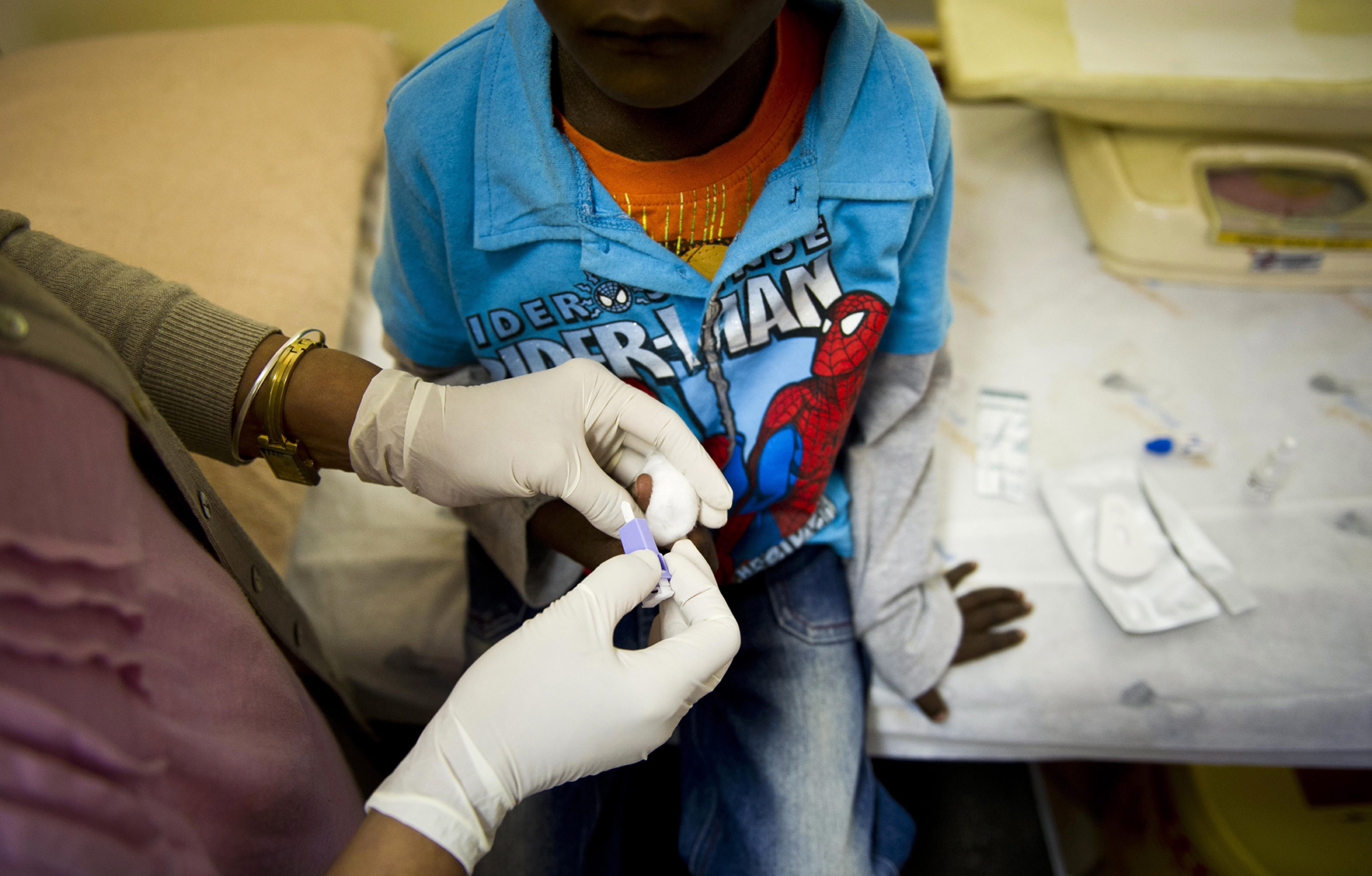
 A boy is tested for HIV at the Right To Care Aids clinic in Johannesburg, which was funded by Pepfar. (Photo: Cornel van Heerden / Gallo Images / Foto24)
 It has been exactly a year since the United States Agency for International Development (USAID) issued notices to HIV organisations in South Africa funded by Pepfar (President’s Emergency Plan for Aids Relief), terminating its funding for good.
The decision followed on the heels of US President Donald Trump’s executive order imposing a 90-day freeze on almost all foreign development assistance pending a review. The major funding cuts sent shockwaves through the HIV sector in South Africa and around the world, as organisations faced the collapse of key services.
More recently, on 3 February 2026, Trump signed a bipartisan $5.88-billion spending package into law, with the aim of reinforcing “the continued commitment and leadership of the United States in the global response to HIV”, according to the Joint United Nations Programme on HIV/Aids (UNAids).
The package included:
- $4.6-billion for bilateral HIV support through the America First Global Health Strategy;
- $1.25-billion to the Global Fund to Fight Aids, Tuberculosis and Malaria; and
- US$45-million for UNAids.
While this appears to be a welcome boost for the international fight against HIV, what significance does it hold for South Africa?
/file/attachments/orphans/GettyImages-2202134548_344427.jpg "Demonstrators, some of them former Pepfar and USAID employees, protest on Capitol Hill in Washington, DC, on 26 February 2025, demanding the reinstatement of lifesaving programmes. (Photo: Chip Somodevilla / Getty Images)")
Benefits through the global system
Dr Kate Rees, a public health specialist at the Anova Health Institute, noted that money funnelled into the Global Fund, UNAids and other international health agencies is of benefit to South Africa, as the country is part of the global ecosystem tied in with these organisations.
“Continuation and continuity for those [agencies] is really positive for us,” she said.
Anova lost all its Pepfar funding during the US cuts last year, but continues to run HIV intervention programmes, largely focused on the key populations vulnerable to the disease. It receives support from the Global Fund, which Rees described as a “really important funder of HIV programming in South Africa”.
However, Rees added that South African health programmes were unlikely to benefit directly from the US funding.
“Where we are not going to see money is directly into South Africa. It’s very unlikely that any of that [US] money will come to South Africa to fund our programmes, but we […] weren’t expecting that,” she said.
/file/attachments/2985/00001547253_506779_b75c6b84977c1bbdba619807ac7b57b2.jpg "The Right to Care Aids clinic in Johannesburg, which was supported by Pepfar. (Photo: Cornel van Heerden /Foto24 / Gallo Images)")
This sentiment was echoed by Professor Francois Venter, clinician researcher at Wits University and renowned HIV research scientist. He said the programmes the US funding package would feed into provided a range of technical support mechanisms across the globe.
“It’s not going to be the kind of benefit that’s going to drag us out of the mess that we’re in at the moment.”
“I think there will be benefit [for South Africa]. It’s not going to be the kind of benefit that’s going to drag us out of the mess that we’re in at the moment. For that, we need a government that’s really nimble, who’s thinking creatively, who’s really putting all the experts in the room on an almost weekly basis […] saying how things are going; what can we learn; what are we doing?” said Venter.
Gaps in the system
When asked where the South African HIV sector stood, one year after the US funding cuts, Venter said things looked “every bit as grim as we predicted”.
“We’ve seen the near complete destruction of our key population programme, which is where probably half of all new infections were happening, and no indication that it’s come back,” he said.
“The government keeps saying that these services have magically occurred elsewhere. There’s no indication of where this has happened, and there’s no indication that people are receiving these services. We actually interview people – sex workers, people from the LGBTI community, drug users – who are meant to be receiving these services, who tell us, no, they’re not receiving these services.”
/file/dailymaverick/wp-content/uploads/2025/10/12796793-scaled-1.jpg "A protester outside the USAID headquarters in Washington, DC, on 3 February 2025. (Photo: Will Oliver / EPA-EFE)")
Professor Linda-Gail Bekker, CEO of the Desmond Tutu Health Foundation and director of the Desmond Tutu HIV Centre, raised concerns around data collection in the wake of the Pepfar withdrawal through USAID.
“We heard early reports that there was less testing, less people getting onto antiretrovirals, less [HIV] viral load [tests] being done. But is the data being systematically collected? Are we moving forward? Are we just holding the fort, or are we actually sliding back?” she asked.
“I think there’s concern that a lot of the mechanisms for data collection were actually in these foreign aid programmes, and we’re going to have to grapple with trying to put something back in place across the board.”
“We’ve come to terms with the fact that the money is going to be less, that the situation from a finance point of view is pretty dire, but that we’ve got to still get on with the job.”
While there is gratitude in the sector for entities such as the Global Fund, and even continued Pepfar funding in some regions, Bekker noted that many stakeholders have accepted the reality that countries are going to need to do more with less.
“We’ve come to terms with the fact that the money is going to be less, that the situation from a finance point of view is pretty dire, but that we’ve got to still get on with the job,” she said.
In October 2025, the South African government announced that the US had approved a Pepfar Bridge Plan for South Africa to the value of US$115-million, which would be administered through the Centres for Disease Control and Prevention (CDC). This funding period is set to end on 31 March 2026, with no confirmation at this stage that any extension plan has been settled between the two countries.
“It does look like the CDC component of the Pepfar will be coming to a close at the end of March. And so it sounds like we are going to be pretty much on our own, except for Global Fund and any other funders that may come to the party,” Bekker said.
While Venter acknowledged that limited strategic funding for HIV programmes from the US would be beneficial, he warned against reliance on a partnership that had proved to be increasingly volatile.
“We saw what happened when they withdrew the funding overnight, literally overnight, in South Africa and across the region, and the sort of devastation that wrought. I think people have to be much more careful about taking funding in the future,” he said.
Daily Maverick reached out to the Department of Health about the status of funding agreements with the US heading into 2026, but had not received a response at the time of publishing.
Looking ahead
Prevention strategies for HIV had “taken a back seat” in South Africa since the US funding cuts, Rees said. She emphasised the need to fund and prioritise this aspect of the country’s HIV programme.
Rees said the South African roll-out of Lenacapavir, a new long-acting antiretroviral drug, is an exciting development, However, it needs to be paired with a robust budget, planning and prioritisation for prevention and testing.
“The [HIV] programme has to be redesigned. We’ve got less resources. We can’t rely on how the programme was designed underneath the Americans but we also can’t just leave the programme alone,” Venter said.
“What can we do as a country to protect what we’ve done, or reinvigorate or strengthen key structures [...] without doing another 10 years of research, while we watch the whole thing unravel.” DM