



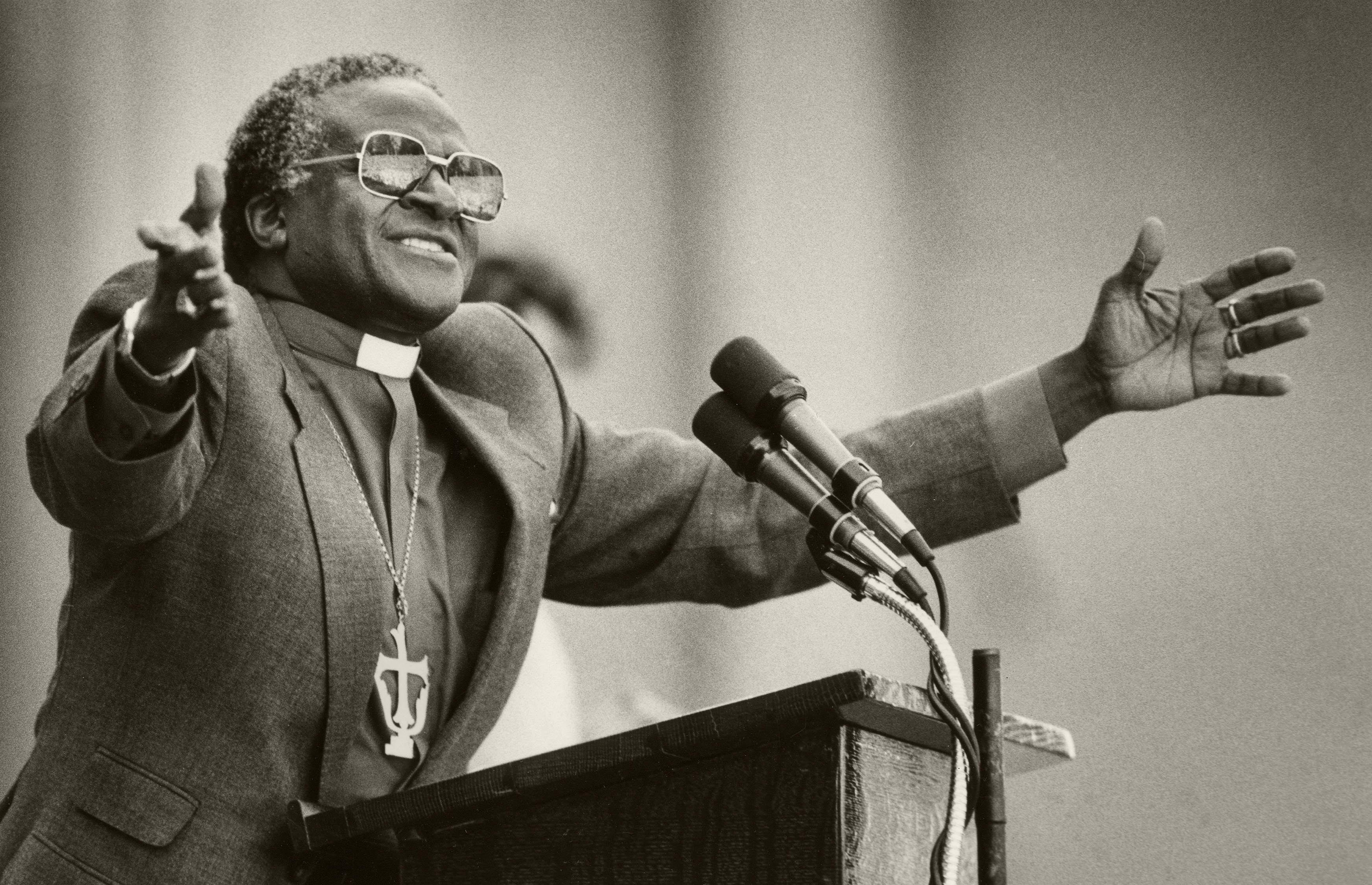
 Berlinale award-winning documentary Tutu is a layered exposition of Archbishop Desmond Tutu’s core foundational values. (Photo: Bromberger Hoover Photography / Getty)
 The feature-film-length documentary by award-winning African American director Sam Pollard, Tutu, is unapologetically political, but does not canonise or caricature the Arch, as the late Anglican Archbishop Emeritus Desmond Tutu is fondly known in South Africa.
It is a layered exposition of Tutu’s core foundational values that shaped his life between pulpit, protest, diplomacy and human rights, as an anti-apartheid activist, Anglican priest diffusing potentially lethal situations at funerals, 1984 Nobel peace prize laureate, first black Anglican archbishop, protest leader and lifelong human rights campaigner.
It would not have been possible without the footage from Benny Gool and Roger Friedman, two Cape Town journalists-turned-chroniclers who over 20-plus years of unprecedented proximity to the Arch and his family captured, as Friedman put it, “who he (Tutu) was as a human being”.
It’s moments like filming Tutu singing happy birthday and blowing kisses into a phone, reflective comments at a Norwegian retreat following his cancer diagnosis, and scenes of family life that show a friendly ribbing of the Arch. (Spoiler alert: despite his infectious laughter, Tutu couldn’t land a punchline.)
Conversations and filmed moments with Leah Tutu show her in her own right, with dignity and a delightful sense of humour, like changing the marriage vow to “for better and better” when the couple renewed their vows in July 2015.
This intimate footage provides the documentary’s rich texture, taking it beyond the headlines, official news and archival footage. Without Gool and Friedman’s footage and insights, this documentary might not have been made, or risen as it has above the usual documentary fare. It is the repudiation of the often cynical sniggers from some circles that sometimes met their project over the years.
Different approach
Crucially, Pollard takes a different approach to most.
He stays away from Tutu’s “Rainbow Nation” term, coined in the optimism of the 1994 democratic transition. Instead, the focus is on his core foundational beliefs and values, which allowed him to withstand more than just criticism from the apartheid government and security forces, and later the criticism from the ANC. As former president Nelson Mandela says in the documentary, Tutu’s comments were not always appreciated, even if the two leaders formed a strong bond.
“I wanted Tutu’s voice to be the heartbeat of the story, to let his humanity, humour and moral conviction lead us through his world,” said Pollard in his Berlinale production notes.
“His message to recognise our shared humanity; choosing love and tolerance has never mattered more than it does in our divided world today.”
With astute political focus, the documentary turns to Black Consciousness leader Steve Biko with footage of him speaking on dignity and a theme he frequently wrote about – how the mind of the oppressed is the most potent weapon of the oppressor. This part of South Africa’s political history, like the commemoration of ordinary people, is often minimised, if not forgotten, in favour of ANC liberation politics. Yet it had a proven impact in SA’s fight for democracy.
As a younger priest, Tutu spent at least a week with Biko less than two years before the Black Consciousness leader was killed while in police custody. Tutu led Biko’s 25 September 1977 funeral service, which turned into a mass political event with more than 20,000 people in attendance. And in October 2006 he returned to Biko’s tenets about psychological liberation and dignity in his Steve Biko memorial lecture at the University of Cape Town, highlighting a lifelong engagement.
The documentary is a timely reminder that even though Tutu was unable to change US president Ronald Reagan’s mind about the need for sanctions against apartheid South Africa when they met at the White House, it was a key moment of leverage for the international anti-apartheid movement. These international protests and global calls for Mandela’s release from prison and for sanctions played an important role in bringing about the end of apartheid.
In SA’s noisy, grinding and partisan politics, and the disillusionment caused by the democratic government’s failure to meaningfully reduce inequality and poverty, such contributions are often minimised or forgotten.
Rushed and compressed
Towards the end, the documentary, which is not a chronological account, nevertheless seems rushed and compresses years into a curated sequence.
Interviewees comment that Tutu, even in retirement from public life, maintained an interest in human rights matters globally and sought to address them.
The documentary looks not only at Tutu’s role in the UN peace envoy to Gaza, and his comments that the then blockade was illegal, but also a brief appearance at a music concert where he emphasises the fight against HIV, in which SA today remains the most affected country in the world.
Perhaps this inclusiveness and perspective is one of the reasons that Pollard’s documentary is hits all the right notes – involving Hidden Light, the independent UK production house with a track record of documentary awards, Universal Pictures and a list of executive producers that includes comedian, author and television host Trevor Noah, Ayanda Ntsaluba, the group executive director at Discovery Ltd, and British entrepreneur Sir Richard Branson.
Tutu is about a man whose humour, failings, devotion to prayer and being grounded in family and community are inseparable from his public leadership.
And the impact is clear in the documentary’s closing with Tutu’s unmistakable voice offering a blessing. DM