




 US President Donald Trump at a dinner with Israeli Prime Minister Benjamin Netanyahu at the White House on 7 July 2025. (Photo: EPA / Alexander Drago / Pool)
 On Monday, 23 February, the gold price climbed for the fourth day on a trot to a three-week high of $5,150 an ounce. The rand put in mild gains to break back below 16.0/dlr. And these gains were driven by the usual suspect: US President Donald Trump and his topsy-turvy tariff tiffs.
On Friday, 20 February, the US Supreme Court hit Trump with a snotklap of note, ruling that his sweeping tariffs – his signature economic policy – exceeded his authority.
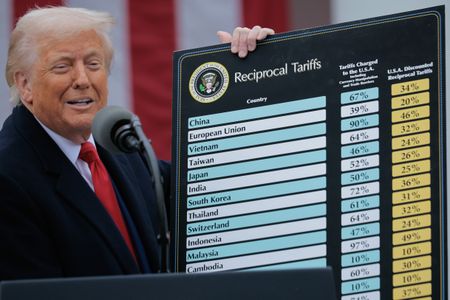
Trump immediately doubled down, imposing a 10% tariff on imports from all of America’s trading partners and then lifting it to 15% under under section 122 of the Trade Act of 1974. This quirky law allows the president to do so for up to 150 days in the face of trade deficits.
But amid the swirling confusion, the US customs agency has since said that a 10% duty will be imposed effective Tuesday, 24 February.
What comes next is anyone's guess – chaos is the only thing that is certain in the age of Trump – but for South Africa’s economy, the Trumpocene has been a double-edged sword and it will keep on swinging until he leaves office.
The good news
First, the good news: the 10% across-the-board tariff effectively levels the global playing field for all countries that are exporting to America, and slashes the 30% “reciprocal” tariff that South Africa faced by two-thirds.
The US is a major trading partner of South Africa’s and Trump’s protectionist policies have had a material impact on some export sectors of the economy.
Where to from here?
The US Supreme Court’s tariff decision is a jolt of note for South Africa’s economy. It has slashed the tariffs on many of South Africa’s exports to the US, while Trump’s reaction – not to mention the rising tensions around Iran, Greenland and who-knows-where-next? – will keep the gold price primed. Trump’s tariff and other policies have had inadvertent silver linings for South Africa’s economy.
Automotive sector
According to data compiled by the Automotive Business Council of South Africa – also confusingly called Naamsa – South African vehicle exports to North America plunged in 2025 to 6,530 from 25,544 in 2024. That represents a decline of almost 75%.
But South African automakers have been making a plan with other markets. Despite the dramatic contraction in the North American market, South African vehicle exports rose almost 6% in 2025 to a record 414,268 units.
“The economic partnership agreements with the EU and the UK ensured that the region dominated exports and accounted for a substantial 80.3%, or four out of every five vehicles exported in 2025, with 57,0% of light vehicle production destined for the region,” Naamsa said.
/file/attachments/orphans/2026-02-2412_15_30-Greenshot_952082.jpg "South African automobile exports by region. (Source: Naamsa)")
Still, the curtailment in exports to the US hurts and last year’s record number would have been more glittering were it not for this state of affairs.
“Vehicle exports to North America remained affected by the section 232 protectionist automotive duty imposed by the US, but exports to Canada increased during the quarter. The volume loss to the US is an issue for the full supply chain for OEMs as any volumes lost have a knock-on impact on upstream suppliers, volume efficiencies and more,” Naamsa said.
But slashing of the tariffs now holds the promise of a boost for all South African export sectors that were subject to the 30% duty.
Agricultural sector
South Africa’s agricultural exports tanked by 39% in the fourth quarter of last year to $81-million.
“For us in South Africa’s agriculture, our competitors in the US market faced much lower tariffs, around 10%, and managed to take our market share in some products. With the new tariff possibility, we will likely be competitive in the US market again,” noted Agbiz chief economist Wandile Sihlobo.
/file/attachments/orphans/13768746_549418.jpg "A trader works on the New York Stock Exchange trading floor as US President Donald Trump holds a press conference in New York on 20 February 2026. Trump was speaking about the Supreme Court ruling that he exceeded his authority when imposing sweeping tariffs using a law reserved for a national emergency. (Photo: EPA / Sarah Yenesel)")
The US only accounts for 4% of South Africa’s agricultural exports – citrus, berries, wine, pears and ostrich products are among the main items – but every export opportunity counts and the US as the world’s largest market is one where you want to grow rather than shrink your share.
Precious metals
And one key sector of South Africa’s export economy has not been directly affected by Trump’s tariffs: precious metals. Gold and platinum group metals are excluded from his tariffs.
South Africa’s gold sector has profited handsomely from Trump’s tariffs and the wider geopolitical chaos unleashed by his helter-skelter administration. Gold’s record run last year and this year – breaching $3,000 an ounce, then $4,000, then $5,000 this year – has been underpinned by a range of factors.
But the biggest one has been Trump’s madness and mayhem. That looks set to stay the course as the Supreme Court rebuke to his tariff policies has backed him into a policy corner and he will swing around wildly for any path to reimpose them.
For Trump, tariffs are an article of faith: he believes in them and facts will never sway him. Trump and his MAGA movement have effectively morphed into fascism, and fascists have scant interest in the truth. Witness the ludicrous allegations of “white genocide” and land seizures here in South Africa.
This all bodes well for the gold price and by extension the rand – and the taxes and royalties paid by South African producers. In trade terms, this makes South African imports cheaper and exports more costly. But while South African exporters such as the gold producers wince when the rand makes a gain, gold’s price has removed the pain and they also import a lot of stuff. DM