




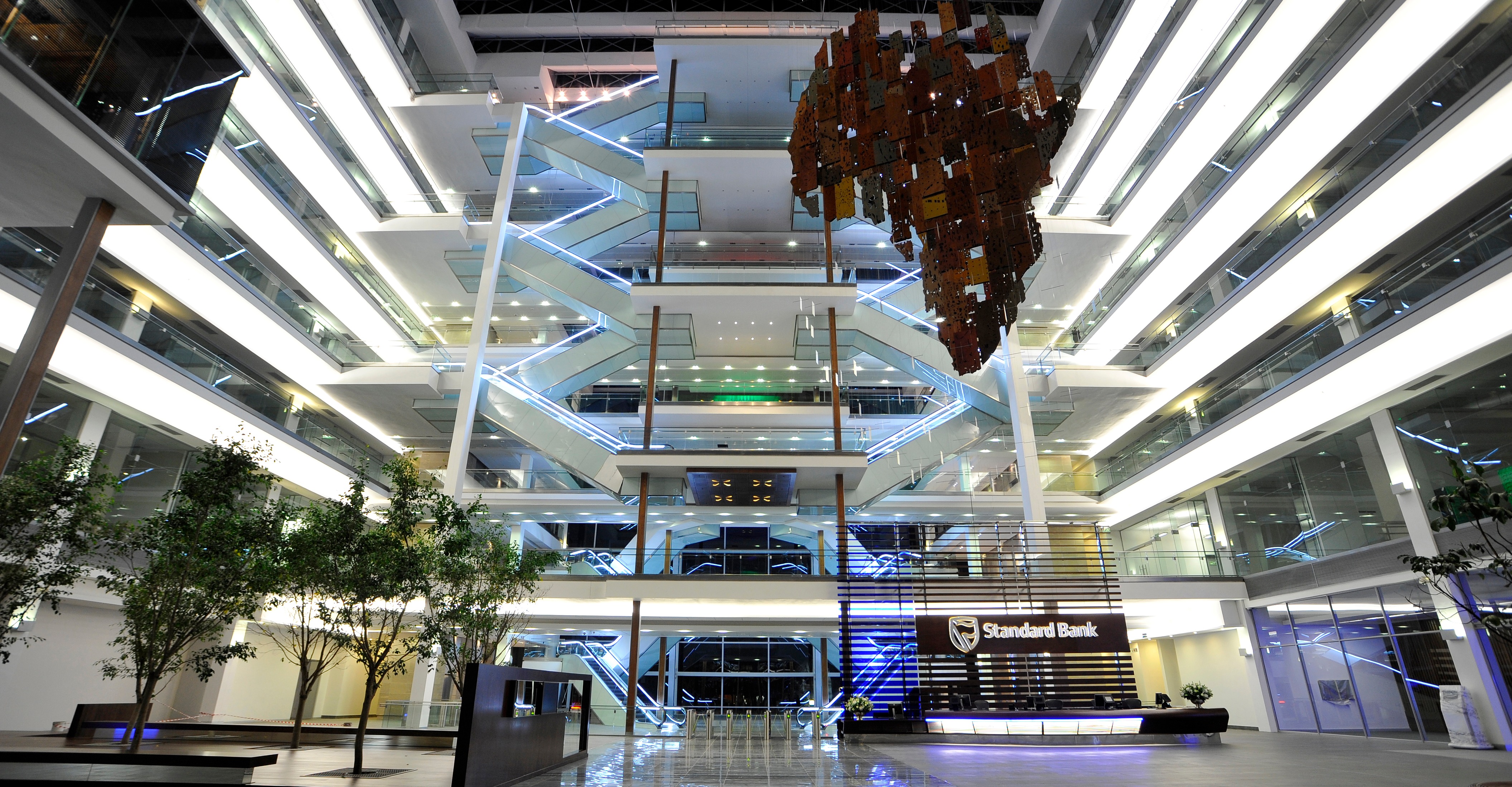
 Inside Standard Bank head office.
 The programme positions South Africa’s loss and damage agenda within national and global climate discourse, accelerating the operationalisation of the National Loss and Damage Programme through public private partnerships and robust data systems that strengthen planning and preparedness for unavoidable climate impacts. The partnership will prioritise research into both economic and non-economic losses, develop indicators to inform compensation and support mechanisms, and enable collaboration with communities, government departments and international organisations.
Pearl Phoolo, Standard Bank Head of CSI says: “Addressing loss and damage from environmental events requires more than emergency relief, it demands rigorous research, systems thinking, and policy innovation rooted in Africa’s realities. Standard Bank’s support of the Unisa Climate Disaster CILD research programme is a strategic investment in knowledge that strengthens national climate adaptation discussions, advances disaster risk reduction, and delivers inclusive and evidence-based solutions for communities most exposed to environmental shocks.”
This commitment reflects the growing urgency signalled by South Africa’s leading public institutions. The South African Weather Service (SAWS) reports that 2024 was the country’s hottest year in records dating back to 1951, with the annual mean temperature about 0.9°C above the 1991–2020 average, consistent with a long-term warming trend. Statistics South Africa (Stats SA) similarly noted November 2023 heat records at more than ten stations, including a maximum of 46.7°C at Augrabies Falls, and highlighted the knock on impacts of heat stress on crop yields and livestock.
Phoolo added: “When climate extremes hit, data matters. Reliable, locally grounded research, linked to practical indicators and early warning systems, helps decision makers act sooner, target support better and measure what communities actually lose. That is what this partnership is designed to deliver.”
UNISA’s ISCC, led by Prof. Godwell Nhamo, has collaborated with DFFE since 2023 to co create a national loss and damage programme that translates global debates into local realities. “Loss and damage is no longer a future risk; it is a present and lived reality for many communities in Southern Africa,” said Prof. Nhamo. “This partnership allows us to generate context specific evidence that can inform policy, support affected communities and ensure that loss and damage is treated as a development and justice issue, not just an environmental one.”
Outcomes of the programme should generate robust analyses of economic losses (such as damage to assets, crops and incomes) and non-economic losses (including cultural heritage, ecosystem services and psychosocial impacts), enabling evidence-based decisions at national, provincial and municipal levels.
In developing tailored loss and damage indicators and monitoring tools, the initiative will help public agencies and communities quantify impacts over time, inform compensation and support mechanisms, and track the effectiveness of resilience investments.
The programme will cultivate a pipeline of South African researchers and practitioners able to link climate science with social policy and budgeting, ensuring that the country’s adaptation and disaster risk reduction agenda remains rooted in local knowledge and practical delivery.
In investing in UNISA’s loss and damage research, Standard Bank is contributing to the knowledge, partnerships and practical tools South Africa needs to protect people, ecosystems and the economy. The more we understand our climate impacts today, the better we are able to plan for tomorrow. DM
/file/dailymaverick/wp-content/uploads/2025/08/SB_Primary_Full_Colour_Logo_Horizontal_RGB-2.png)