



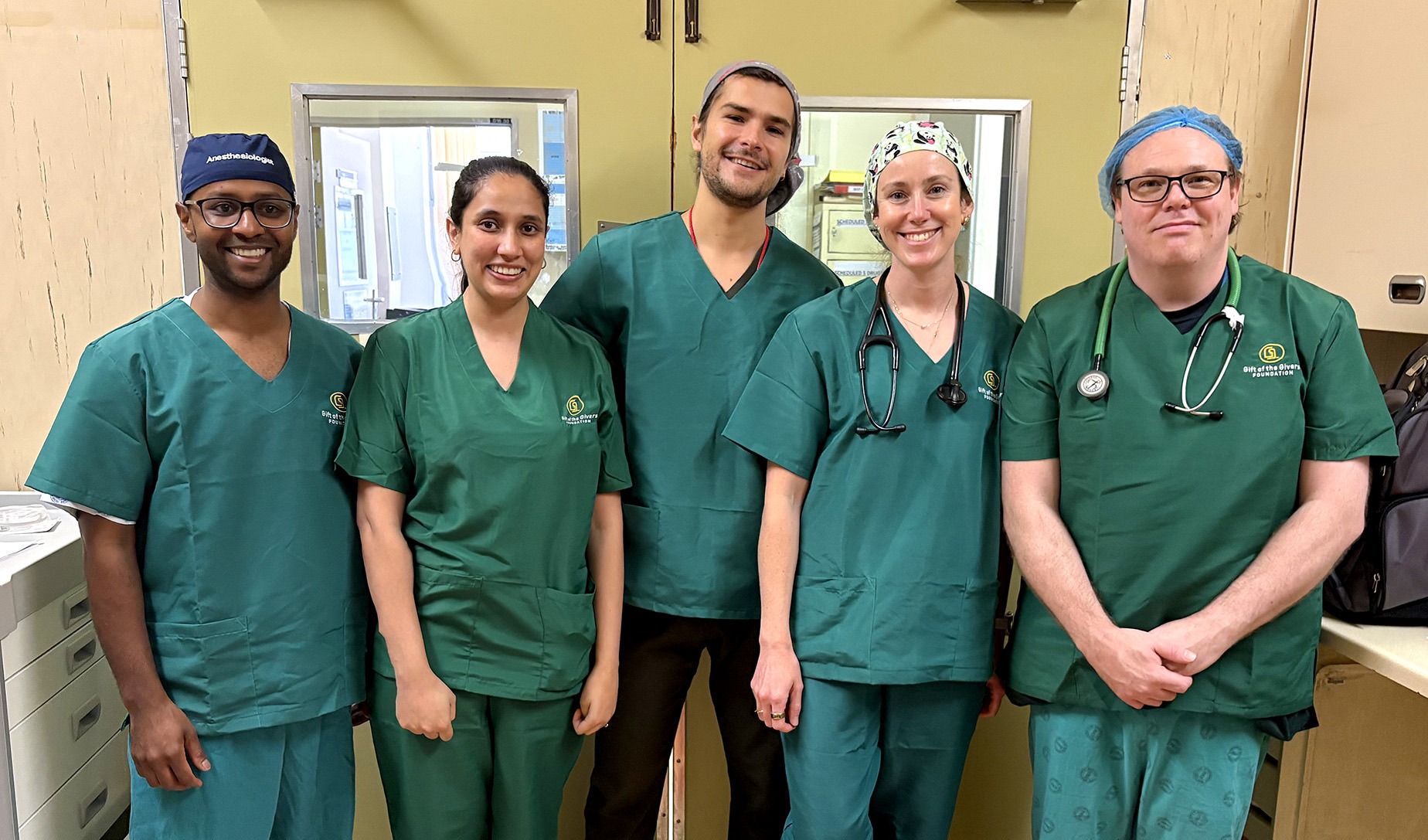
 Dr Dinell Bihari (anaesthetics), Dr Aayesha Soni (neurology and project lead), Dr Alessio Giuricich (anaesthetics), Dr Alison Kouverallis (anaesthetics) and Dr Heinrich Weeber (anaesthetics) at the epilepsy surgery initiative held at Groote Schuur Hospital on 21 February 2026. (Photo: Aayesha Soni)
 In a public health system under pressure due to resource constraints and high patient loads, it is not uncommon for some patients to wait long periods for medical procedures, particularly if their conditions require elective rather than emergency surgeries.
In response, some doctors are going above and beyond to help ensure greater equitability in access to care. That is what happened on Saturday, 21 February 2026, when specialists from the public and private sectors came together for an epilepsy surgery initiative at Groote Schuur Hospital in Cape Town, which brought relief for two patients who had been waiting for surgery for two years.
The Restoring Independence through Surgery for Epilepsy (Rise) initiative aims to provide ring-fenced epilepsy surgery theatre lists at the hospital, facilitating surgical care for adults with drug-resistant focal epilepsy.
“Epilepsy is the second-most-common neurological condition after stroke, but there’s still all the stigma associated with it… While [epilepsy surgery] is not an option for everyone, if you carefully select your patients, it really offers them a lot of opportunities… and the fact that this is being done at a public hospital is really great. We’re hoping to build momentum, make it sustainable here,” said Dr Aayesha Soni, the specialist adult neurologist and epileptologist who spearheaded the Rise initiative.
/file/attachments/orphans/PHOTO3_584755.jpeg "Dr Jesse Bulabula from neurosurgery checking equipment at Groote Schuur Hospital before the epilepsy surgeries on 21 February 2026. (Photo: Aayesha Soni)")
The nonprofit Gift of the Givers provided funding for the project, which was used to pay the nursing staff. Specialists in neurology, neurosurgery and anaesthetics from Groote Schuur Hospital and the private sector provided their skills pro bono.
Read more: Meet the Groote Schuur Hospital team tackling epilepsy head-on
The correct execution of the surgery, called an anterior temporal lobectomy, cures epilepsy in up to 85% of the patients who undergo it, according to Dr Sally Röthemeyer, head of the neuro-oncology and functional neurosurgery unit at Groote Schuur Hospital.
“That is huge. That is really fighting odds,” said Röthemeyer, who was the lead neurosurgeon for the procedures on Saturday.
Momentum for change
The Rise initiative is linked to an epilepsy surgery programme started at Groote Schuur in 2020. It aimed to create a high-throughput centre for anterior temporal lobectomies for patients with temporal lobe epilepsy, making the hospital the first public health facility in South Africa to offer the procedure to adult patients more regularly.
Soni worked with this team as a neurology registrar, before completing her training at the hospital in 2024 and travelling to Canada for a fellowship opportunity focused on epilepsy.
/file/attachments/orphans/PHOTO4_535169.jpeg "Dr Naluca Beckford (neurology), Dr Sally Röthemeyer (lead neurosurgeon) and Dr Aayesha Soni (neurology and project lead) at an epilepsy surgery initiative held at Groote Schuur Hospital on 21 February 2026. (Photo: Aayesha Soni)")
Since 2024, constrained resources in the public health sector have made it increasingly difficult for the Groote Schuur epilepsy surgery programme to provide procedures for eligible patients, leading to a yearslong wait for those on the list.
Röthemeyer noted that the challenges facing surgeons were two-fold:
- A high patient load at the hospital, with many individuals coming in every day requiring urgent, emergency surgeries; and
- The resource constraints caused by stringent national and provincial budget cuts for health over the past two years, which resulted in cuts to operating lists.
“We have ongoing operating list cuts every week that affect all surgeons, because there’s still budget cuts happening in the background, and because we have a shortage of nurses at this hospital,” she explained.
“But the sick patients are still coming in. Patients with brain tumours, brain cancer, urgent neurosurgery conditions are coming in every day and requiring surgery. So, we’re on the back foot. We’re not proactive, we’re reactive. We are always trying to absorb the work and make a plan to operate when there’s no lists.”
This leads to long waits for patients requiring elective surgeries – planned, non-emergency medical procedures.
When Soni returned to South Africa, she acquired a post in the private sector due to the limited positions available in the public sector. However, she also took up pro bono work at Groote Schuur Hospital and started looking for ways to kickstart the provision of epilepsy surgeries once more.
The heads of surgery, neurosurgery and anaesthetics at the hospital were supportive of the idea, but highlighted the challenge created by limited theatre lists. Soni’s efforts to bring Gift of the Givers and anaesthetists from the private sector on board allowed the idea of running an additional day of surgeries on a Saturday to take shape.
“I thought it was amazing how everything came together… Within a week actually, Gift of the Givers were on board; the anaesthetists found me,” said Soni.
“In South Africa, if people are willing to always overcome the obstacle, then they make things happen. And I think that’s also amazing. It’s one of the reasons I came back.”
Parallel streams for patients
The significance of Saturday’s epilepsy surgery initiative was that it created a parallel opportunity for patients who had been sidelined by the constraints in the state system, according to Röthemeyer.
There was a “fantastic response across the board” from medical professionals who could assist with the procedures, she continued.
“My anaesthetic colleagues jumped on this… Nursing was also extremely willing, and this is scrub sisters who are short-staffed and who are already working hard during the week, but now they’re coming in on a Saturday, during family time, to get this work done. I think it’s incredible,” she said.
Dr Naeem Kathrada, head of the Gift of the Givers medical team in Cape Town, said the organisation had provided about R20,000 in funding for the project. Since the Covid-19 pandemic, which worsened backlogs for certain medical procedures in the public health space, the nonprofit has been involved in efforts to facilitate catch-up surgeries at Groote Schuur Hospital.
“We’ve got an excellent relationship with Groote Schuur because the CEO, the managers and Professor Lydia Cairncross, who is the head of surgery, have bought in completely to the project,” said Kathrada.
Both Soni and Röthemeyer expressed their hope that the Rise initiative could be made sustainable beyond the pilot project, with epilepsy surgeries provided to patients in need every few months.
“We could start off about twice a year, so every six months, and then tailor it to need and capacity. It’s a great initiative, it shows goodwill. It achieves a lot for patients who really deserve the surgery, and it continues to create that parallel service space where good services are offered in a stressed system, as well as that parallel teaching and training and super-specialised skill space. I would like for it to continue into the future,” said Röthemeyer. DM
This article was corrected on 25 February to reflect that the RISE initiative is linked to an epilepsy surgery programme started at Groote Schuur in 2020.