
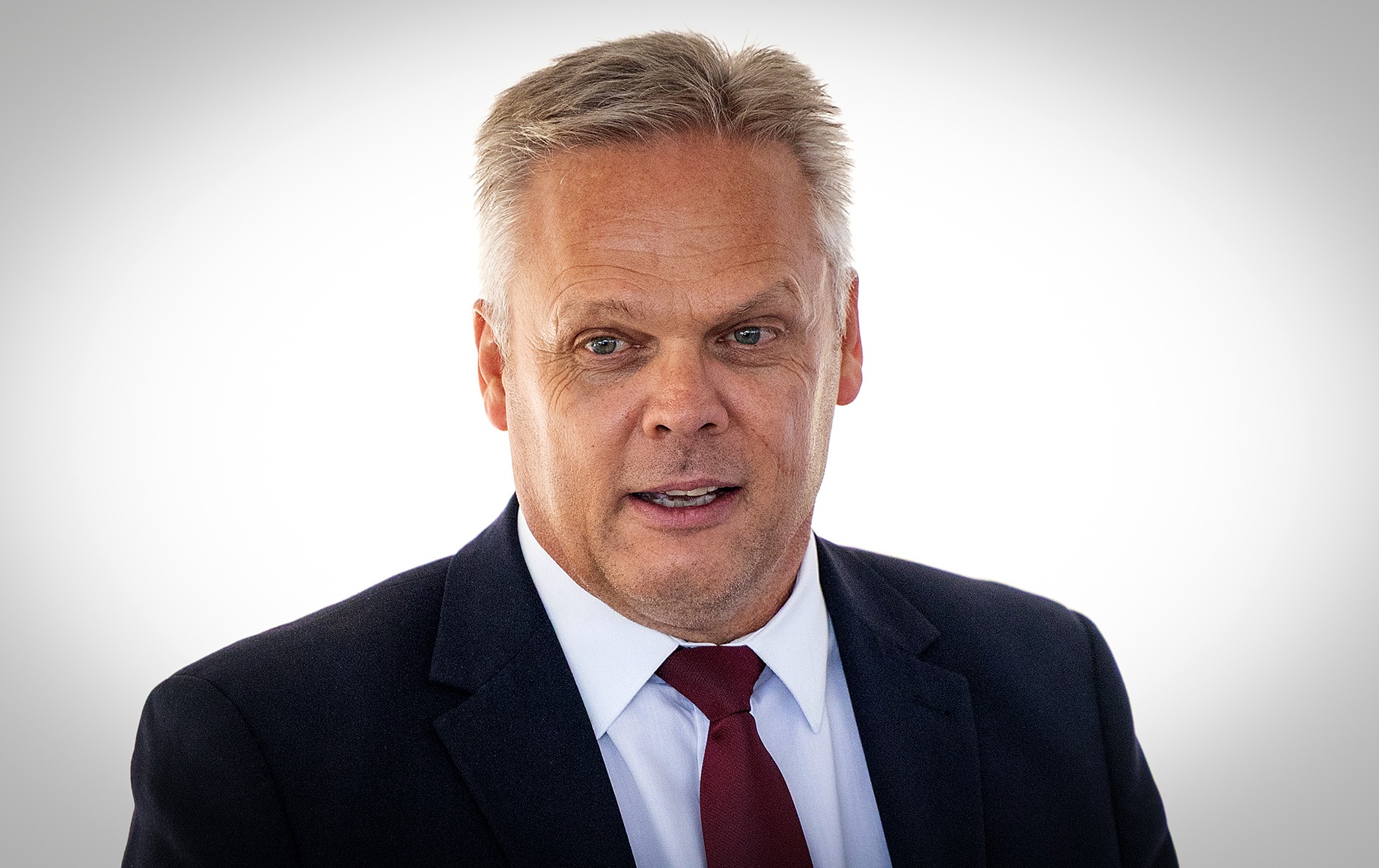
 Environment Minister Willie Aucamp at the launch of the Braille Coastal Environmental Education Signage at Blaauwberg Nature Reserve in Cape Town on 11 February 2026. (Photo: Gallo Images / Misha Jordaan)
 A few minutes late, Willie Aucamp pops into the virtual waiting room as Daily Maverick’s crew is killing time, talking about the merits of swerving for shongololos — the Zulu name for the world’s largest millipede.
In good spirits despite the public firestorm that marked the start of his tenure, the new minister of forestry, fisheries and the environment doesn’t miss a beat.
“The elephants and giraffes play rugby in Kruger,” he offers in his Afrikaans brogue. “In the first half, the elephants trounce them. In the second, the shongololos join the giraffes and flip the game. The giraffes win. When asked why they didn’t help the giraffes from the start, the shongololos say: ‘Because it took a really long time to put on our boots.’”
With that, Aucamp breaks the ice but also, unintentionally, offers a metaphor for his first 100 days in office. The DA’s chief spin doctor before being handed his fired predecessor’s post, Aucamp has many big boots to fill.
Former environment minister Dion George was viewed by observers as technocratic, versatile, diplomatically debonair. It is still wildly unclear why now-outgoing, embattled DA leader John Steenhuisen sacked him in November. Critics accused Aucamp of being in bed with consumptive-use industries he must square up to as minister.
When Daily Maverick asked Aucamp to clarify his positions, he toed the government line. He is marred by no conflict of interest, he insists. He will shut down canned lion hunting which is “wrong”.
“I’ve never owned a lion farm. I’ve never been involved in the management of a lion farm,” he says. “Neither has any of my family.”
He will also appeal a high court decision to legalise international rhino horn sales out of South Africa.
“I studied law myself. I had a look at the judgment and the court papers… and I said that we must carry on with this appeal,” says Aucamp, who has a bachelor’s in law from the University of South Africa.
“I don’t want to speak ill of the judge or the judgment,” he says. “But according to us, there were errors in law that were made. Should this judgment carry through, it’ll have repercussions for us with regards to what the Convention on International Trade in Endangered Species (CITES) will do; and how CITES and other people will see us. We are definitely carrying on. We have lodged leave to apply for appeal and we are awaiting their judgment.”
Big boots, bigger expectations
And Aucamp says he is energised by the business of rebuilding Kruger National Park – the crown jewel of South Africa’s national parks damaged by a year’s worth of rain during a 10-day deluge in January.
It is, in fact, clear that Aucamp wants to brand himself as the Kruger minister.
“I grew up in Tzaneen, which is a town not very far from Kruger. We went there as children very often. I have been going there myself since I’ve been an adult for almost 40 years now,” Aucamp says, referring to the fruit town in the greater Kruger region.
Aucamp has also picked Skukuza, Kruger’s largest rest camp, to address the media in his 100-days “achievement” press conference on Friday.
“I go camping with my family in Kruger every year. And when I became the minister they said, ‘No minister, we will have accommodation for you. You don’t have to camp. And I said to them, ‘Sorry guys, I’m still gonna camp’. I camp in Satara every year for quite a number of nights.”
And he says his kids love that joke.
Aucamp’s folksy humour is personable; but then one would expect him to be at ease – Kruger is his natural habitat.
A park in the red
As a practised spin doctor, it seems he also appreciates the optics of not skirting questions about facing genuine disaster in his own backyard.
In its centenary year, which will be marked on 31 May, the park now faces “an estimated R25-million [revenue loss] up to the end of March”, with “an additional estimated R80-million revenue loss” projected for the new financial year.
The floods, then, are projected to pour more than R100-million in key revenue streams down the drain, on top of confirmed damage at roughly R500-million. The final estimate is anticipated mid-March and Aucamp expects the damage assessment to settle at about R650-million.
Bedecked in shimmering green bush brimming with life, the post-rain park may now be a photographer’s dream. It’s a dream that cannot be sustained without the ecotourism revenue necessary to fund the intensive operations of an Israel-sized reserve.
Yet the Kruger Recovery Fund, hailed as a vehicle for salvaging the park, is now dangerously undercapitalised.
After launching it to fanfare in a parliamentary press conference in January, Aucamp confirms it currently holds R500,000 – the price of, say, a budget apartment in Hoedspruit, central gateway to Kruger. The South African National Parks (SANParks) Honorary Rangers’ companion fund has raked in “just over R2-million”.
This is an elephant’s eyelash of the full cost needed to resuscitate the entire beast. Even if both funds tripled between the sunset and dawn chorus, it would still amount to well under 1% of recorded damage.
For now, Aucamp’s practised confidence rests on sent letters rather than locked-in cash.
“I’ve already written letters to CEOs of some of the biggest corporate entities in the country... I think we will see a huge spike in corporate money that will come in,” he says. The fund patrons are “world-renowned” novelist Tony Park and the Honorary Rangers. “Other forms of income will be from insurance… but a place like Kruger will always be underinsured. Nobody wants to insure a gravel or river road. It’s just not how it works.”
Damage assessments are still under way, but previous insurance flood payouts covered only 20% of the cost. He suggests that the Department of Forestry, Fisheries and the Environment (DFFE) would look at “reprioritisation” of its own funds; while the department has also applied for support from the Limpopo and Mpumalanga disaster funds. These relief streams will also not be enough – and the shortfall is “what we will have to target. We have a huge task in front of us. We will get there.”
Aucamp says he “insisted on three independent auditing firms” to provide “proper oversight”.
“Not one single cent of this money will go to anything else than the recovery efforts of Kruger,” he says. “I think all the safety nets have been built in.”
In the face of the shortfall, the minister's assurances are unlikely to unlock donor confidence on their own, but he also notes the state has “asked people to also make available their professional expertise. We had civil and electrical engineers, people with knowledge on all these issues of rebuilding, approach us, offering their services. And it goes a long way.”
Open gates, broken bridges
Aucamp stresses not only the immediate disaster response but the pace at which Kruger has been reopening.
“Not one person lost their life,” he says, crediting this fact to standard management meetings that “quickly became” meetings on a disaster response that has indeed drawn praise from observers who spoke to Daily Maverick. “We are opening as much as we can as soon as we can.”
Most rest camps are accommodating tourists again. Even the camps in hardest-hit northern Kruger, which received up to 1,000mm of rain during those fateful 10 days, have largely reopened.
Shingwedzi is the only northern rest camp that is still shut, but Aucamp says its gate should swing open in March.
But then there are, to put it delicately, the special projects – such as Letaba Rest Camp in the park’s northern half.
Letaba was pummelled by the river from which it takes its name. “We all saw the videos... It was a scene out of a horror movie – if you see all these rondavels and chalets with all these mattresses, cutlery and things being stacked outside, which obviously must now be thrown away because it is just absolutely ruined,” he observes.
He says Letaba’s fuel station, shop and ablution facilities have reopened to service “people travelling through that area”. As for the rest, “we are trying our utmost best to have certain areas of Letaba camp open for overnight accommodation by the end of May when the winter school holiday starts”.
/file/attachments/orphans/WhatsAppImage2026-01-15at184820_613429.jpg "Letaba Rest Camp. (Photo: SA National Defence Force)")
Northern Kruger’s Sirheni Bushveld Camp, right on the banks of the Mphongolo River, “has a lot of damage. It will take a lot of time to repair it, but we will have that repaired within this year as well.”
The more Aucamp speaks, the more apparent it becomes that reopened camps – though impressively fast – mark a mere chapter of reconstruction. Other chapters, for instance, involve hammered roads and bridges. The front section of the high-level bridge at Letaba “washed away” but he hopes it will “already be repaired and accessed” by the end of March.
Another chapter involves more climate-resilient upgrades.
“If we are going to rebuild Kruger in the same way as it was designed 30, 40, 50 years ago, the same effects on those areas will happen when we get new floods. Climate change is a reality,” he says. “Slim” layers on tar roads, particularly in low-lying roads close to rivers, must be redesigned so they “will be able to withstand whatever climate change and flooding throw at us”.
/file/dailymaverick/wp-content/uploads/2023/02/Floods-kruger-limpopo-EC-2.jpg "The view from a helicopter of the Nwatimhiri Bridge on the H4-1 main tar road between the Skukuza and Lower Sabie rest camps on 10 February 2026. (Photo: Hein Grobler/SANParks)")
The roads to Kruger
Promising roads that can withstand “whatever” is unleashed by an angry planet is an ambitious claim, especially since the park has weathered many floods in recent memory: think 2000, 2012 and 2023.
But even the most luxury, climate-savvy camps and bridges are a dust-infused mirage without actual safe provincial road access to the park.
Ask a local. Some main roads servicing the park, to borrow a phrase Aucamp used to describe Letaba, were a “horror show” even before the floods hit.
Indeed, they have manifest implications for Aucamp’s own mandate but here, too, the minister’s enthusiasm is a renewable fountain.
“The fact that these floods have been declared as a disaster really helps a lot, especially with interdepartmental cooperation. We’ve already had two meetings with the Department of Cooperative Governance and Traditional Affairs, together with the premiers of both Limpopo and Mpumalanga provinces... I attended both of those meetings,” he says. “We said to them, ‘We need to have an income in Kruger, but to have an income we must have access – and we need to look at how we can get those roads repaired as soon as possible.”
Tourists can pick any African park, so “as soon as possible” does not quite immunise the money businesses stand to lose once those tourists decide that pot canyons on provincial roads outside the park are not worth the hassle – or risk.
Roads are not the DFFE’s responsibility – but that is part of the worry. They have been left to the mercy of roads authorities who say they are working on them.
Acknowledging the multitudes who live outside Kruger and rely on the park as their main income source, Aucamp insists: “We will give our full cooperation, but we expect the same back.”
After the flood, the poachers
The elephant in the room is the rhino (and all other species in poacher crosshairs). Asked how the deluge has smoothed the way for criminal incursion through damaged fences, Aucamp gets nerdishly enthused – rattling off the litany of big rivers that span the park from Makuleke to Malelane.
“It’s very important that whoever listens to this interview must understand how Kruger looks when it comes to rivers. You’ve got several big rivers crossing from west to east. If you start from the top, you’ve got the Limpopo River; Luvuvhu, then the Shingwedzi, Letaba River, Olifants River, Sabie River and, right to the south, the Crocodile River,” he says, citing the fencing that crosses those rivers. “You know you’re going to lose fencing when floods come in.”
Some fencing has “been repaired as far as we could go, but those rivers are still in flood,” he says. “As those rivers subside, SANParks will repair that to make sure we minimise human-animal conflict and prevent animals from going out. We saw the whole issue of foot-and-mouth disease. We’ve got to repair the western boundary of the park to make sure we keep buffalo especially contained; fences are in certain areas very damaged.”
/file/attachments/orphans/Alex-Shapiro-Timbavati-Rangers2_414735.jpg "Anti-poaching rangers cross the Monwana, a non-perennial river, on 29 January 2026. (Photo: Alex Shapiro)")
A minister’s measure
For a minister whose critics fear he represents the interests of consumptive use, the interview was an attempt to recast himself as a conservationist in crisis mode.
“Kruger is my place, my safe haven where I go to fill up my tank, to generate energy, to take on life every day. I’m in love with Kruger. It’s my favourite place in this country,” he said. “I will always stand up for Kruger. As I am feeling about Kruger, a lot of other people are as well.”
And it helps fund other parks.
“Unlike a lot of other state entities, SANParks is 80% self-sufficient when it comes to their money. In SANParks, we’ve got a lot of different parks, some of whom are not financially viable, but they are very important from an environmental perspective. So, they get funded by the income that we get from places like Kruger and Table Mountain,” he says. “Kruger is one of the biggest contributors towards the cash flow and income of that 80% that SANParks is paying towards its own cost.”
For Willie Aucamp, the test is not just keeping alive and open what he describes as “South Africa’s biggest natural asset”.
Can the DFFE minister rejuvenate ageing state infrastructure that was struggling to compete with the best of other African parks even before the waters hit?
If this is the sole thing the Limpopo native achieves while heading the DFFE’s elephantine portfolio – which spans snow management around South Africa’s Antarctic station to decisively ending canned hunting – it will be a many-booted achievement indeed. DM
Access the details for the Kruger Recovery Fund here.