
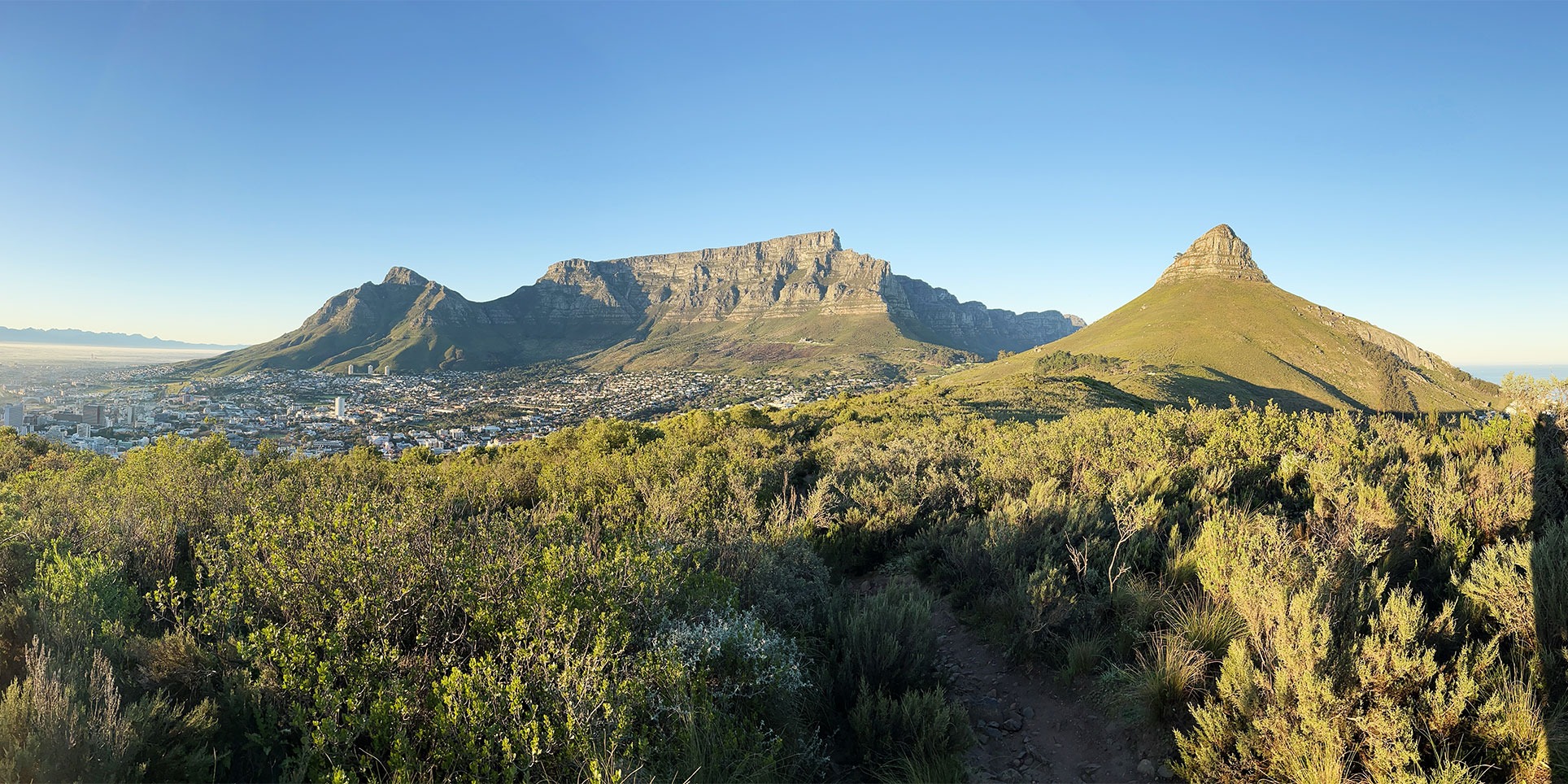
 Cape Town’s beloved and world-famous Table Mountain in all its majestic beauty. (Photo: Supplied)
 /file/attachments/orphans/storiedmountainlogo_692149.png)
If you ask Professor John Compton what Table Mountain is, he won’t give you the simple answer you may have hoped for. He won’t say “a mountain in Cape Town” or even “a famous landmark”. Instead, he smiles as though you’ve asked a mischievous question – one worth unclasping slowly.
Because the truth is, Table Mountain isn’t a thing. It’s a story. A long, slow, astonishing, utterly improbable story – one still being written. And understanding that story, Compton argues, might be one of the healthiest perspectives we can cultivate in anxious times.
So: what is Table Mountain? And if it had a birth certificate, what would the date of birth even be?
The professor leans back and gives the only possible answer: it’s complicated.
The rocks we see today – the bright, clean quartzitic sandstone that form the cliffs – were once loose grains of sand, weathered from a long-vanished mountain range to the north. That ancient range has its own name: the Cargonian Highlands, formed more than 600 million years ago as continents collided, forming the supercontinent Gondwana.
Those grains were carried by braided rivers across a barren landscape – no trees, no roots, no flowers. Picture Iceland today, he says: vast sheets of water flowing over gravel plains, shifting channels combing through a world of bare rock and wind. That’s the closest modern analogy.
It is not a mountain.
It is a motion – paused.
A long exhale of the earth.
Sometime between 545 and 444 million years ago, the sand piled deeper and deeper into a sinking basin –accumulating along the hundreds of kilometres of shoreline of the Cape Basin.
The truth is, we don’t know exactly when this sand settled into place. The rock holds almost no fossils, no minerals that can be precisely dated. Table Mountain’s birth certificate is smudged, half-missing, written in a script nature never intended us to decode.
But we do know this: when those sediments were laid down, there was no mountain. There was only water, sand, gravity and time – so much time.
Read the first article in The Storied Mountain series.
/file/attachments/orphans/5_471498.jpg "The supercontinent Pangea when continents were still fused. (Image: Supplied)")
Becoming a mountain
The next part of the story feels almost like metamorphosis folklore. The Cape Basin filled with more sediment – seven to nine kilometres of layers weighing down on the early sand deposits.
Buried so deep, the pressure fused quartz grains together, forming a hard, almost unweatherable rock. This is why the sandstone cliffs endure: the pores between grains are filled with quartz cement, turning loose sand into solid rock, a sandstone that is so impervious to erosion, it erodes far more slowly than the granite rock on which it rests.
Then came the great compressions, the collisions around 250 million years ago that deformed the Cape Supergroup into the rugged mountains of the Cape Fold Belt. Table Mountain wasn’t a peak then – it sat low, deep in the trough of a fold.
/file/attachments/orphans/6_548749.jpg "Higher and lower water levels during hot and cold periods. (Image: Supplied)")
Later, as Gondwana was rifted apart, forces lifted the whole region. What was once buried kilometres beneath the surface emerged into the sunlight, carved out by rain and rivers.
Only in the past 40–50 million years – yesterday, in geological terms – would a visitor recognise Table Mountain in something close to its current form.
So what is Table Mountain?
It’s a sandstone beach turned into a rock cathedral.
It’s the residue of vanished mountain landscapes.
It’s the westernmost remnant of the ancient Cape Fold Belt mountains, the last hard bit left standing while everything around it eroded away.
/file/attachments/orphans/4_769209.jpg "Mudstone and sandstone layering can be seen along Table Mountain. (Photo: Supplied)")
The consolation of deep time
At this point, Compton shifts from geology to philosophy. Understanding deep time, he says, is a kind of therapy. A reminder that our frantic, doom-scrolling present is a flashbulb in a 4.5-billion-year slideshow.
We worry – rightly – about existential threats: climate change, political instability, AI, the fragile social fabric. But deep time offers perspective, not apathy. It teaches humility. It shows us that species rise and fall. Oceans open and close. Mountains appear and disappear. And yet, amid all this relentless planetary churn, life persists. Earth endures.
“I don’t take the daily news quite as dramatically as many people,” he admits. Not because it doesn’t matter, but because deep time teaches us that transformation is the rule, not the exception. The mountain we fret beneath has already survived ice ages, mass extinctions, supercontinents breaking apart, oceans disappearing and reappearing. It will survive us too – beautiful, indifferent, steady.
And in a strange way, that steadiness is comforting.
/file/attachments/orphans/2_968432.jpg "Quartz fused under enormous pressure to form sandstone. (Photo: Supplied)")
The wow moments
Compton is no jaded scientist. He still experiences wonder: the purity of the quartz sand that travelled across half a continent; the improbable survival of such a huge erosional outlier; the sheer immensity of the forces that can move continents, create oceans and make mountains rise.
Even with 50 years of research, deep time still unsettles him. That’s healthy, he insists. We’re not built to intuit a million years, let alone a billion. Our lives are measured in decades, our memories in moments. But standing before a cliff face that retreats at five metres per million years, you glimpse a different scale, a more patient world.
Geologists don’t see a static postcard. They see a process – a frozen wave of time mid-crash. They see the forces that shaped the cliffs, the faults beneath gorges, the slow retreat by rockfalls, the white quartz pebbles that weather out on the summit. They see movement, not stillness.
And that’s perhaps the most powerful answer to “What is Table Mountain?”
It is not a mountain.
It is a motion – paused.
A long exhale of the earth.
Really see it
Finally, Compton hopes people will look at the mountain and feel what he feels: curiosity, patience, perspective. He wants Capetonians – who live under this massive, unavoidable geology – to see it. To notice it. To let it recalibrate their inner clocks.
When the present feels overwhelming, look at Table Mountain. Really look.
Think of the rivers without trees.
Think of continents colliding.
Think of quartz grains fusing under kilometres of rock.
Think of 500 million years of motion and stillness, uplift and erosion.
And suddenly, the traffic, the news cycle, the inbox – everything feels a little lighter.
Deep time doesn’t erase our problems. But it softens them. It stretches the tight frame of “now” into something wide, breathable, humane.
Table Mountain teaches the same lesson it embodies:
Change is slow. Change is constant. And beauty emerges, again and again, from unimaginable time. DM
For more information check out www.johnscompton.com
Read the full Table Mountain series:
• The flat mountain that wouldn’t behave
• What is Table Mountain? A story of Deep Time
• Hotter, drier, wilder: reinventing conservation for a changing climate
• Table Mountain’s green cloak that took 60 million years to weave
• The fluid intelligence of Table Mountain’s rivers
• What it takes to keep Table Mountain wild
• Rough sleepers: The mountain keeps us
• Cormac Cullinan: thinking like a mountain, listening like a river