




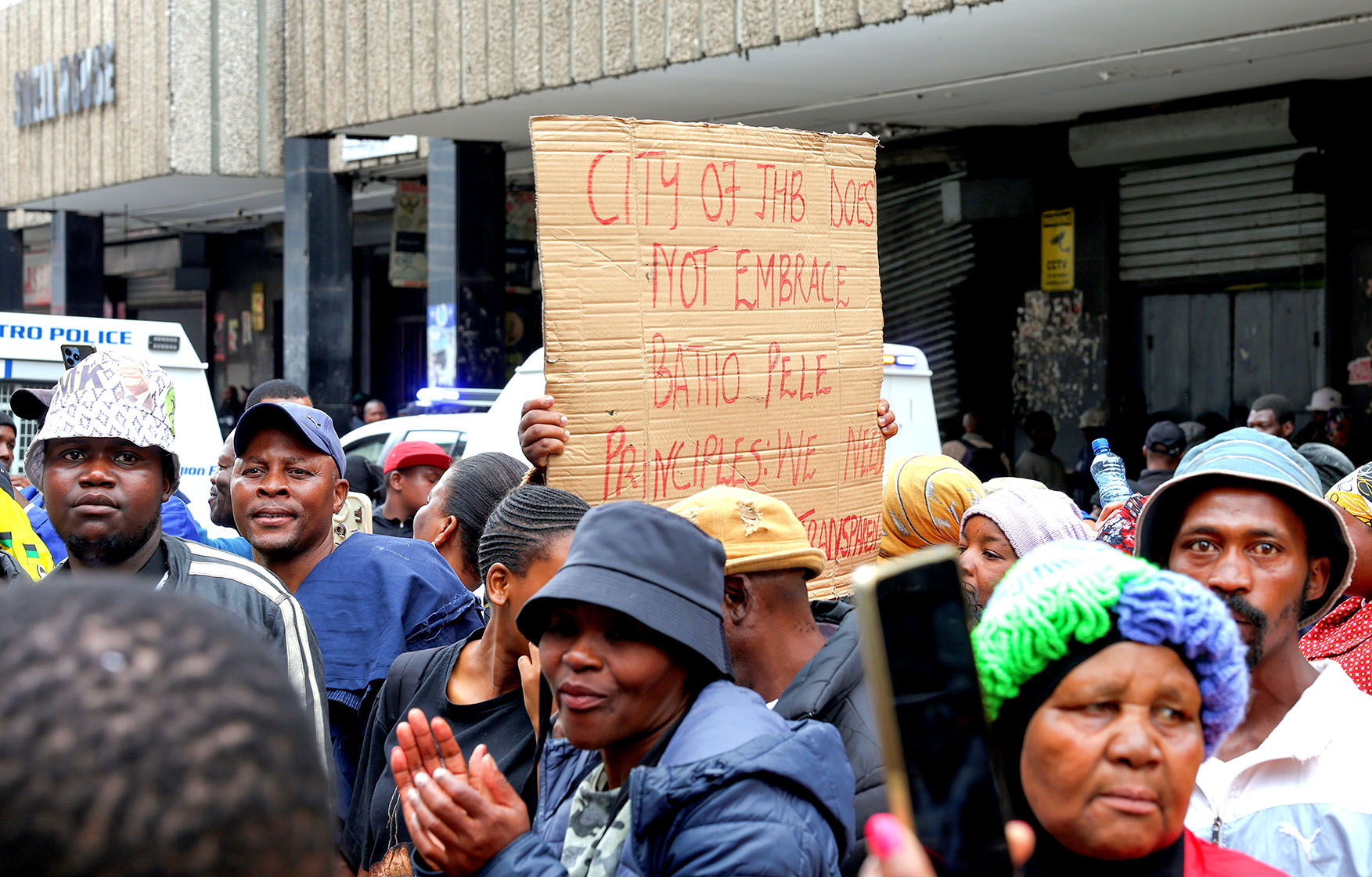
 Protesters in De Villiers Street on 3 November after City of Joburg officials cleared some informal traders. (Photo: Gallo Images / Luba Lesolle)
 A number of verified informal traders’ lives in Johannesburg are falling apart as they claim that, despite being verified to trade, they have not been allowed back on the streets. Four months after Johannesburg’s informal trader verification process began, their efforts are being stonewalled.
The process sought to regulate the informal economy, enforce by-laws, and finally settle the City’s long-running disputes with informal traders after they went to court when the City removed many of them from the streets in October 2025 as part of a clean-up operation.
“My policies and insurances have lapsed. School fees for my children remain unpaid and so is their scholar transport,” said Ayanda Kela, an informal trader and one of the leaders of the South African Informal Traders Forum (SAITF).
“We are not getting any sound explanation for preventing us from working when we are already verified,” Kela said. “We wake up every day, come to the street with the hope we would be allowed to trade, but no luck.”
In November 2025, the Gauteng High Court ordered the City to verify, register and allocate spaces to qualifying informal traders, but while some traders are back on the streets, others say they have not been issued trading cards or haven’t been allocated trading bays.
/file/attachments/orphans/ED_582339_471053.jpg "Excecutive Mayor Dada Morero cleans the streets during the by-law enforcement operation at Joburg CBD on 14 October 2025. The operation aimed to restore law and order in the inner city. (Photo: Gallo Images / Sharon Seretlo)")
Kela has not been trading since 2 October 2025: “We’ve been issued with smart card permits, but we are not allowed to go back to business.”
Kela, who is waiting to be allotted a trading bay, said that even the issued smart cards were not in line with the new policy, as they do not bear the name and picture of the cardholder.
“It’s by the grace of God that my family and I are still alive,” said Kela, who has been trading on De Villiers Street for 25 years.
Livelihoods destroyed
Informal trader Lebogang Eneh said, “My son, who is in Grade 12, is struggling to do his homework because we cannot afford electricity… My children lost their father, who was also a trader, in October last year, and in November, I lost my livelihood.”
“I guess, next will be our home as I am far behind with my bond payments,” Eneh said.
Eneh says she qualifies for a permit but City officials have only said she will get a card at a later stage and couldn’t give her a legitimate reason for the delay.
“My desperate situation is worsening daily as we also cannot afford to pay for our water,” Eneh said.
She said officials had made it clear from the beginning that they wanted to get rid of foreign migrants (the City says it will issue permits to citizens and documented migrants), adding, “But I don’t know what my sin is because I am South African, born and raised in Daveyton, in Benoni.”
“This is too much to handle for me,” said Eneh, who has traded in Joburg for 22 years. “Today, I did not have bread for my two children’s school lunch boxes.”
/file/dailymaverick/wp-content/uploads/2025/11/ED_585137.jpg "Protesters and police in De Villiers Street on 3 November. (Photo: Gallo Images / Luba Lesolle)")
Thulani Eneh, an informal trader and Lebogang’s brother, is in the same predicament.
“When it comes to my livelihood, man, it’s very tough,” he said.
Thulani received his verification card in November. He said he received an SMS requiring him to go to Noord Street the following day to be allocated a stand. When he turned up, there were no officials in sight.
“The City put Metro Police on the streets where we are supposed to trade. They say one thing and do the opposite.”
He said he was introduced to the trading business by his sister and her husband. “Then in 2008, I started trading in Benoni… In 2016, I then started trading on De Villiers Street in the CBD.”
City dismisses concerns
At the time of writing, the City of Johannesburg and Gauteng Department of Economic Development did not respond to Daily Maverick’s questions, with the City saying it was still collating responses to the informal traders’ claims.
But in a statement from 18 February, ahead of a march the next day by the Johannesburg Informal Traders Development Powerhouse (Jowedet), the City dismissed a number of grievances raised.
It said the march “follows a letter from certain trader representatives alleging harassment by officials and calling for the re-marking of trading bays, the issuance of permits to compliant traders, and for the Johannesburg Metropolitan Police to stop harassing them”.
It said the City dismissed the claims and said that the consistent enforcement of by-laws throughout the inner city was appropriate to restore order, cleanliness, safety and long-term economic stability.
/file/dailymaverick/wp-content/uploads/2025/10/ED_583611.jpg "Joburg Mayor Dada Morero hands over an informal trading permit at Noord Street Market, Johannesburg, on 24 October. (Photo: Sharon Seretlo / Gallo Images)")
The City claimed it had not received a verified list of the traders allegedly affected, which limited its ability to determine the scale of any non-compliance.
It further said that permits would be issued on a priority basis and that traders will have four weeks to collect their permits or they would be re-allocated.
“The City values the role of informal traders in local economic activity and remains committed to ensuring fair, safe and lawful trading conditions. Compliance with municipal by-laws protects both traders and the broader community,” the city’s statement said.
Jowedet march convenor Ndumiso Nonjonjo told Daily Maverick that he has been a trader in the Johannesburg CBD for 24 years.
“As traders, we are tired of the harassment by the JMPD,” Nonjonjo said. “The JMPD (Johannesburg Metropolitan Police Department) do not respect traders’ rights and they are employing apartheid-era tactics on us,” he claimed.
Informal trader David Nduka, 52, said, “They said they will call me, but to this day, since 2 October last year, they have not called me… All four of my children have stopped going to school because I cannot afford it. I have four children and one of them is in matric.” DM