




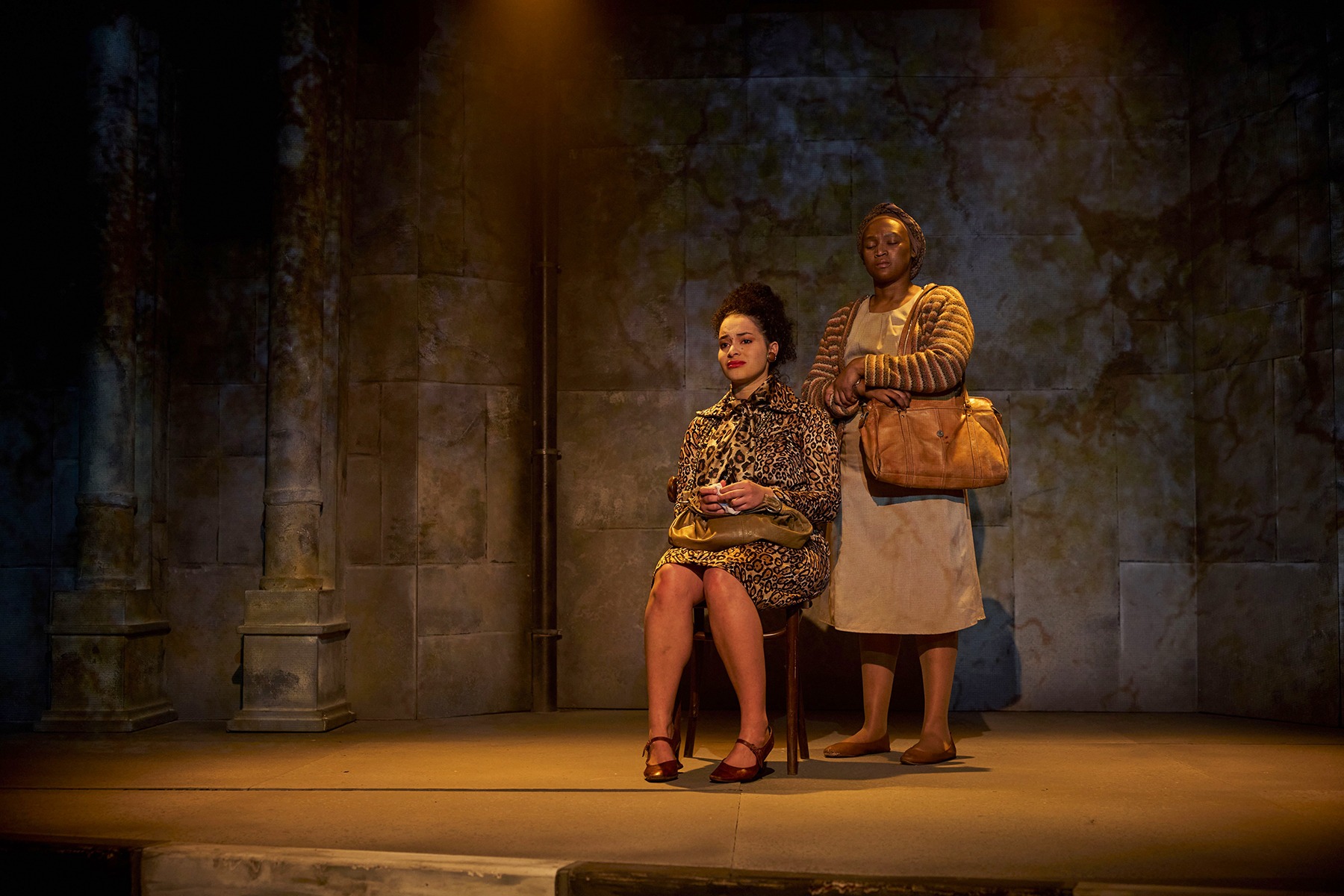
 Awethu Hleli and Tamzin Daniels in And the Girls in their Sunday Dresses. (Photo: Oscar O'Ryan)
 Used as a kind of timelapse motif in The Baxter’s new production of And the Girls in their Sunday Dresses, director Mdu Kweyama has tasked his actors with performing a series of compulsive gestures. They’re manic, repetitive bits of hyperbolic physical expression conveying a kind of silent madness, frustration, urgency, perhaps rage.
They’re used to great effect during dimly lit, dreamlike vignettes between scenes, all of which play out at the same location, a pavement outside some government warehouse in (probably) Maseru, Lesotho.
Their compulsive gestures, which are like the building blocks of a dance language, could be many things, but it occurred to me during one of these sequences in particular that what the actors were doing was writing – obsessively, compulsively, frantically – on the pavement, on the chair, on street poles, on the walls of the building they’re forced to wait at. After writing a word or a phrase, they’d flick their pursed fingers as if trying to get the last drops of ink into the nib so they could write and write some more.
This piece of theatre business felt to me to be a kind of homage to the playwright Zakes Mda, whose play this is and who penned it, no doubt as a way of getting his own fury and frustration with the status quo, with corruption and bureaucracy, out of his system.
/file/attachments/orphans/AwethuHleliandTamzinDanielsinAndtheGirlsintheirSundayDresses_OscarORyan4_400743.jpg "Awethu Hleli and Tamzin Daniels, in a sense, help us get some of our collective frustrations off our chests. (Photo: Oscar O'Ryan)")
The two women on stage might just as easily have been trying to loosen the bile from their throats, or shake the last drops of blood into the tips of ossified fingers.
They were, I thought, also getting something – all of our collective frustrations – off their chests.
The two-hander which, like Waiting for Godot, subjects its characters to a game of endless waiting, the dramatic tension riding on whether or not they will ever be rewarded for their patience. While Samuel Beckett’s play traverses metaphysical territory, enabling its characters to ponder existential questions, Mda’s situation is rooted in a sociopolitical reality.
They’re not expecting the arrival of some mystical figure, but have been waiting days simply to purchase some subsidised rice. Their situation represents something every one of us can relate to: waiting for the wheels of bureaucratic ineptitude to turn. Which, of course, gives the play a Kafkaesque dimension, something that is cleverly underscored during those frantic between-scenes vignettes.
While they wait they squabble, share details of startlingly similar fateful romances, insult one another, apologise, complain about men, express their dissatisfaction with the corrupt state, and generally get a load off. Occasionally, their waiting is interrupted by the striking of a bell, announcing that the government workers, on their lunch break, are about to file out of their offices. The women watch as these disinterested bureaucrats make their way to lunch and back: they’re a mix of supposedly important men and their female colleagues whose beautiful summery frocks give rise to the play’s title.
/file/attachments/orphans/AwethuHlelirightandTamzinDanielsinAndtheGirlsintheirSundayDresses_OscarORyan_739653.jpg "Awethu Hleli (right) and Tamzin Daniels share a reflective moment in And the Girls in their Sunday Dresses. (Photo: Oscar O'Ryan)")
/file/attachments/orphans/AwethuHleliandTamzinDanielsinAndtheGirlsintheirSundayDresses_OscarORyan3_124361.jpg "Awethu Hleli and Tamzin Daniels, whose situation represents something every one of us can relate to: waiting for the wheels of bureaucratic ineptitude to turn. (Photo: Oscar O'Ryan)")
That this play was was first performed in 1988 (when it premiered at the Edinburgh Fringe Festival) and yet feels like a window into life today hints at Mda’s ability to distil very specific and intimate stories into universal truths. Whether considering ongoing social injustice within our own country, or the current abuses of power happening in Trump’s America, Mda’s writing repeatedly touches nerves that are still frayed, still very much exposed.
The play, which is by turns sweet, funny and warm, and which occasionally lapses into blunt protest, has a slightly heightened quality, too, as if the two women (like Vladimir and Estragon in Godot) are subtlely aware of occupying their slice of pavement as though it was indeed a platform for performance.
The actors, Awethu Hleli and Tamzin Daniels, are enormously entertaining, the energy and life they breath into Mda’s words, which at times veer unflinchingly into political speech-making, is enchanting to watch. Whether it’s observing Daniels obsessively attending to her makeup as she perches on a chair that she carts around with her whenever she attends to the countless bureaucratic waiting games she must endure, or Hleli’s scrunched-up made-for comedy expressions as she expresses her unmasked disgust, they are both a delight, and together make quite the fiery pair.
/file/attachments/orphans/AwethuHleliandTamzinDanielsinAndtheGirlsintheirSundayDresses_OscarORyan2_684698.jpg "And the Girls in their Sunday Dresses is, at heart, a play about two people who start out seeing only their differences, but come to realise how very alike they are. (Photo: Oscar O'Ryan)")
It may be a play about the ills and evils associated with state power and the ineptitude and corruption of the people who wield that power, but at its heart it’s in fact about two people who start out seeing only what differentiates them (one is a proud prostitute who plies her trade as a way of punishing men for their misdeeds, while the other has endured a life of cleaning other people’s homes), but through shared conversation – and shared experience – come to realise how very alike they are.
They’re two human beings as bonded by their ultimate refusal to be subjugated by the tyranny of those in power as they are connected by their resilience in the face of everything they have endured – and by their incredible capacity to laugh.
Kweyama’s direction is crisp and humanising, and expertly draws the comedy out of a play that wants us to witness the indignity of being forced to wait while never allowing us to experience the boredom and frustration that such waiting entails.
The play also reminded me of another existential masterpiece, Sartre’s No Exit (or Huis Clos, also known as In Camera) – about three damned souls forced to endure eternity in a locked room in Hell, where the punishment for their sins is the perpetual torment and guilt resulting from the critical gaze of the others in the room.
Whereas Satre’s 1944 play famously gave rise to the aphorism “Hell is other people”, Mda’s play unravels that notion and ultimately reveals the extent to which we might find solace, comfort, refuge and love in our fellow human beings – even if the journey towards this reassuringly humanising discovery is a bumpy one. DM
And the Girls in their Sunday Dresses will show at the Baxter Studio in Cape Town until 7 March.