




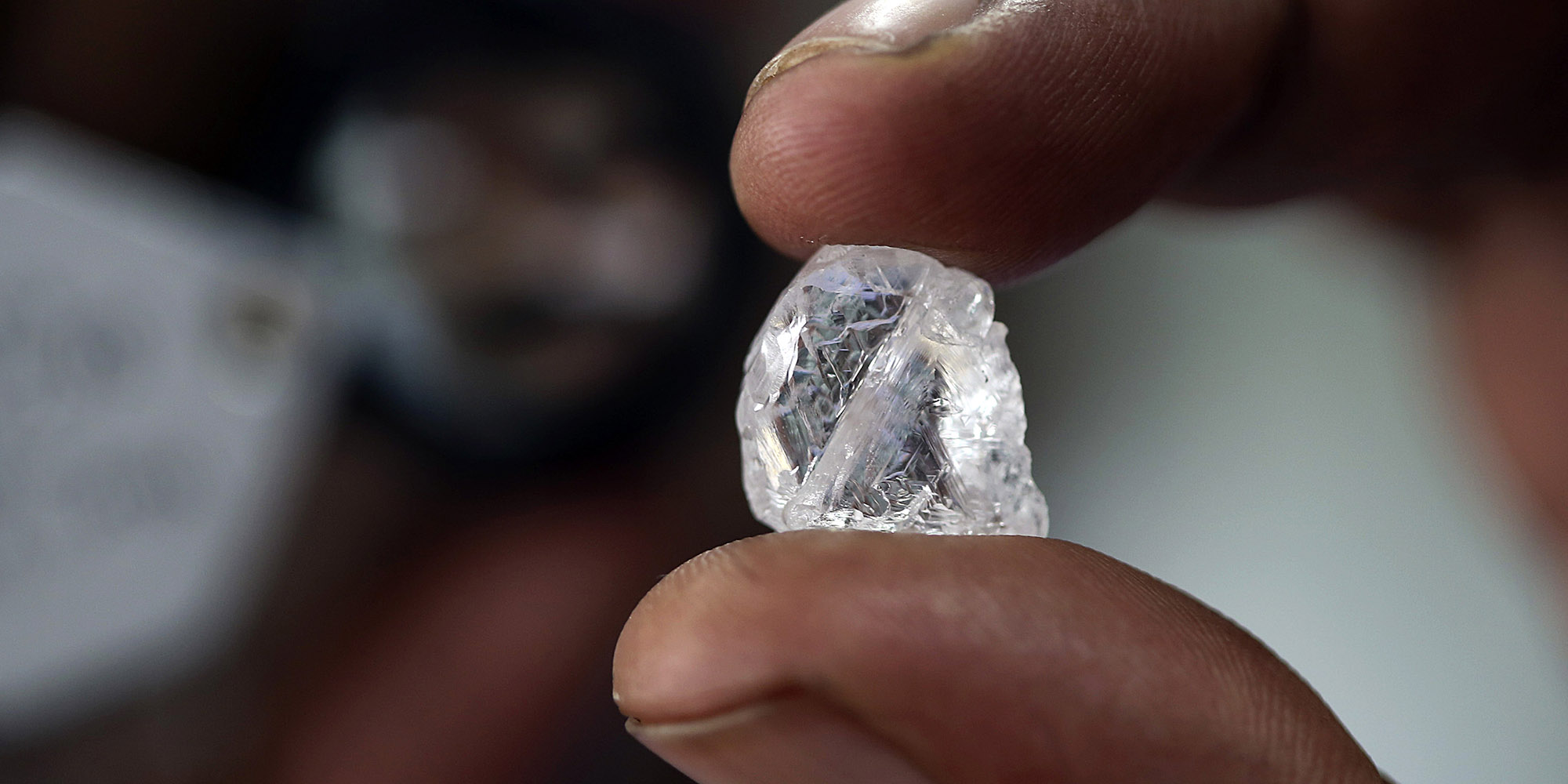
 An uncut diamond at DTC Botswana, a unit of De Beers, in Gaborone. (Photo: Chris Ratcliffe / Bloomberg via Getty Images)
 It is a truth universally acknowledged that a single man in love with a young woman must be in want of an engagement ring.
When that moment arrived for me, among the many emotions I had (hope, fear and a wonderful feeling of joy) was a concern about money.
I was young, working as a journalist and not really sure how much I had to spend.
But I did have, in my mind, somewhere, a rough amount. I knew kind of what I needed to spend.
At the time I had no idea that the concept that a woman’s engagement ring should be “two to three months’ earnings” (or six weeks, according to some sources) was just a marketing gimmick.
That it had been dreamt up by marketing people for De Beers.
In fact, the BBC has suggested that the first time it was used was back in 1947, showing that such cynicism came long before the era portrayed so well by Mad Men.
Even now, I find it so interesting that even before that De Beers was really only able to make the money it did from diamonds through operating as a cartel.
An academic paper by the Harvard Business School makes no bones about this, that De Beers “managed to uphold one of the greatest marketing coups of history: convincing millions of customers that diamonds are actually rare and therefore highly prized”. But now the sparkle seems to be fading.
Anglo American said last week it was battling to find a buyer for De Beers. It wanted to get it out of the way.
/file/dailymaverick/wp-content/uploads/2024/10/GettyImages-2153377996.jpg "A couple passes a jewellery store in Hong Kong on 18 May 2024. (Photo: Lam Yik / Bloomberg via Getty Images)")
It’s a fascinating problem that gets to the heart of how our society is changing, and how technology is threatening the entire industry.
As Kara le Roux explained so well in Daily Maverick last week, members of the industry seem to lose their minds at the idea that lab-grown diamonds could supplant natural diamonds.
Read more: Lab diamonds vs mined - how much does love cost?
They point to how the artificial diamonds are made in factories, and how the natural-diamond industry is critical to the economy of Botswana.
One industry member even says “we are too big to fail”.
Really? I’m not so sure about that.
/file/dailymaverick/wp-content/uploads/2025/09/20V8989.jpg "Anglo American’s headquarters in Rosebank. (Photo: Felix Dlangamandla)")
I mean, sure, Botswana needs its diamond industry (we would not like to lose ours either), but so what?
If there is no demand for what you sell, there is no value in it.
As McKinsey (itself an obvious expert on ethics) points out, several things could happen. In some scenarios artificial diamonds could take over the market outside “niche luxury segments”.
It also says that “assuming consumers cannot tell the difference between natural stones and LGDs, all diamonds could simply go out of fashion, lose their appeal, and are no longer seen as a must-have for engagement rings”.
Frankly, considering how society generally is changing, I’m not sure that investing in the future of natural diamonds would make sense.
It’s not just that I cannot tell the difference between a natural diamond or an artificial one. It’s that I don’t think I know anyone who can. And if that is the case, what is the point of using natural diamonds?
The only reason can be to show bling. And while there is obviously a market for that, it’s a crowded field. There are so many other ways to do this.
You’re literally saying that a small natural stone has more bling value than a Lamborghini. Good luck with that.
As everyone knows, the point of conspicuous consumption is to be, well, conspicuous.
This is why some people like to be seen at a Formula One Grand Prix, or even better, Central Court at Wimbledon.
Or, if you’re really brave, or just want to send a statement, you could always buy two tickets to the nearest Coldplay concert.
And, of course, while Marilyn Monroe might have claimed that Diamonds are a Girl’s Best Friend, it’s been some time since any film producer dared suggest a movie called Gentlemen Prefer Blondes.
/file/dailymaverick/wp-content/uploads/2021/08/BM-Ed-Miningdata-option-2.jpg "Inspecting a finished pear-shaped diamond. (Photo: Chris Ratcliffe / Bloomberg via Getty Images)")
I must also just say, it must be true that when younger people are getting married, the value of the engagement ring really does not have the power that it once did.
I think it might be quite offensive to some people to be told that someone is choosing an engagement ring for them, and is using the ring to place some kind of monetary value on them.
De Beers is in a bit of a squeeze in some ways.
If diamonds don’t lose value because of cultural shifts, it will be because of artificial diamonds.
And its power to be a cartel is also weakening. It is allowing more entrants into the market.
The people who have been running De Beers over the decades are not stupid. They will try all sorts of clever things to try to stimulate demand.
Perhaps some will be successful.
But if I had money to invest, and I had to put it into some kind of mineral that comes out of the ground, diamonds would not be my first choice.
This may be a truth not yet universally acknowledged, but I suspect the glory days of diamonds are behind them. DM