




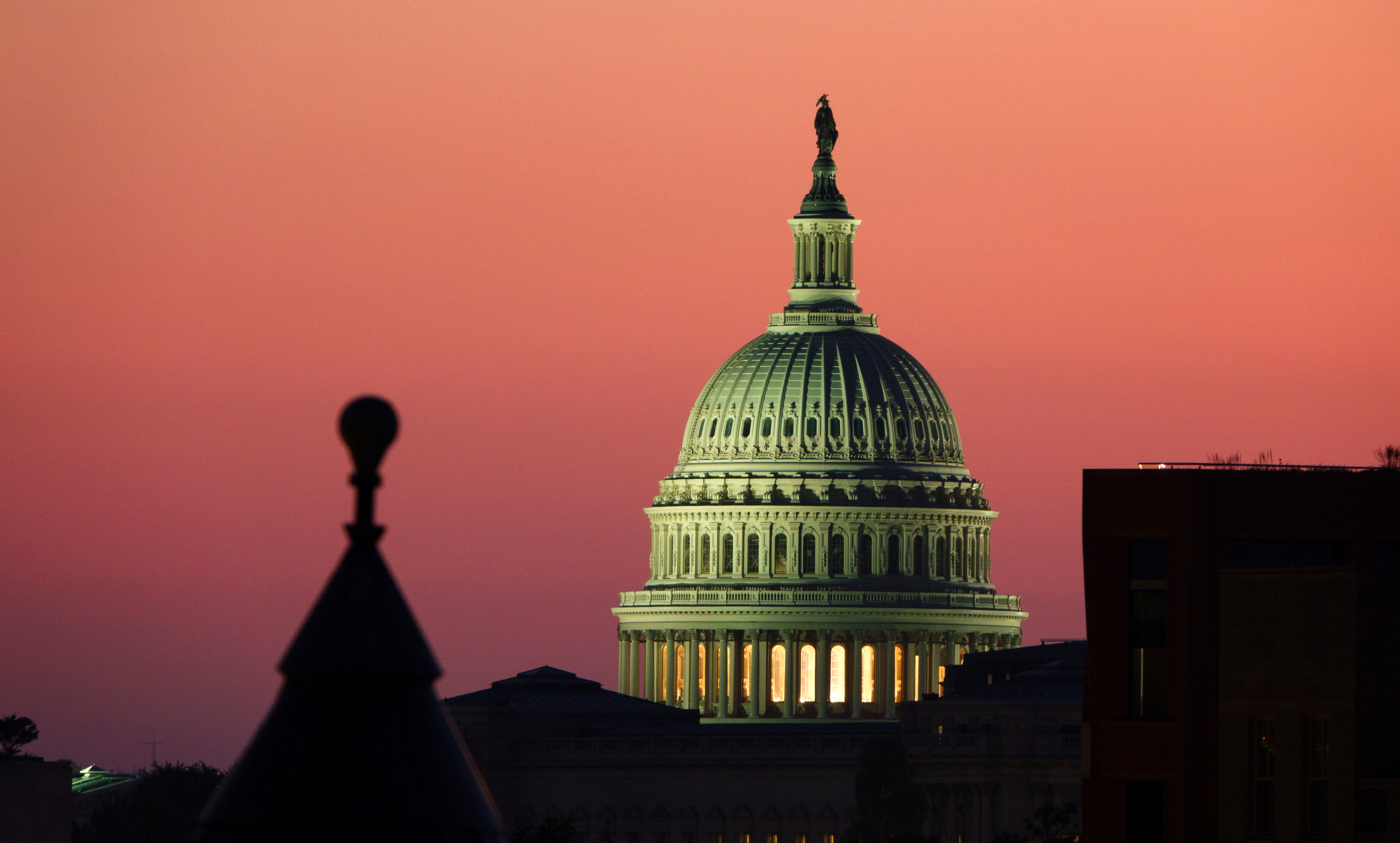
 The U.S. Capitol Building is seen at dusk after the National Weather Service issued an Extreme Heat Warning for the region on June 23, 2025 in Washington, DC. (Photo: Kevin Carter/Getty Images)
 /file/dailymaverick/wp-content/uploads/2025/10/label-Op-Ed.jpg)
‘Extraterritorial reach” refers to powerful states extending their laws or policies beyond their borders to influence other nations’ affairs. The US stands out as the primary actor in this regard, posing one of the most significant political risks for South Africa in 2026, but not without obstacles.
Congressional focus on South Africa
Five bills directly pertinent to South Africa have been introduced in the 119th Congress:
- H.R. 2607: AFRIKANER (Asylum for Farmers and Refugees in Crisis and Necessary Emigration Resettlement) Act;
- H.R. 2633: US-South Africa Bilateral Relations Review Act of 2025;
- H.R. 405: Addressing Hostile and Antisemitic Conduct by the Republic of South Africa Act of 2025;
- S. 2751: US-South Africa Bilateral Relations Review Act; and
- S. 2958: Agoa Extension and Bilateral Engagement Act of 2025.
A related development is the reauthorisation of the African Growth and Opportunity Act (Agoa). In December 2025, Representative Jason Smith (Republican, Missouri) introduced H.R. 6500, the Agoa Extension Act, to extend Agoa for three years to 31 December 2028. It passed the House Ways and Means Committee by 37 votes to three and the full House with strong bipartisan support by 340 votes to 54 in January 2026. Despite this, competing priorities led to a short-term relief with the Consolidated Appropriations Act, 2026 (H.R. 7148), signed into law by President Donald Trump on 3 February 2026, which extended Agoa only through 31 December 2026.
Senator John Kennedy (Republican, Louisiana) introduced a competing bill (S. 2958) that would extend Agoa for two years to 2027 while mandating a review of US-South Africa relations, citing Pretoria’s ties to Iran, China and Russia, and potentially excluding South Africa from benefits or imposing targeted sanctions on ANC officials. Kennedy has also sponsored separate sanctions-focused measures against the ANC, reflecting growing scrutiny of South African companies servicing Russian or Iranian vessels, as well as joint naval exercises with US-designated adversaries. Despite the one-year extension of Agoa by the signing of H.R. 7148, both H.R. 6500 and S. 2958 remain active in the Senate, with H.R. 6500 placed on the Senate calendar as of 10 February 2026.
Domestic politics and legislative gridlock
These five bills should not be interpreted as inevitable. US domestic politics heavily influences legislative outcomes, and businesses operating in South Africa exposed to this political risk should monitor them closely.
The 119th Congress set a modern record for low productivity in 2025, with only 38 bills signed into law. Legislative output during Trump’s first year compares poorly with previous first years: Obama (2009: 115), Trump 1.0 (2017: 76), and Biden (2021: 68). Such gridlock reduces the odds of passage for South Africa-focused legislation.
All five bills were introduced by Republicans, who hold slim majorities: 53 Republicans, 45 Democrats and two Independents in the Senate (100 seats total); and 218 Republicans, 214 Democrats and three vacancies in the House (435 seats total). A simple majority of 51 votes in the Senate and 218 in the House is required to pass legislation. The narrow House margin leaves little room for defections, especially on contentious issues. A special election on 10 March 2026 to fill the Georgia 14th District vacancy (left by former-Trump activist, now-defector Marjorie Taylor Greene) offers Republicans a chance to re-strengthen their majority, but Greene’s political shift and resignation have left voters in that district uncertain about the future.
Because of these narrow majorities, H.R. 6500 enjoys broader bipartisan appeal than the more partisan, South Africa-specific S. 2958, which faces steeper hurdles.
Electoral pressures and structural constraints
The 3 November 2026 midterm elections will reconfigure Congress, with all 435 House seats and 35 Senate seats up for grabs. Notably one of the contested Senate seats is Kennedy’s Louisiana seat, which he has used to introduce two bills targeting South Africa (read: ANC). Republican losses could dilute focus on South Africa-related issues, since US-Africa policy rarely ranks as a voter priority.
The current congressional term (the 119th Congress) runs from 3 January 2025 to 3 January 2027. Bills not passed by the end of a term expire and must be reintroduced in the next term. With the Senate scheduled for 149 days in 2026 (127 pre-midterms) and the House for 116, time is limited.
The sitting schedules align with the staggered US two-year election cycle, creating a lag between elections and winners taking office (3 November 2026 to 3 January 2027). This puts legislators in permanent campaign mode amid polarised rhetoric framing every election as existential. These institutional factors make significant federal legislative activity in 2026 unlikely, particularly for non-existential US priorities such as South Africa and the ANC.
The threat persists
US extraterritorial reach is emerging as a major political risk for South Africa in 2026 and beyond, with potential to influence government policy and commercial operations through sanctions, trade restrictions or bilateral reviews. While appetite in Washington for such measures is growing, slim majorities, low legislative productivity, midterm uncertainties and competing domestic priorities make passage of the most aggressive bills unlikely in the near term.
Nevertheless, the threat persists as failed bills can be revived in the 120th Congress starting January 2027. South African stakeholders should remain vigilant, since US foreign policy tools can evolve rapidly even if current efforts stall. DM
Ofentse Donald Davhie is a research associate for the Centre for Risk Analysis, with a focus on political risk and foreign policy.