




 Mourners at the funeral service in Naledi, Soweto, on 13 October 2024 for children who died after after ingesting a highly toxic organophosphate pesticide. (Photo: Gallo Images / Sharon Seretlo)
 /file/dailymaverick/wp-content/uploads/2025/10/label-Op-Ed.jpg)
A crisis beyond a single incident
In late 2024, six children in Naledi, Soweto, tragically lost their lives after ingesting terbufos, a highly toxic organophosphate pesticide that had been decanted into a soft-drink bottle and sold informally. Public outrage was immediate and intense. The state’s subsequent decision to revoke terbufos’ non-agricultural registration was necessary, but ultimately reactive.
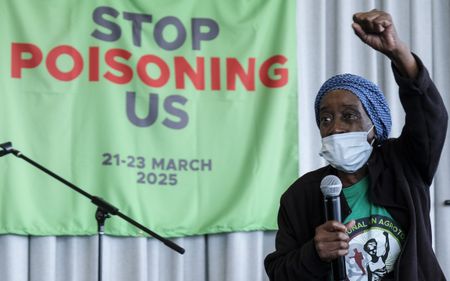
Regulatory action followed irreversible harm. The Naledi deaths did not represent an isolated lapse, but rather exposed systemic regulatory failure: highly hazardous pesticides continue to circulate through informal markets, agricultural settings and domestic spaces with insufficient regulatory oversight. Testimony before the South African People’s Tribunal on Agrotoxins has further underscored that acute poisoning incidents are only the most visible expression of a much wider structural crisis.
The deeper harm is cumulative, slower to manifest, far less visible and potentially more pervasive.
A ‘silent pandemic’ of neurodevelopmental harm
The term “silent pandemic” was coined by environmental health researcher Philippe Grandjean to describe the global burden of chemical-related neurodevelopmental harm. It does not present as mass poisoning events. It unfolds through subtle disruptions to children’s developing brains; disruptions that accumulate during sensitive windows of development, altering life trajectories.
Children are biologically distinct from adults. They absorb, metabolise and eliminate chemicals differently from their developing bodies. More critically, their brains are under active construction from before birth, through adolescence and into early adulthood. Neural systems responsible for attention, impulse control, emotional regulation and cognitive flexibility are still being assembled and refined.
During these sensitive windows, timing of exposure matters as much as dose. Exposures that appear tolerable under adult-based safety thresholds can interfere with developmental processes through cumulative encounters. This directly challenges the current regulatory paradigm built on short-term, single-chemical, adult exposure models.
What the scientific evidence from South Africa shows
Over the past two decades, the science on pesticides has shifted. So-called non-persistent pesticides (including organophosphate, pyrethroid and carbamate insecticides) may break down relatively quickly in the body and environment, but exposure is rarely a one-off event. It is chronic, patterned and embedded in daily life, particularly in agricultural areas.
/file/dailymaverick/wp-content/uploads/2024/10/ED_530080_1.jpg "Consumer Goods Council members and law enforcement officers inspect a spaza shop in Naledi on 14 October 2024. (Photo: Fani Mahuntsi / Gallo Images)")
In South Africa, longitudinal data from the Child Health Agricultural Pesticide Study, led by Professor Mohamed Aqiel Dalvie, demonstrate near-universal detection of several pesticide classes in children’s biological samples across time in multiple Western Cape farming communities. This is not merely episodic or infrequent contact; it is a consistent background of exposure, seen across multiple farming areas.
Higher average concentrations of specific pesticide biomarkers were associated with poorer performance on measures of executive function: the mental skills required to focus attention, regulate impulses, plan ahead and adapt to change.
These are not dramatic IQ collapses. They are small but statistically meaningful shifts. At a population level, such shifts can matter enormously. When many children experience slightly reduced attention or inhibitory control, classrooms become harder to manage, learning gaps widen and long-term educational attainment declines. The cumulative social and economic cost can be substantial.
Behavioural outcomes in these communities are shaped not only by chemical exposures but by a multitude of co-occurring social stressors. Environmental health scholar Rachel Morello-Frosch describes these layered exposures as “environmental riskscapes”: intersecting chemical and structural conditions that compound over time. Risk is produced across lived environments, not in isolation.
Double standards, double blow
For children in farming areas and low-income communities, pesticide exposure is a double blow. Social vulnerability heightens biological susceptibility: poverty, food insecurity and limited healthcare compound toxic harms. Simultaneously, neurotoxic exposure can erode the very cognitive capacities children rely on to navigate structural adversity, deepening inequality across the life course.
This is not accidental. It reflects what Brazilian geographer Larissa Bombardi calls “chemical colonialism”: pesticides banned or tightly restricted in the Global North continue to be manufactured, exported and used in countries such as South Africa. The asymmetry is clear. Children here remain exposed to chemicals deemed too hazardous elsewhere. Our biology is universal; regulatory protection is not.
South Africa must confront an uncomfortable reality: without stronger safeguards, we risk becoming a dumping ground for highly hazardous chemicals that wealthier nations no longer accept or use within their own borders. Refusing that role is not anti-agriculture; it is pro-children and pro-justice.
Outdated law in a modern risk landscape
South Africa’s primary pesticide statute, the Fertilisers, Farm Feeds, Agricultural Remedies and Stock Remedies Act, 1947 (Act No. 36 of 1947) was drafted in a pre-constitutional era focused on agricultural productivity, not cumulative exposure, developmental neurotoxicity or environmental justice.
/file/dailymaverick/wp-content/uploads/2024/10/IMG_71111-1.jpg "An inspection officer holds the banned insecticide found inside a spaza shop in Naledi, Soweto. (Photo: Lerato Mutsila)")
Risk assessments currently rely heavily on industry-generated data. They typically evaluate single chemicals rather than mixtures, model adult exposures rather than developmental vulnerability, and inadequately address chronic, low-dose effects. Post-market surveillance is limited. Enforcement capacity is constrained. Unregulated informal markets flourish. Oversight is fragmented across government departments, diffusing accountability.
This is not a lack of knowledge. The scientific evidence is growing. The constitutional framework exists. The gap lies in implementation, enforcement and political will.
Regulatory capture and structural dependence on industry data slow reform. Harm becomes politically visible only after tragedy occurs, while slower forms of neurodevelopmental erosion remain easy to ignore.
From constitutional rights to regulatory action
The implications are not merely scientific, they are constitutional.
Section 24 of South Africa’s Constitution guarantees everyone the right to an environment that is not harmful to health or wellbeing. Section 28 requires that a child’s best interests be paramount in every matter concerning them. These duties are reinforced by South Africa’s commitments under the UN Convention on the Rights of the Child, which obliges states to protect children proactively from environmental risks that threaten their development.
Precaution is embedded in domestic environmental law. Where credible evidence of risk exists, the law does not demand absolute certainty before action.
But law on paper is insufficient. Rights must be operationalised in practice. That means shifting the burden of proof towards producers of hazardous chemicals; insulating regulatory decisions from conflicts of interest; strengthening customs controls and inspections; regulating informal markets; resourcing enforcement agencies; and ensuring that phase-outs are not merely announced but implemented.
It also means making a political choice: refusing to accept weaker standards for South African children than those applied elsewhere.
/file/dailymaverick/wp-content/uploads/2024/10/ED_530087.jpg "Consumer Goods Council staff with law enforcement officers during an inspection of spaza shops in Naledi, Soweto, on 14 October 2024. This followed the deaths of six children, after they ingested a highly toxic organophosphate pesticide. (Photo: Gallo Images / Fani Mahuntsi)")
Children cannot bear the cost of delay
Children do not choose where they are born, where they live or what chemicals enter their bodies. When science shows that ordinary life in some South African communities includes repeated exposure to substances that can quietly undermine neurodevelopmental outcomes, the state has a legal and moral duty to act.
The Naledi poisonings made the cost of inaction visible in the most devastating way. But the deeper harm is slower and less visible: chronic, low-level exposures that accumulate during sensitive developmental periods, eroding attention, learning and self-regulation. This is slow violence: a disaster unfolding over time.
None of this is inevitable. It is the result of policy choices that tolerate exposure and displace responsibility onto individuals and families least able to protect themselves. We know enough. We have the legal tools. What remains is a choice: to accept a slow erosion of children’s futures, or to make prevention the default.
South Africa’s children cannot wait. DM
Paola Gabriela Viglietti is based at the University of Cape Town’s Department of Public Health and the Centre for Environmental and Occupational Health Research.