




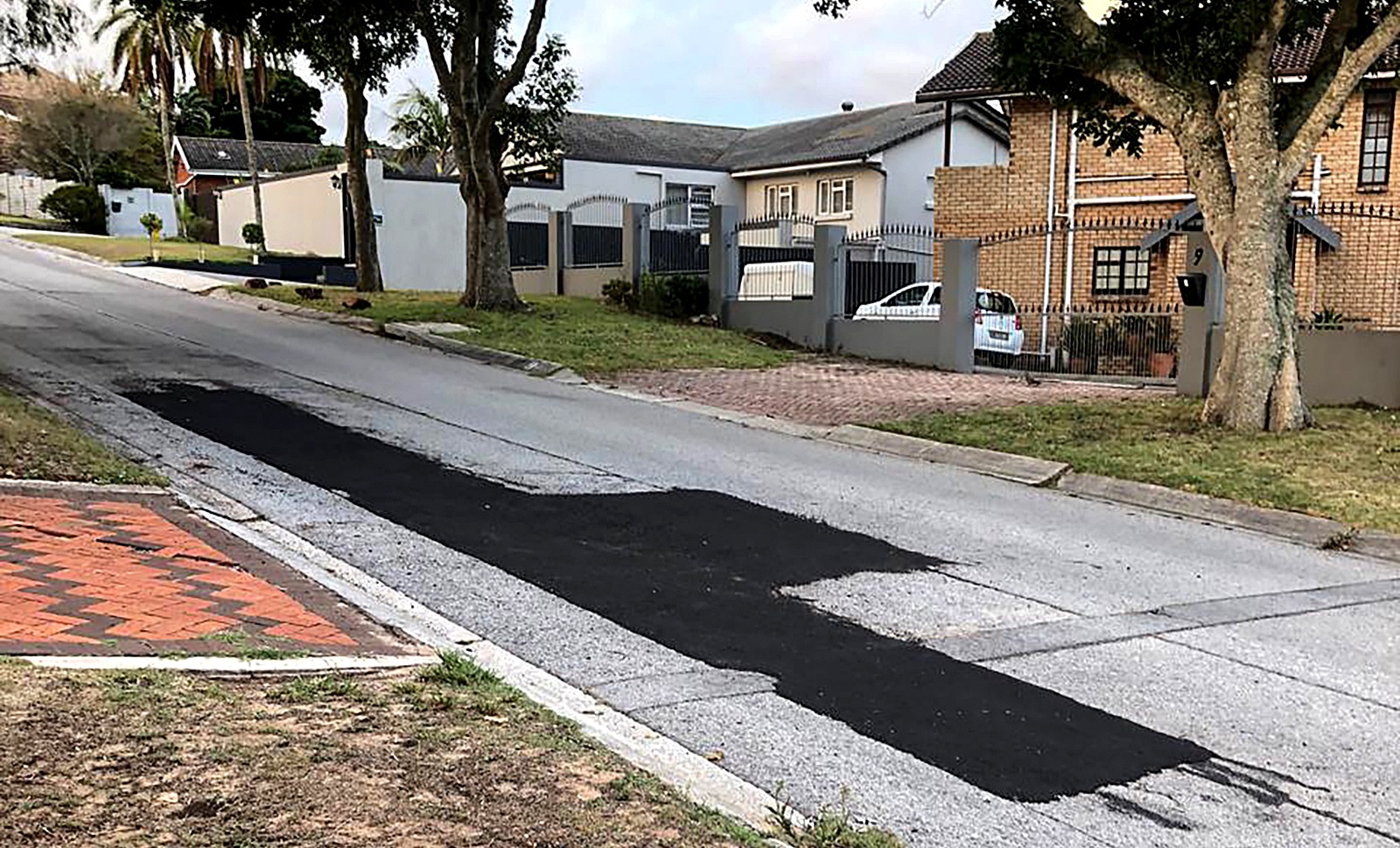
 Nelson Mandela Bay Municipality took nearly ten months to attend to four potholes in Lovemore Heights, Gqeberha. When workers eventually arrived, they only repaired one of the four potholes. (Photo: Supplied / William Dryden)
 In Nelson Mandela Bay’s Lovemore Heights, four potholes have claimed Louise Michael Drive as their own for almost a year. And then, when municipal crews finally showed up to do repair work only one was fixed – leaving the other three to fester like stubborn tenants who refuse to pay rent.
For nearly a year William Dryden, a Lovemore Heights resident, repeatedly contacted the Nelson Mandela Bay Municipality, urging it to repair the four big potholes on Louise Michael Drive – with little to show for his efforts.
A tale of four potholes
“We contacted the municipality on 23 April [2025] to report the four potholes on our street. We even were given a reference number,” Dryden said.
In theory, a reference number signals that a complaint has entered the system. In practice – especially in a municipality sych as Nelson Mandela Bay – it is a bureaucratic receipt acknowledging that yes, the problem exists, but won’t be solved any time soon, as the Louise Michael Drive situation illustrates.
/file/attachments/orphans/2_470792.jpeg "One of the largest potholes on Louise Michael Drive remains unrepaired, despite repeated complaints to the municipality. (Photo: Supplied / William Dryden)")
In early February 2026, after nearly 10 months of waiting, municipal workers finally arrived to repair the potholes. For a brief moment, Dryden said, there was relief at the sight of municipal teams making good on their promise. But the optimism proved short-lived.
“They repaired only one large pothole on Louise Michael Drive. The others were left completely untouched,” Dryden said. “The one is nicely covered, but there are still three remaining potholes. We were absolutely surprised and shocked to see that the others weren’t fixed.”
One can almost picture the scene: high-vis vests glowing in the morning sun, machine drilling louder than the usual 5am hadedah chorus, bright orange traffic cones to show that the crew mean business – at last, something is happening.
And then, with haste, the tools are packed away while three potholes remain exactly as they were – unbothered and disrespectfully unfilled.
Read more: Pothole payback — A 21-month battle for a R40,000 payout from Nelson Mandela Bay municipality
Dryden says the consequences are more than cosmetic.
He said: “Further up the road, there is a large pothole in the centre of the lane, which forces drivers to move out of the way for oncoming traffic before they can proceed.
“There are also several other potholes that are large enough to cause serious damage to vehicles,” he added.
Outside his home, Dryden said, another sizeable pothole lies directly in the path of exiting vehicles.
“I have to be very careful when leaving my property to avoid damaging my tyres,” he said.
Dryden was at a loss to explain the selective repair job. He said that it appears that whoever instructed the repair team “did not provide clear instructions to fix every pothole”.
He says the process of reporting – and then re-reporting – the potholes has been painstaking, and as a responsible resident he followed the proper channels.
/file/attachments/orphans/3_823962.jpeg "Residents of Louise Michael Drive say they have reported the hazardous potholes numerous times, but no repairs have been carried out to date. (Photo: Supplied / William Dryden)")
“After the incomplete repair, we attempted to contact the municipality through their hotlines. However, the lines just ring and ring, and the calls are often disconnected before reaching anyone. Even when you do get through, you are frequently cut off. We have tried three or four times, only to be told that the calls were dropped. It has become clear that these attempts are a waste of time,” he said.
Why this basic service delivery delay happened is something only the Nelson Mandela Bay Municipality could possibly explain.
When asked on 19 February why only one pothole had been fixed – and why it took the municipality nearly a year to do even that – the municipality did not respond. A follow-up media inquiry with municipal spokesperson Sithembiso Soyaya on 20 February prompted this answer: “The response is currently being finalised”. True to form, much like the city’s pothole repairs, that response never materialised.
If a response is received from Soyaya, it will be included.
In its Integrated Development Plan in 2025, Nelson Mandela Bay reported that the city has a backlog of 630km of unsurfaced roads. According to the report, it will cost about R7-billion to eliminate this backlog.
The report reads: “This backlog has occurred largely because the housing development programme, funded by the provincial government, only includes sufficient funding for gravel roads.
“In addition, there is a backlog of 160km sidewalks (non-motorised transport) with an estimated cost of R400-million. Furthermore, the Municipality continues to face the challenge of inadequate road maintenance resulting in potholes on municipal roads.
“The poor road conditions can also be attributed to the impact of climate change resulting from flooding as well as illegal use of roads by heavy good vehicles. A draft Comprehensive Integrated Transportation Plan is in place.”
When the city won’t, Gatvol (PE)ople will
Not everything involving potholes in the city is a complete disaster. Gatvol PE – a community initiative whose name aptly captures both public frustration and the act of filling potholes – has decided to stop waiting and start fixing.
Gatvol PE is an initiative of the Vistarus Mission Station, a centre for homeless individuals where participants gain skills and earn an income by filling potholes, helping them sustain themselves.
“Besides that we are also working towards improving and uplighting our city. At the core is to make our city safer and to ensure the safety of our road users. But we also want to give residents hope,” Gatvol PE team leader Christian Lamprechts said.
/file/attachments/orphans/560008807_796799459896442_3295199626137763357_n_959640.jpg "A pothole patched up by Gatvol PE members using its own tar mixture. (Photo: Facebook / Gatvol PE)")
Lamprechts said Gatvol PE has filled an estimated 200 potholes over the past year, making the city’s roads a tad safer for motorists.
Receiving no support from the state, it generates its own income and relies on donations and sponsorships. The tar mixture its members produce is a key source of income.
“People have been responding positively to the project. There’s been massive buy-in from the community. Residents are seeing the vision and the work we’re doing – we’re being proactive and finding solutions,” Lamprechts said.
He said residents can either report a pothole on the project’s website and pay R250 per repair, with most fixes carried out on Thursdays, or they can purchase the Gatvol PE-tar mixture and fill the potholes themselves. DM