




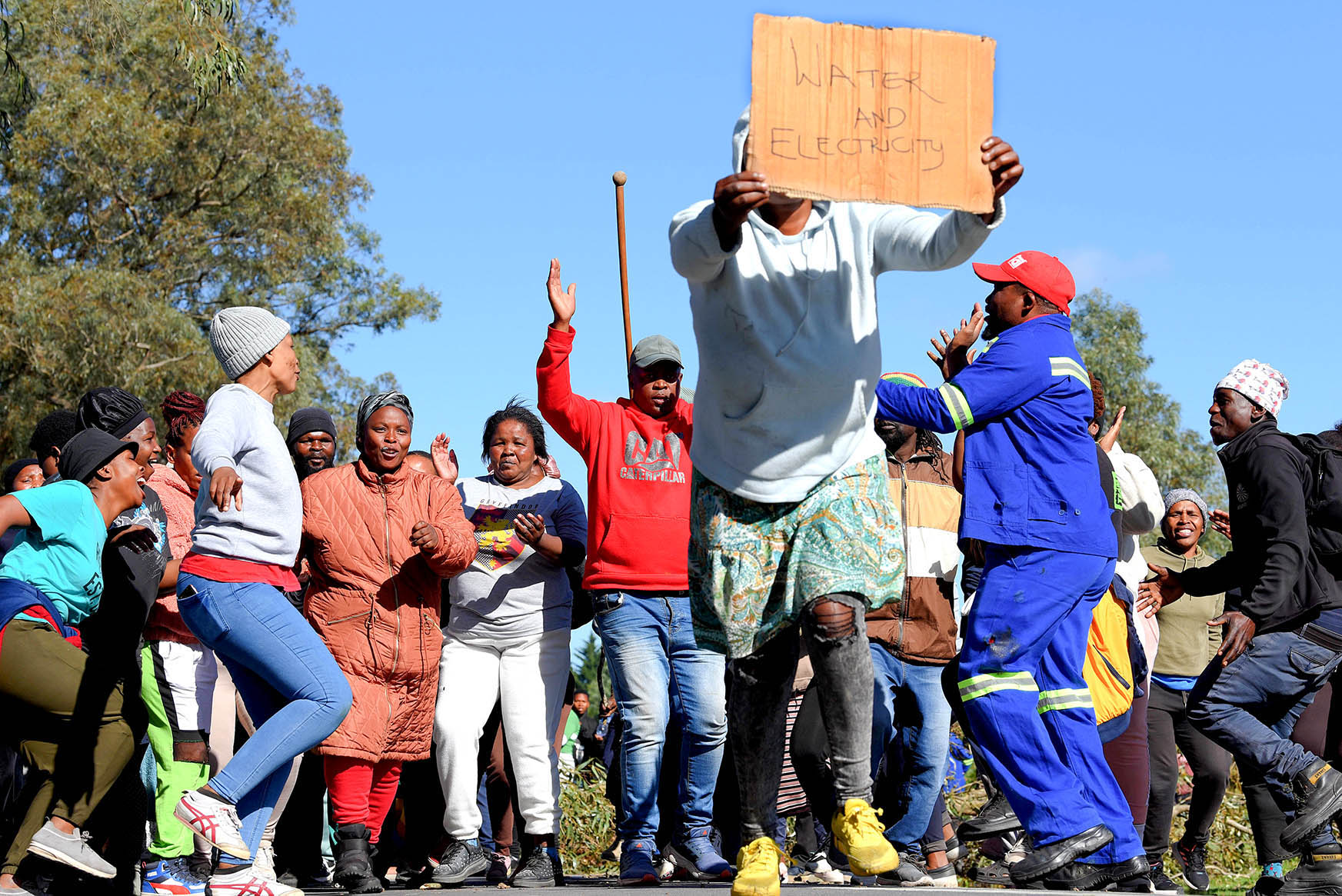
 Grogro residents are waiting for feedback from the Nelson Mandela Bay Municipality after protesting on 11 February over basic service delivery and promises of temporary services that never materialised. (Photo: Deon Ferreira)
 The community of Grogro has withdrawn into an uneasy ceasefire with the Nelson Mandela Bay Municipality as metro representatives have reopened negotiations with the owner of the land where the informal settlement is situated.
But the question hanging in the air is whether or not the two parties will be able to meet each other somewhere in the middle, as there still seems to be a R74-million difference between what Mayor Babalwa Lobishe thinks the metro should pay and the last private offer that was on the table.
And while officials say the figures being discussed are way too high for the property in question, the owner, Dr Albert van Rooyen, said an engineering report detailing the land’s development potential shows otherwise – as well as offers from other potential buyers.
Frustration boils over
The residents of the Grogro informal settlement first took to the streets in October 2025, after the municipality severed the illegal electricity connections that fed power to the about 1,000 people living on the plot of land just off Kragga Kamma Road.
Frustrated after 40 years of living without basic services, residents used burning logs, stones and other debris to block the road, disrupting traffic and businesses along the busy route.
/file/dailymaverick/wp-content/uploads/2025/10/DSC_1517-copy.jpg "Deputy mayor Gary van Niekerk addressed the Grogro community in October, promising to provide temporary services. (Photo: Deon Ferreira)")
Promises of temporary infrastructure, in the form of a transformer, were made to appease the residents, who blocked off one of Gqeberha’s arterial routes, linking businesses, farms and private homes to the rest of the city.
However, these promises could not be fulfilled as municipal laws bar spending public funds on infrastructure on private land.
Read more: NMB politicians warn R7m electricity promise to informal settlement could break rules
Subsequently, communication with the community leadership of Grogro broke down, and on Wednesday 11 February, dozens of residents once again blocked off Kragga Kamma Road with burning debris. The protesters also clashed with members of the public order policing unit and demanded a meeting with the mayor.
Lobishe’s new promises were met with scepticism, but the community agreed to stay their hands from further protests to give the city officials time to resolve the issue.
Lobishe said talks with the landowner were ongoing, but the R80-million price tag for the 85ha piece of land was far too high, and estimated that the land could not be worth much more than R6-million.
Relocation suggestion elicits mixed response
Alternatively, the residents of Grogro will have to be relocated to another development, N2 North, on the western outskirts of the city. This suggestion was met with a mixed response from the community, ranging from unhappy to outraged.
/file/attachments/orphans/GrogroMayor1_714262.jpg "Nelson Mandela Bay mayor Babalwa Lobishe and several high-ranking city officials met with the community of the Grogro informal settlement to negotiate terms for them back down from their protests and to reopen Kragga Kamma Road. Grogro and the municipality have been at loggerheads since October when they demanded electricity after the metro removed the illegal connections they were using. (Photo: Riaan Marais)")
When contacted for comment, Van Rooyen confirmed that a law firm contacted him on behalf of the metro and that discussions over the land were ongoing.
Asked about the R80-million Lobishe mentioned, Van Rooyen said he did not want to discuss specific figures, but confirmed that he had received similar offers in the same ballpark.
In 2018, he appointed an engineering firm to conduct a study on the portion of land in question and what possible development could be done there.
Potential uses for the land
The study, of which Daily Maverick has a copy, detailed the potential use of the land, taking into consideration what the surrounding suburbs offer and developments on similar properties in recent years.
It also took into account that a certain percentage of the area will have to be preserved for its natural vegetation, in accordance with legislation, and that roads will have to be built to facilitate traffic through the area.
“[The property] is located approximately 15km away from the Port Elizabeth City Centre and even closer to the Bay West Mall development. This locality thus seems suitable for development being inside the urban edge as well as close to a major commercial node,” the report read.
While the land is currently zoned for agricultural use, the report stated that because of the proximity to the Bay West Mall, the property could be rezoned to accommodate extensive business development.
However, the more likely scenario would be to rezone it for residential use, and to build a series of housing complexes, similar to developments in neighbouring suburbs such as Sherwood and Lorraine. In that case, the report stated, the property could accommodate upwards of 3,000 housing units of varying sizes.
“The total number of residential opportunities in terms of this calculation is 3,373, of which the majority is for 1,537 flats, 1,110 for single residential sites and 726 for semi-detached units.”
Van Rooyen had said that before acquiring the engineers’ report, he had already received offers of large sums of money from several interested parties for the property.
Between 2005 and 2008 he had three offers, ranging between R30-million and R75-million. However, the sales never proceeded because all three offers were on condition that the land be vacated.
One of the offers stated that “the seller lawfully and permanently removes all squatters and/or unlawful occupants currently residing on the property”.
“I have been in contact with attorneys appointed by the municipality, who said they want to finalise a deal as soon as possible. I really hope we can come to some kind of agreement, for the sake of everyone involved,” Van Rooyen said.
Market analysis report under way
Following the mayor’s engagements with the community on 11 February, the municipality released a statement saying that Lobishe returned to Grogro the next week to inform the community that engagements with Van Rooyen were under way.
She said that a municipal valuator was also sent to assess the site and conduct a market analysis of the potential value of the property. That report should be complete soon.
With regards to a possible relocation of the Grogro settlement to N2 North, the municipality is in communication with the provincial Department of Economic Development, Environmental Affairs and Tourism to acquire the necessary environmental authorisation.
The municipality said relocation can start after the department’s go-ahead, but anticipated it could take between six to 18 months. DM