




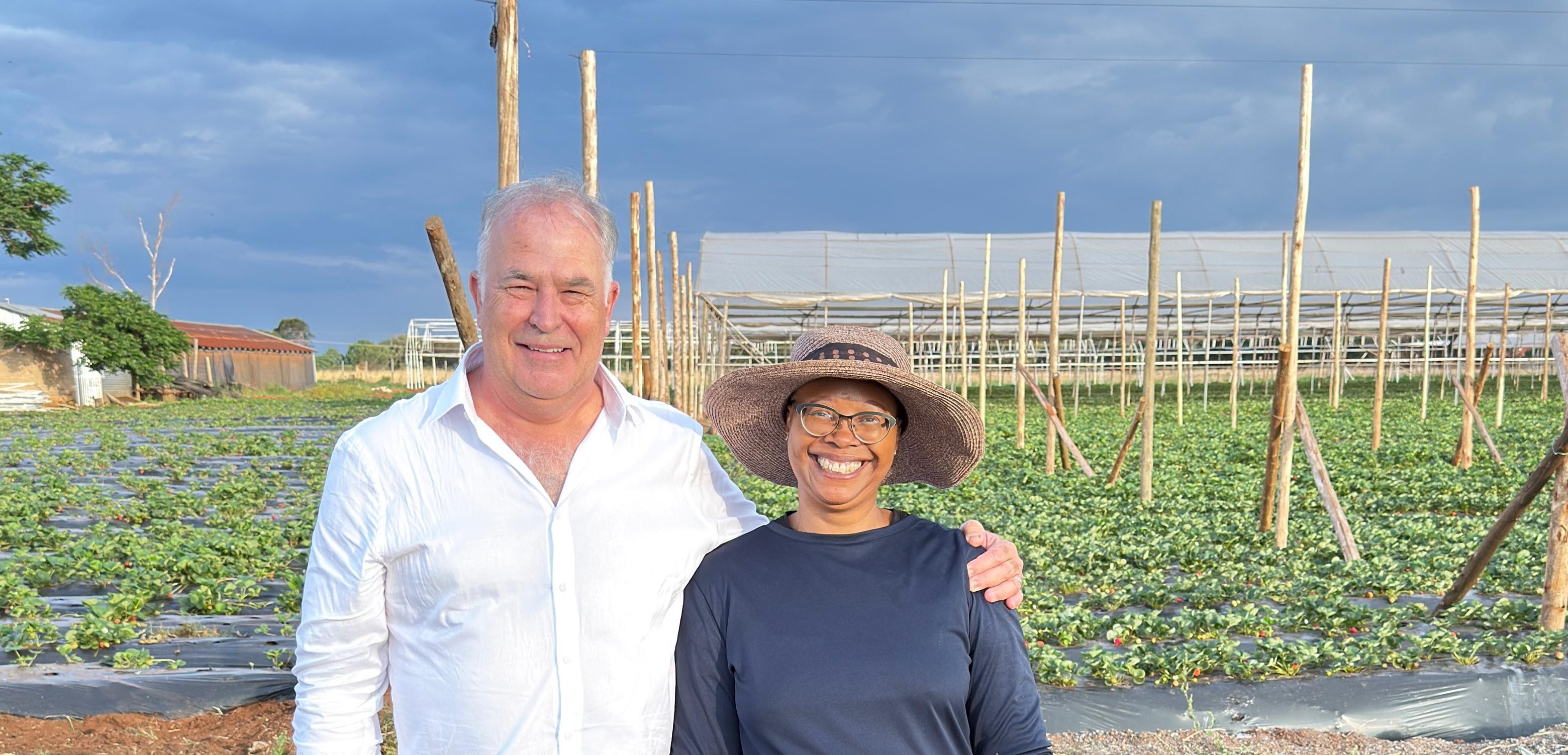
 Baden Jacka with Zimbili Mosheshe the owner of Toberri strawberry farm who has recently started supplying Woolies with strawberries from her four hectare farm.
 This financial year marked a significant milestone in Woolworths’ social justice journey. For the first time in the history of the Woolworths CEO Excellence Awards, the top honour was awarded for social justice impact.
The Woolworths CEO Excellence Awards recognises outstanding performance across the business from its stores and distribution centres to its head office support teams.
Baden Jacka, Trading Head of Fresh Produce and Horticulture, received the grand prize for his leadership in expanding market access for Micro, Small and Medium Enterprises (MSMEs). His work reflects a deeper shift, one in which commercial leadership and inclusive justice are no longer separate pursuits, but mutually reinforcing ones.
We spoke with Baden about what the CEO Excellence Award for social justice impact means to him, and his work at Woolworths.
How did you feel when you won a Woolworths CEO Excellence Award for Social Justice Impact?
I was both surprised and deeply honoured. I come from a modest background where equality was a non-negotiable value. My father instilled in us the importance of “doing the right thing”, regardless of what others choose to do. It’s a simple principle, but one I try to live by every day.
As a Trading Head at Woolworths, supporting the growth of MSMEs forms part of both our strategy and our values. For me, that means actively looking for opportunities to bring small and emerging suppliers into our business and sharing this vision with my team. MSMEs have the potential to create much-needed jobs and to contribute meaningfully to South Africa’s inclusive economic growth.
One of the biggest barriers small suppliers face is access to market. Woolworths has a significant and trusted market presence, so opening that access is transformative. Integrating MSMEs into our supplier base not only strengthens our business through greater diversity and resilience but also helps grow the broader economy.
How have you been contributing to transforming Woolworths’ supplier base?
Before moving into fresh produce and horticulture, I was the Trading Head of Woolworths’ Gifting, Snacking, Confectionary and Beverages, which included wine. My background had largely been in the perishable side of the Foods business, so this role exposed me to a new part of Woolies Foods. Entering a new category gives you the advantage of bringing fresh perspectives while also learning deeply about the industry.
Within the wine portfolio, I was particularly interested in the opportunities our business could create for smaller, especially black-owned, producers. While the South African wine industry has historically been dominated by established, often family-owned businesses, I saw an opportunity within our own branded wine portfolio, to partner with smaller, particularly black-owned suppliers enabling them to benefit from Woolworths’ scale and market reach.
We identified Koopmanskloof Vineyards and Paardenkloof Estate as partners who aligned to our quality and brand standards and began collaborating on the production of our Woolworths house wines. Koopmanskloof Vineyards was awarded Woolworths Foods’ SME Supplier of the Year in 2025, a recognition that was incredibly rewarding for me. The wines we developed together have delivered excellent quality, matching, and in some cases exceeding, previous ranges while demonstrating what inclusive supplier partnerships can achieve.
Five years ago, I left Long-Life to lead Woolworths’ Fresh Produce and Horticulture. I welcome change because it creates opportunities to learn and to rethink established ways of working. Woolworths has partnered with small farming businesses for many years, but the path has not always been easy. Small and emerging farmers are particularly vulnerable to adverse changing weather patterns which threatens their productivity and sustainability. Our centralised distribution model means that produce often needs to travel considerable distances from rural farming areas. To maintain our quality standards, our fresh produce must enter the cold chain immediately after harvesting and remain within it until it leaves our stores with our customers. For small and emerging farmers, meeting these logistical and technical requirements can be complex and resource intensive.
With the support and expertise of the Woolworths Enterprise Inclusive Justice Institute (EIJI), an independent non-profit company dedicated to small business development and breaking barriers to economic inclusion, and the commitment from my Produce team we have begun to challenge some of our traditional approaches and unlocked more practical pathways to participation. In a relatively short time, and without compromising on Woolworths’ quality standards my team has onboarded several small and emerging farmers (some of which are women farmers) into our fresh produce supplier base.
It remains a work in progress and there is lots to learn and improve on. However, with the right partnerships, technical support and a shared commitment, we are confident that we can make a meaningful contribution to building a more inclusive and resilient supply chain.
Tell us about your involvement in the Woolworths’ Community Inclusive Justice Institute (CIJI) Living Soils Community Learning Farm.
Seven years ago, Woolworths partnered with our supplier, Spier Wine Farm and the Sustainability Institute to establish the Living Soils Community Learning Farm (Living Soils), in Stellenbosch. The objective was to create a working learning farm to empower and upskill young and emerging farmers especially women farmers with practical skills in regenerative agriculture, enabling them to grow nutrient-rich foods to improve community food security.
Last year, working closely with Woolworths’ Community Inclusive Justice Institute (CIJI) who drives Woolworths’ social impact programmes including Living Soils, I was involved in introducing a “Farmers Day”. The initiative brought Woolworths suppliers to the Living Soils farm to meet graduates and engage directly with their work to help address access to employment which is one of the most significant barriers graduates face. Students were given the opportunity to present their farming projects and demonstrate their capabilities to potential employers. The results have been encouraging in that six of the 2025 graduates have already secured employment in the agricultural sector following the event.
When Living Soils was created, the intention was to create a viable model of community-based food security and the sustainable development of local livelihoods that could be replicated all over South Africa. We are therefore pleased that the second farm in the Living Soils expansion programme is scheduled to open in March in partnership with our long-standing supplier of salads and vegetables Harvest Fresh in Gauteng.
Harvest Fresh’s strong commitment to responsibly grown produce and its ten-year participation in our regenerative farming programme Farming for the Future made them a natural partner for the next phase of Living Soils. Its operations will provide students with valuable exposure to hydroponic farming systems, a commercial nursery as well as high-care processing facilities, where our mixed leaf salads and diced vegetables are prepared and packed. This experience will further strengthen the graduates’ technical capability and employment readiness.
I am looking forward to visiting our Gauteng Living Soils farm and creating similar opportunities for supplier interaction, helping to accelerate pathways into meaningful employment within the agricultural sector.
Woolworths’ broader commitment to social justice
Woolworths believes that social justice is a cornerstone of a stable, inclusive, and sustainable business environment. The company has a long history of supporting social justice and recently established an Inclusive Justice Institute which is home to two non-profit companies: the Community Inclusive Justice Institute (CIJI) and the Enterprise Inclusive Justice Institute (EIJI).
“Our purpose as a business has always been to add quality to life, not only for our people and customers, but also in the value chains and communities where we operate,” said Group CEO Roy Bagattini. “The Inclusive Justice Institute aligns with our vision to be one of the world’s most responsible retailers. It underscores our deep commitment to addressing social justice in a meaningful way.”
In a short time, the launch of the Institute has energised Woolworths’ social justice efforts across the business and ignited meaningful partnerships with other organisations in South Africa. Woolworths employees have also embraced this work and stepping forward as ‘Social Justice Champions’. DM
/file/attachments/2988/0000WORLDDAYOFSOCIALJUSTICE_BANNER_2025_1900x370_867237.jpg)