




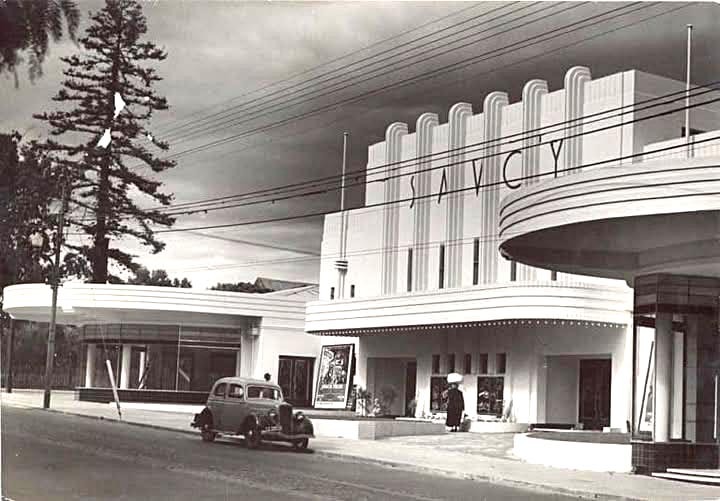
 When the Cinerama in Rosebank, Cape Town, was gutted, the builders found the façade of the original Savoy Cinema (opened 1937) behind – with thanks to the Brandon Platt Collection. Photo taken circa 1988. (Photo: Independent News Archive / Facebook)
 Once, there were hundreds of bioscopes across South Africa: inner-city big-screen cinemas, tearooms, biocafés, bughouses and, yes, romantic drive-ins. The magic of story, imagination and the silver screen was everywhere, even during apartheid, in townships, where films were screened in multipurpose halls, churches and community centres.
In Cape Town, some had names like The Grand, Monte Carlo and Old Tivoli. District Six alone boasted nine movie houses. Nine!
Many Cape Town venues drew mixed audiences, mostly so-called coloured people and whites. They were little secret caves where social barriers dissolved in the shared darkness of cinema.
Today, apart from The Labia Theatre, the intimate magic of the big-screen experience is vanishing. Over the past decade, South Africa has lost roughly 25 locations.
Earlier this year, Daily Maverick reported that the industry, once employing almost 32,000 people and generating more than R7-billion a year, has been halted by bureaucratic inaction within the Department of Trade, Industry and Competition.
It’s a tragedy. And in these dark times, I return to my comforting memories of bughouses. These were not elegant palaces. They were smutty, forceful, wayward, independent.
In Cape Town, I remember the Pigalle, the Piccadilly and the Roxy, grimy shrines where pickpockets worked the crowds, couples smooched, smoke hung thick and Bruce Lee chopped through a haze on screens so blurred you had to squint.
They were intimate spaces indifferent to comfort or rules, vast, foggy arenas where strangers sat shoulder to shoulder, sharing something that can never be replicated. Walk back with me to the bughouses of my youth.
1
It was the early Seventies. South Africa had no TV until 1976. Cape Town felt like a small town, because it was.
I was about 12 when, on another pale, windy Saturday afternoon, I walked down Adderley Street. Plastic bags whipped through the air. People wandered aimlessly, window shopping for distraction, while second-hand bookshops offered another kind of escape.
Then my life changed. At the top of Adderley Street, I saw a cinema poster advertising Enter the Dragon with Bruce Lee. Posters for two more of his films flanked it. The cinema was the Pigalle Tea Room. Three films for 14 cents. I went down the stairs, pulling aside a filthy curtain.
Behind the green Formica counter there were soggy pies with dirty looks from the counterhand. Coke, slap tjips, cigarettes, popcorn, chewing gum, red toffee apples, candyfloss and those pink sweets with messages like Return to Sender. Large cans of Ricoffy and Red Rose tea stood on a trolley, served in polystyrene cups.
The woman who served you had a cigarette perched at the corner of her mouth, her face like Maggie Smith’s in Downton Abbey when she disapproved. She slammed my change down. Bang. I pulled another curtain aside and stepped into a theatre with a massive screen.
/file/attachments/orphans/41xiKFHLoAL_SL500_642154.jpg "Bruce Lee was a hot favourite in sleazy bughouses across South Africa. Teenage boys copied his moves and watched his films again and again.
<br>(Image: Goodreads / Wikipedia)")
(Image: Goodreads / Wikipedia)
Bruce Lee’s fists flew across the necks of villains. The cigarette fumes made the screen pale blue. I sat through all three films. My relationship with bughouses and tearoom cinemas had begun.
I would take my tjommies along and when we left the movie house, we would copy Bruce Lee’s moves, all the way back home, “fighting” on the pavements as if hoodlums.
The patrons of these tearooms were oddballs, outcasts, some drifters, all drawn to spend days in these murky grottos. Over time, Pigalle became “Pie-Gah-Lie” in local patois, the correct pronunciation sounding too grand.
/file/attachments/orphans/BritishBioscopeinDistrictSixcirca1970PiccourtesyofEtienneDuPlessis_911684.jpg "The British Bioscope in District Six circa 1970. There were nine multiracial bioscopes in the neighbourhood, always packed, specifically over weekends. As a child I went to a few. (Photo: Courtesy Etienne du Plessis)")
/file/attachments/orphans/bijou_689902.jpg "The building in the photo is the historic Bijou Theatre (also known as the Bijou Bioscope or old Bijou Cinema), an Art Deco gem located on Lower Main Road in Observatory, Cape Town, not Woodstock, though the two suburbs border each other closely (often confused in casual references, especially as the area around the Woodstock/Observatory line has gentrified). It opened in 1941, designed by architect William Hood Grant, and operated as a cinema until around 2002 (some sources say it ceased cinema use earlier).<br>(Photo: Cape Historical Society / Facebook)")
(Photo: Cape Historical Society / Facebook)
/file/attachments/orphans/AvelonCinemainDistrictSix_866709.jpg "The Avalon Cinema in District Six, circa 1970. (Photo: Google)")
One article in the Cape Argus haunted me. A young man, asleep at the back, had been left there when they closed one Saturday night. He stayed in the dark until Monday morning. That was the Seventies.
No movies on Sundays. Later, theatres evaded this with midnight shows, starting one minute after midnight on Mondays. A small, silent rebellion against the stringent Dutch Reformed Church and the dour Nats.
2
Then I discovered the Piccadilly Tea Room Cinema in the old Picbel Parcade. In Waterkant Street. Here, short interludes of entertainment interrupted the films.
/file/attachments/orphans/468909270_10160041630122003_8631604694225628111_n_941330.jpg "The Pigalle and Picadilly (sic) Tea Rooms’ prices in Cape Town’s CBD stayed at 14c for most of the 1970s. Three films for that price, about 4.6 cents per movie. You could leave after the first one and return later the same day without paying again. (Image: Google)")
/file/attachments/orphans/SeaPoint_640679.jpg "The photo of the Adelphi Kinema (also called Adelphi Cinema) in Sea Point, Cape Town, on Main Road at the corner of Rhine Road, dates from the late 1960s. It has been a shopping centre for decades.
<br>(Photo: Google)")
(Photo: Google)
/file/attachments/orphans/palace_204817.jpg "The Palace Cinema in Salt River, Cape Town, operated from the 1920s into the late 1980s. This photo is from the late 1960s to very early 1970s based on the visible cars. (Photo: Cape Historical Society / Jason Patrick Hanslo / Facebook)<br>")
One act remains vivid. An elderly man with eight spoons tossed them like circus balls, clanging some like castanets, dancing between flights. The cinema focused on Wild West films: men on horseback, fighting, whips lashing, barroom shootouts and puffy-dressed women fleeing in terror, only to fall into the arms of the dying hero. John Wayne, Charles Bronson, Clint Eastwood were the cowboys of my youth. Many of them were excellent flicks.
In hindsight, this genre was often racist, framing white cowboys as heroes and Native Americans as villains. I was too young to grasp it then.
3
The Roxy, near the City Hall, was a descent into darkness. A staircase led deep into the theatre. On the left, a kitchen served hamburgers, hot dogs, pies, ghastly but comforting. Each chair had a tray with an ashtray.
The Roxy welcomed all hues; like many others, management looked away, so did the cops. Elvis Presley films dominated. Heintje, the Dutch singer, performed his saccharine songs about grandmothers. You could watch films repeatedly. I sometimes did, each movie, twice in a row.
/file/attachments/orphans/pic8_461104.jpg "A Fistful of Dollars (1967 release in the US; original Italian premiere 1964), Sergio Leone’s groundbreaking spaghetti Western that launched Clint Eastwood as the ultimate anti-hero as The Man with No Name. It is the nickname for the mysterious, nameless rebel played by Eastwood in Leone’s legendary Dollars Trilogy of spaghetti Westerns: A Fistful of Dollars (1964), For a Few Dollars More (1965) and The Good, the Bad and the Ugly (1966). (Image: IMBd / Wikipedia)")
/file/attachments/orphans/JAILHOUSE-ROCK-9124-scaled-679x1024_545070.jpg "Elvis Presley’s film Jailhouse Rock caused a huge riot in Cape Town in the late 1950s when it was released. Ducktails went wild after the movie, smashed car windows, and then fled the scene.
<br>(Image: Wikipedia)")
(Image: Wikipedia)
At the back, the Crying Room allowed mothers to soothe babies. Over time, it became a hideaway for amorous encounters. One night, ducktails, groups of teenagers with slicked-back hair, watched Jailhouse Rock. When it ended, chaos spilled onto the streets. Chains drawn from jackets, car windows smashed, rain pouring. Sirens, blue lights, a dispersal, then silence.
Only shards of glass shimmered under the lampposts. The city, briefly, became a movie set. DM
When time was heavy...
It is tempting to call these memories cheap nostalgia. They are not. Those places allowed you to sit in the dark with strangers for hours without being productive, reachable or optimised. That is what has disappeared.
Today, the issue is not that people no longer love movies. It is that the conditions required to watch them have been dismantled. Attention is no longer something you give.
It is something that is extracted, sliced into units, monetised and repackaged. Film students now struggle to sit through feature-length films. Phones glow in theatres. Streaming platforms encourage filmmakers to hook viewers within the first five minutes. Plots are repeated so that distracted audiences can keep up while scrolling.
The bughouse cinema worked because time was heavy. You could not pause it. You could not speed it up. You could not leave without committing to the awkward ritual of climbing over knees and ashtrays. You were stuck, and in being stuck, something happened. Not revelation, necessarily, but immersion.
Susan Sontag wrote that cinema begins in wonder, the shock that reality could be transcribed and thrown back at us with such force. But that wonder depended on darkness, scale and duration. Often, a film watched on a television, a laptop, or worse, a phone, is not an experience so much as information. Like a postcard of a painting. You see it, but it does not take you anywhere.
Not because the films were better, but because the world around them moved more slowly. You were simply there, steeped in the moment.