




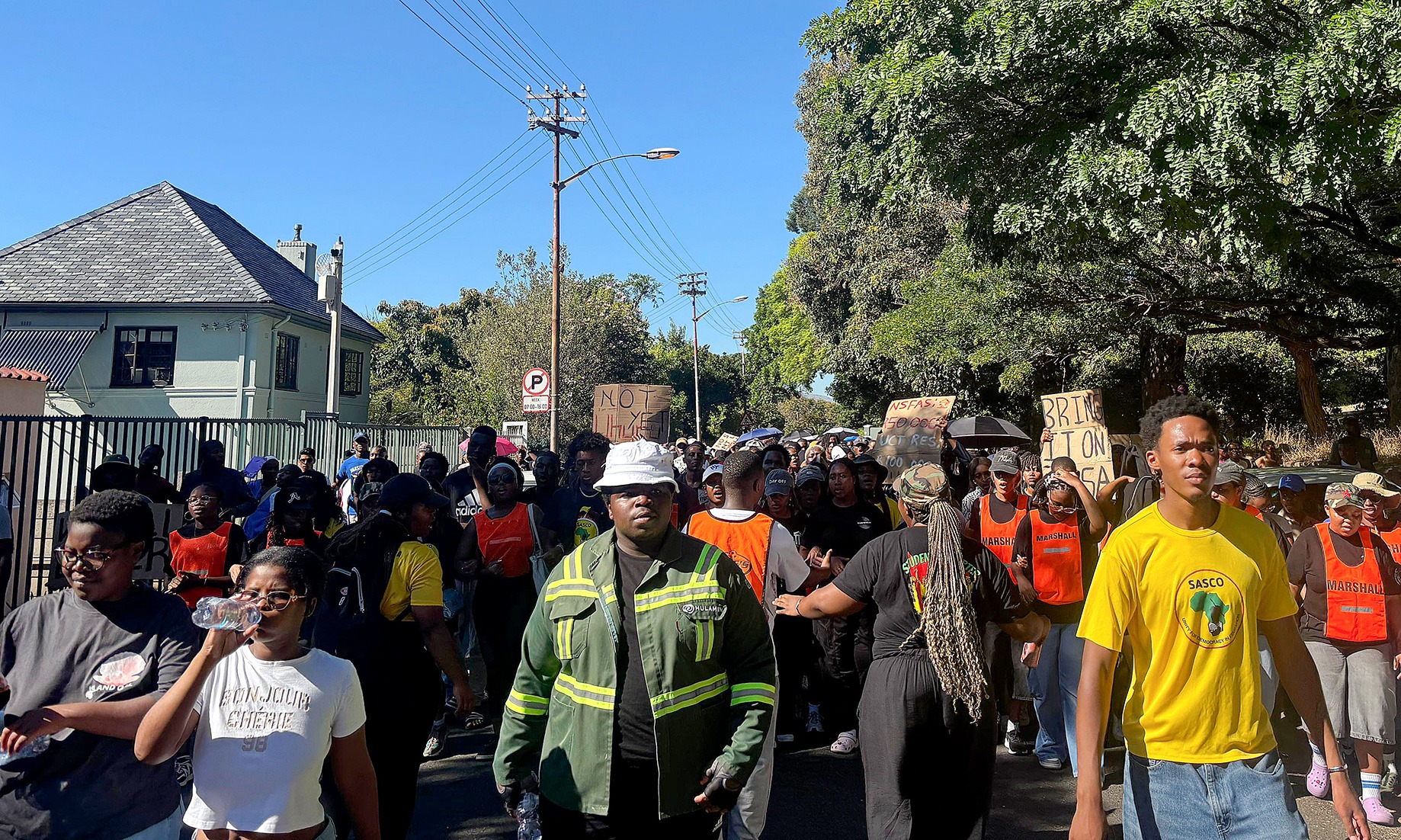
 On the first day of the academic year students blocked UCT campus entrances, including the M3 access in Rondebosch, protesting against fee blocks, student debt and accommodation shortages, on 16 February 2026. (Photo: Supplied / Khanya Mndende)
 In a statement released on 17 February 2026, the University of Cape Town’s vice-chancellor, Professor Mosa Moshabela, confirmed that nearly all remaining registration holds affect self-funded students. Of these, about 900 are postgraduates, 100 are from the Graduate School of Business and 400 are undergraduates, some of whom are still trying to settle their accounts.
On Monday, 16 February 2026, students handed a memorandum of demands to management that relate largely to registration holds for students who have incurred debt of more than R10,000, issues of accommodation and extension of registration to 20 February to allow students who are trying to raise funds to pay their debt and register, which has been approved by management.
/file/attachments/orphans/UCTstudentsprotestinginfrontoftheSarahBatmanbuildingburningandblockingtheentrancenearM3Rondeboschoverfinancialexclusion16February2026Imagesuppliedby_927940.jpg "UCT students protest in front of the Sarah Baartman Hall, burning and blocking the entrance near the M3 entrance, over financial exclusion on 16 February 2026. (Photo: Supplied / Khanya Mndende)")
While management has moved to assist those eligible for the National Student Financial Aid Scheme (NSFAS) and “missing middle” students (those with household incomes between R350,000 and R600,000), self-funded students have not seen the same blanket relief. These students are typically expected to settle their accounts or maintain a low debt level to register.
“We recognise that some of them may have genuine financial circumstances making fee payment difficult,” Moshabela stated. “For these students, we have agreed to review their appeals on a case-by-case basis, and we encourage them to accept study loans and sign an acknowledgement of debt so they can proceed with their studies.”
Student representative council (SRC) president Kitso Mojapelo told Daily Maverick that self-funded students are the ones in limbo, and their situation needs to be handled carefully: “As it currently stands at the council policy institution, for the self-funded students to register, their debt has to be below R10,000… I think as a result of that there’s a collective understanding that there needs to be a look into how we can best assist those students to come into the university, and the actioning of that is something that still needs to be taken under way.”
Asked whether students will protest anytime soon, he said: “The SRC will not be initiating any protest action.”
Registration threshold
At the university, students with outstanding fees cannot be registered. If you owe more than R10,000 you must clear the debt or make arrangements with the fees office before registration. UCT spokesperson Elijah Moholola said the previous threshold of R1,000 had been amended to R10,000 two years ago.
For Simphiwe Rasegwete, a third-year LLB student, the policy feels like a dream slipping away. He told Daily Maverick he was rejected by NSFAS because he previously had a smaller government bursary that failed to cover his full costs – a decision he says he made before fully understanding the complexities of university funding.
“We are on the third day of our studies... for each class, that’s probably five cases... 70 pages each,” Rasegwete said, highlighting the academic mountain he is already climbing while locked out of the system. “The thought of going back home and not having attained a degree is so hard... we are academically eligible to continue... we are not academically excluded; we are financially excluded.”
Rasegwete said the cost of accommodation is a hindrance to registration. “UCT residences are expensive. One residence can cost 120,000 a year. This is before you include tuition, so if you include tuition, for example, you end up with 200,000 a year. When they (UCT) say pay 50% of that, which is 100,000, it’s money we still don’t have. ”
Another self-funded student, who wished to remain anonymous, said the financial officer had said he must come up with R21,000 to register and complete his last course in computer science after changing from biochemistry.
“I am left with just one course for the first semester, then I’m done. I was told that I [must] just come up with R21,000 before tomorrow, which is not possible because I did explain that I don’t have anything, and I don’t qualify for any loan. My only guardian is my grandmother, who’s dependent on Sassa. I had NSFAS... it was on a provisionally funded status, but I didn’t get funding, I’m not sure what happened… So my only option now is to find a job, which means I’m going to have to give up on this degree that I was already in the finish line for,” the student said.
/file/attachments/orphans/WhatsAppImage2026-02-16at083310_838304.jpeg "Traffic officers have closed the entrance to UCT’s Upper Campus, directing vehicles back onto the M3.<br>(Photo: WhatsApp parents group)<br>")
(Photo: WhatsApp parents group)
The accommodation dilemma
Despite student concerns about housing, Moshabela maintained that UCT is not facing an accommodation crisis, noting that about 852 beds remain available for registered students.
However, the SRC’s Mojapelo argued that bed availability does not solve the issue of affordability in a city like Cape Town. “Property prices in Cape Town are continuously impacting the issue at hand of financial exclusion,” he noted, calling for a more financially sustainable, long-term resident system. DM