




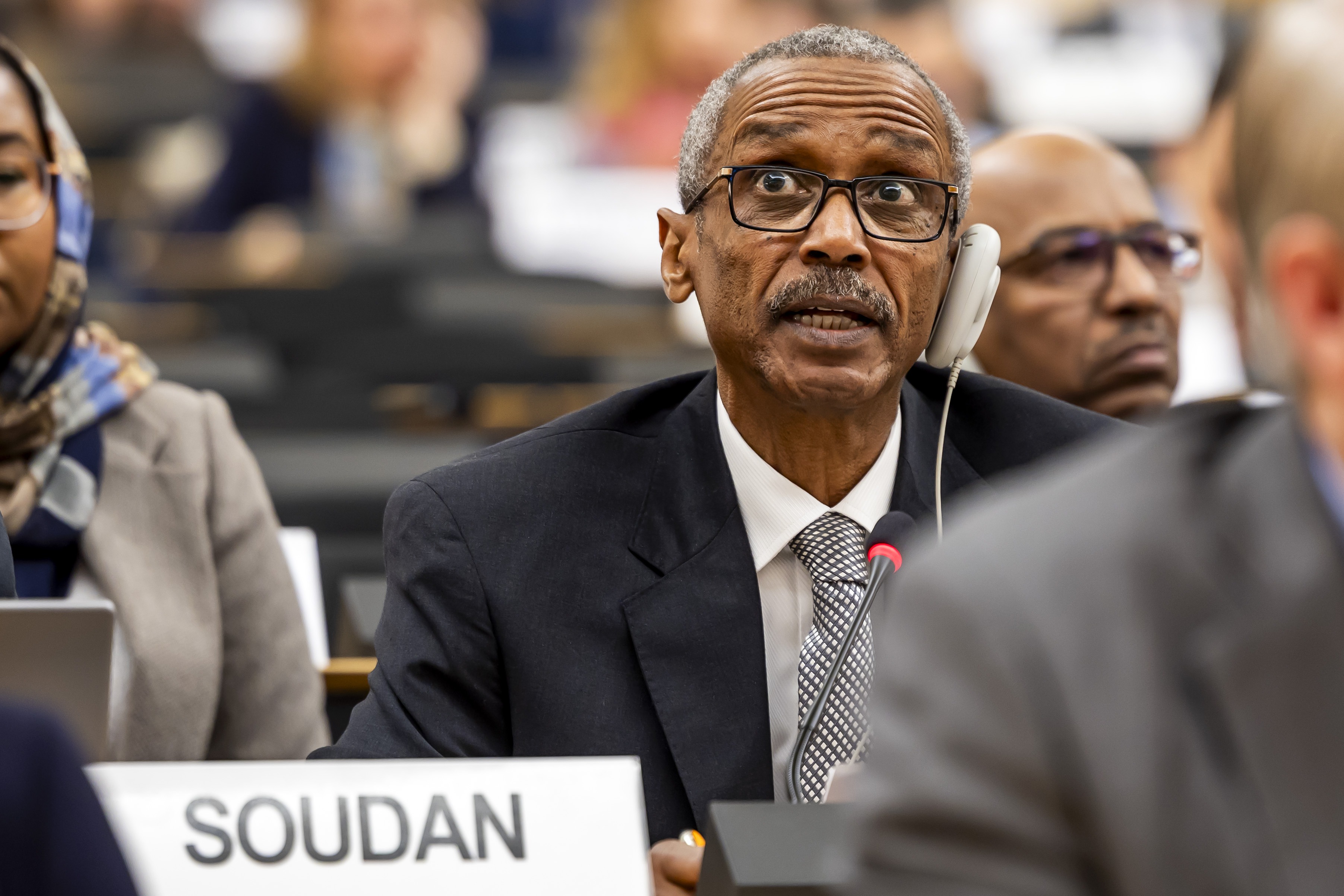
 Ambassador Hassan Hamid Hassan, the Permanent Representative of Sudan to the United Nations Office in Geneva, delivers his statement during the Human Rights Council Special Session on the Human Rights Situation in and around Sudan's El Fasher, at the European headquarters of the United Nations in Geneva, Switzerland, 14 November 2025. The special session, requested by Britain, Germany, Ireland, the Netherlands and Norway, will discuss the situation in and around El Fasher, North Darfur, which fell to the Rapid Support Forces (RSF) on 23 October after an 18-month siege, sparking reports that crimes under international law are being committed. EPA/SALVATORE DI NOLFI
 At the end of October last year, the RSF took over the city - which had been the last remaining stronghold of the Sudanese Armed Forces (SAF) in the Darfur region in the west of the country - with thousands of people killed and raped during three days of horror, the UN Independent International Fact-Finding Mission for Sudan said.
It followed an 18-month siege where the RSF imposed conditions of life calculated to bring about the physical destruction of non-Arab communities, in particular the Zaghawa and the Fur, the report stated.
The U.N. mission said it found evidence that the RSF carried out a pattern of coordinated and repeated targeting of individuals based on ethnicity, gender and perceived political affiliation, including mass killings, rape and torture, as well as inflicting conditions of life calculated to bring about the group’s physical destruction - core elements of the crime of genocide under international law.
The final draft of the report was shared with the Government of Sudan but no response was received, while the RSF did not respond to the U.N. mission's request to meet with its leadership, the report stated. The RSF and SAF did not immediately respond to requests from Reuters for comment.
In the past, the RSF has denied such abuses - saying the accounts have been manufactured by its enemies and making counter-accusations against them.
"The scale, coordination, and public endorsement of the operation by senior RSF leadership demonstrate that the crimes committed in and around al-Fashir were not random excesses of war" said Mohamad Chande Othman, Chair of the Fact-Finding Mission on Sudan.
"They formed part of a planned and organised operation that bears the defining characteristics of genocide," he added.
Before its takeover al-Fashir's population mainly consisted of the Zaghawa, a non-Arab community, while displacement camps around the area were comprised of the Fur community, as well as Berti, Masalit and Tama, the report said.
"EXTERMINATORY RHETORIC"
"Survivors describe explicit threats to 'clean' the city," the report stated. Alongside attacking displacement camps, communal kitchens and medical centres with drones and heavy weapons, the RSF also carried out killings, looting, beatings and sexual violence in al-Fashir, the report stated.
The RSF's "exterminatory rhetoric" and other violations indicated its intent to destroy the Zaghawa and Fur communities in whole or in part, the report said.
"Witnesses heard the Rapid Support Forces saying, 'Is there anyone Zaghawa among you? If we find Zaghawa, we will kill them all'," the report said.
Survivors recounted point-blank executions of civilians, as well as bodies of men, women and children filling roads, the report stated.
Women and girls aged 7 to 70 years old from non-Arab communities, particularly the Zaghawa were raped and subject to other acts of sexual violence, including whipping and forced nudity, the report stated.
British Foreign Secretary Yvette Cooper said the international response to the report and the situation in Sudan had to be emphatic and urged for a ceasefire.
"The findings of this UN report are truly horrific - atrocities including systematic starvation, torture, killings, rape and deliberate ethnic targeting used on the most horrendous scale during the Rapid Support Forces siege of al-Fashir," she said in a statement.
The U.N. mission was mandated by members of the Human Rights Council, following backing from countries that included Britain, to urgently investigate violations and abuses under international law in and around al-Fashir.
(Reporting by Olivia Le Poidevin; additional reporting by James Williams in London and Nafisa Eltahir in Cairo, Editing by Raju Gopalakrishnan)