





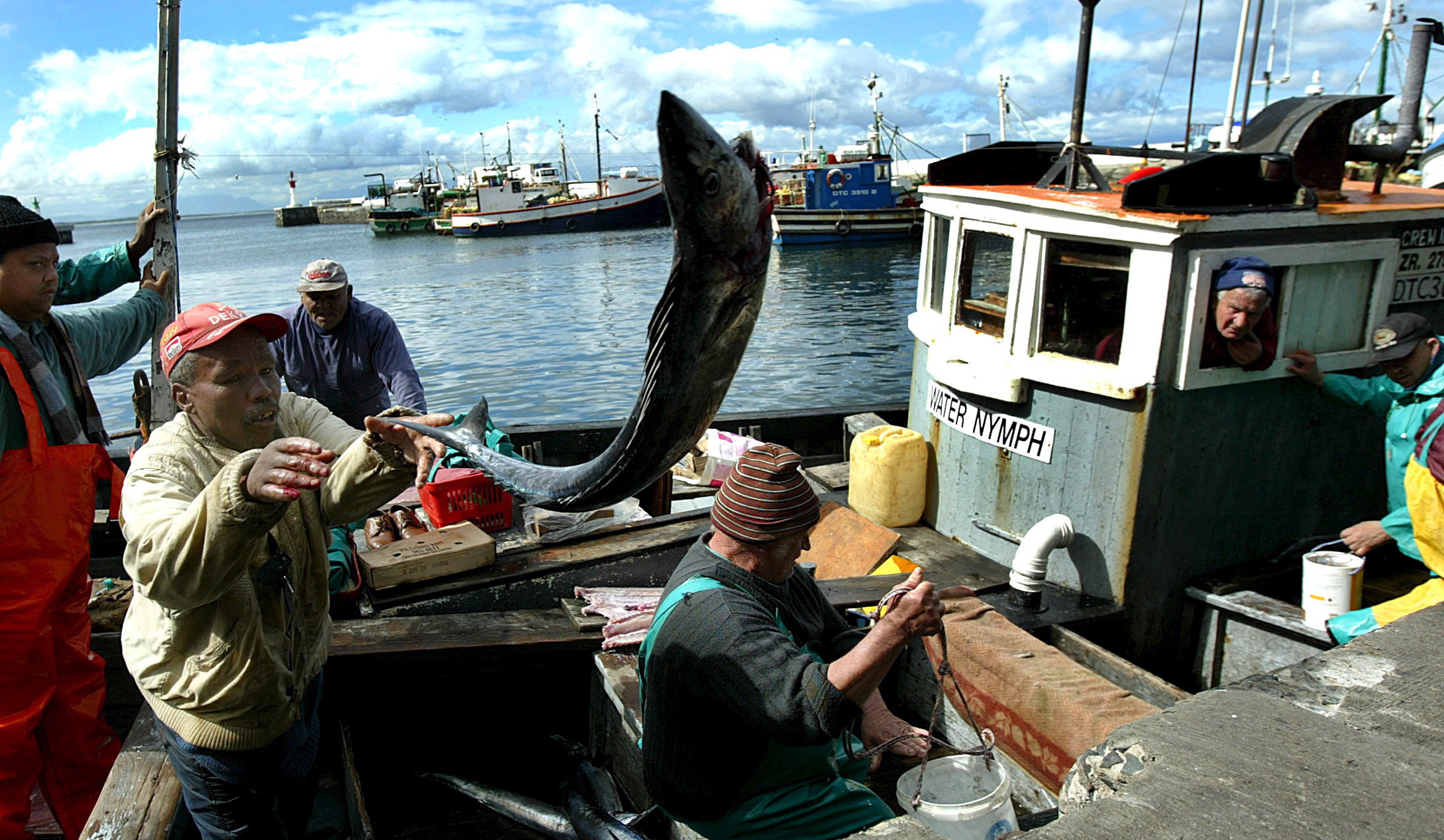
 Fishermen throw snoek onto the quay at Kalk Bay harbour in Cape Town, South Africa. (Photo: EPA)
 /file/dailymaverick/wp-content/uploads/2025/10/label-Op-Ed.jpg)
The dawn of democracy in 1994 filled South Africans with hope for a transformative transition that would finally recognise marginalised communities.
Thirty-two years later, this collective expectation has been met with disappointment, as many South Africans remain in destitute positions with little effective change on the ground.
The systematic exclusion of marginalised communities has been particularly evident in policies designed to support them, such as the South African Small-Scale Fisheries Policy, which, despite its intentions, was built on a foundation that failed to adequately recognise the rights and needs of small-scale fishers.
The Small-Scale Fisheries Policy was adopted in 2012, yet significant impediments to its implementation persist. The policy was developed specifically to redress historical injustices faced by fishers who have sustained their livelihoods through customary knowledge and practices passed down through generations. These communities, many of whom have fished along the South African coast for centuries, were systematically excluded and expected the new democratic dispensation to restore their access and rights.
/file/attachments/orphans/WhatsAppImage2026-02-12at201221_176482.jpeg "President Cyril Ramaphosa delivers the 2026 State of the Nation Address. (Photo: Jairus Mmutle / GCIS)")
At present, we are now witnessing what amounts to an erasure of decades of struggle for fishers’ rights. The most recent example is the Department of Forestry, Fisheries and the Environment’s announcement regarding the 2026/27 traditional linefish decision, which reduced the Total Allowable Effort (TAE) for small-scale cooperatives (i.e. the number of vessels they can use to fish). This reduction directly threatens the livelihoods of communities that depend on these resources for survival, undermining the very purpose of the Small-Scale Fisheries Policy.
While there are many examples of small-scale fishers being evidently sidelined systematically, this one most recent example called for immediate action from small-scale fishers across the coastline. During the 2022 Fishing Rights Allocation Process, the Department of Forestry, Fisheries and the Environment allocated the entire traditional linefish quota to the commercial sector.
/file/attachments/orphans/ED_396369_491896.jpg "About 100 fishers and activists protest near the Cape Town Harbour entrance in Paarden Island in 2022. Small-scale fishers and civil society demanded sustainable energy solutions and a halt to offshore oil and gas exploration. (Photo: Gallo Images / Brenton Geach)")
Years of assurances
This occurred despite years of assurances that, once the Small-Scale Fisheries Policy was fully implemented, small-scale fishers would be accommodated, including a commitment that 50% of the Total Allowable Effort would be reserved for the small-scale fisheries sector. The current Total Allowable Effort decision is widely viewed as disregarding the small-scale fishing sector.
In 2024 Masifundise launched a campaign and petition calling on Minister Barbara Creecy and the Department of Forestry, Fisheries and the Environment to revise the traditional linefish allocation to ensure a fair and equitable distribution. Masifundise and Coastal Links also condemned the 2024 Total Allowable Effort decision, which significantly reduced the small-scale fisheries allocation, even as more fishers were formally recognised following the completion of Small-Scale Fisheries Policy implementation in the Western Cape.
Taken together, these developments suggest a continued failure by the Department to meaningfully consider the lived realities and livelihood needs of small-scale fishing communities.
/file/dailymaverick/wp-content/uploads/MC-Climate-Oped_1.jpg "A fisherman from Elands Bay on the west coast of the Western Cape. (Photo: Schalk van Zuydam / Gallo Images)")
The department’s announcement provoked immediate resistance from the small-scale fisheries sector, including small-scale fisheries organisations and cooperatives, across SA. Through this collective action a letter of demand was drafted to both President Cyril Ramaphosa and the minister of the Department of Forestry, Fisheries and the Environment, urgently requesting a review of the 2026/2027 Traditional Linefish Total Allowable Effort decision. Critically, the letter called for proper procedures of engagement with the sector to be followed, procedures that the Small-Scale Fisheries Policy itself mandates, but which are routinely ignored in practice.
The Portfolio Committee on Forestry, Fisheries and the Environment received this letter on 9 February 2026. The committee concurred with the fishers’ demands, stating that an immediate review of the allocation decision should follow “a meaningful and transparent consultative process that balances both livelihoods and sustainable fishing practices for the benefit of current and future generations”.
No meaningful participation
This acknowledgment from the parliamentary committee validates what fishing communities have been saying all along: decisions affecting their livelihoods are being made without their meaningful participation.
Behind this latest collective action lies a deeper reality. Fisherpeople are fighting to exist. They have been fighting for their rights for more than 20 years within SA’s 32 years of democracy. For more than half of the post-apartheid era, fishing communities have been engaged in ongoing struggles simply to secure the rights and recognition that democracy promised them.
The recent State of the Nation Address emphasised the green economy and environmental sustainability, presenting a vision of SA’s economic future. However, this vision failed to mention who will bear the brunt of “green economy” policies, namely the small-scale fishers whose traditional livelihoods may be reduced or criminalised in the name of conservation and economic development.
Harassment
The daily reality for fisherpeople involves ongoing harassment and criminalisation for conducting the very livelihoods that sustain their families and communities, and that are the very essence of their culture.
Additionally, large-scale commercial interests, often backed by government support and presented as initiatives that will benefit local communities, are gradually displacing traditional fishing practices. These developments are frequently disguised as job creation or empowerment programmes, yet they rarely deliver meaningful benefits to the communities they claim to serve.
The glaring oversight of small-scale fishers on government platforms, from policy announcements to national addresses, reveals a broader pattern that marginalised communities at the national level are simply not being heard. The democratic promise of 1994 was transformation and inclusion. Thirty-two years later, for SA’s small-scale fishing communities, that promise remains unfulfilled. DM
Nobathembu Ndzengu is the media officer at Masifundise Development Trust.