




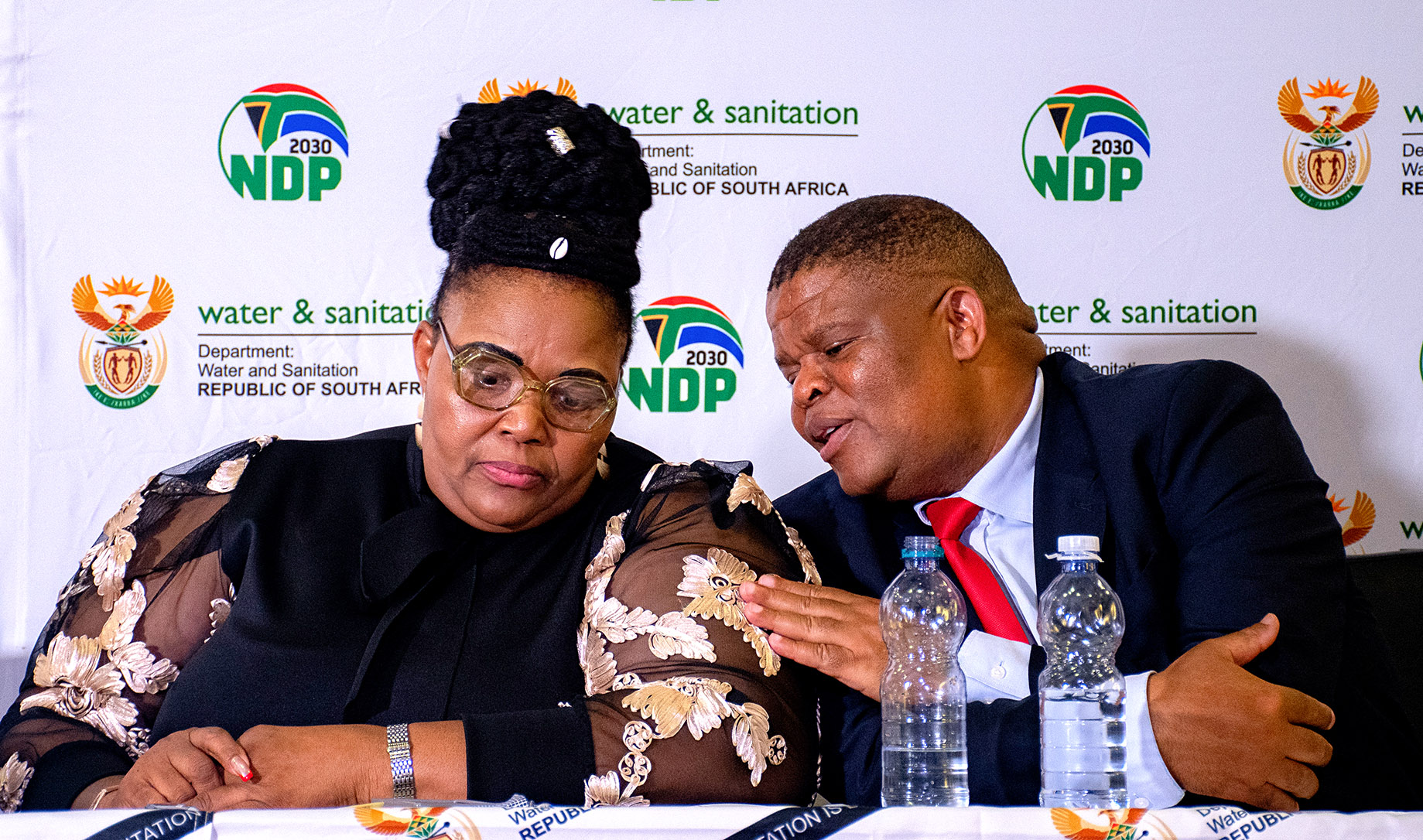
 Minister of Water and Sanitation Pemmy Majodina (left) and Deputy Minister of Water and Sanitation David Mahlobo during a media briefing on water supply challenges facing the City of Johannesburg at the Johannesburg Water Head office, Newtown, on 11 November 2024. (Photo: GCIS)
 Minister of Water and Sanitation Pemmy Majodina announced on Thursday, 19 February, that additional measures have been implemented to curb Johannesburg’s water crisis, including approval of Level 2 water restrictions in high-use areas, controlled throttling of water supplies overnight and a temporary abstraction licence allowing an additional 200 million cubic metres per annum to be allocated to Rand Water.
The new temporary licence will allow additional supplies sourced from the Integrated Vaal River System (IVRS) to be provided to the province until June 2026. The IVRS comprises 14 interlinked dams that are already constrained.
“This is not a long-term solution to the water supply challenges being experienced in Gauteng. It is a temporary measure to assist the municipal reservoir levels to recover,” a statement from Majodina reads.
/file/attachments/orphans/ED_595079_194124.jpg "Residents protest over water crisis outside Joburg Water Headquarters on February 8, 2026, in Johannesburg. (Photo: Gallo Images / Fani Mahuntsi)")
The statement comes as the province reels from the water crisis driven by rising demand amid a heatwave and an earlier multisystem failure. The crisis has seen areas of Johannesburg including Melville, Brixton and Bruma without water supplies for up to 25 days.
Rand Water supplies approximately 77% of the water used by Johannesburg, Tshwane and Ekurhuleni. It has previously raised concerns about water consumption in Gauteng’s metros exceeding licensing agreements. On 7 February, it published a statement saying that the City of Johannesburg and Tshwane had “exceeded the allocated volumes” and was placing “significant strain on the entire water network”.
The entity has published graphs on its official X account comparing water consumption across the three metros with temporary and permanent licensing agreements across the three metros.
The graphs show that consumption across the three metros exceeded 3,620 megalitres (ML) per day in the week of 16 February, above the just over 3,000ML allocated. The City of Johannesburg consumed 1,657ML per day in the same week, down from a peak of 1,794ML per day in the week of 26 January, but still far higher than the allocated 1,500ML per day in the temporary licensing agreement and 1,350ML per day in the permanent licensing agreement.
/file/attachments/2988/RandWatercombined_837288.jpeg "A graph published by Rand Water shows the combined weekly water consumption in Gauteng between 17 February 2025 and 16 February 2026. (Image: Supplied by Rand Water)")
/file/attachments/2988/RandWaterJohannesburg_462908.jpeg "Weekly water consumption in Johannesburg between 17 February 2025 and 16 February 2026. (Image: Supplied by Rand Water)")
DA accuses Rand Water of ‘misleading’ public
But the official opposition party in the City, the Democratic Alliance (DA), has claimed that Rand Water is misleading the public on its water supply statistics.
In a statement published on 17 February, the DA’s mayoral candidate for Johannesburg, Helen Zille, and spokesperson for water and sanitation, Stephen Moore, accused the entity of claiming to provide more water than it currently is.
“In the week ending on 15 February 2026, Rand Water’s own data indicates average pumped volume of 4,726ML/day — substantially below 5,000ML/day. One megalitre is a million litres. Their actual delivery is 274 million litres lower than their claim,” they wrote.
“If Rand Water has not misled the public, more water should be pumped into municipal transmission systems, which is demonstrably not the case in many areas on the ground. If Rand Water’s data is inaccurate, the water board does not have a firm grip over this crisis.”
Moore has also previously called for licensing agreements to be relaxed and for the excess water in the Vaal Dam, which is currently at 101% capacity, to be used to curb the City’s water crisis.
But Rand Water published a statement on 18 February clarifying that the 5,000ML per day figures refers to the production capacity of their Zuikerbosch and Vereeniging water treatment plants.
“However, there are limitations of what can be pumped to customers owing to licence limitations. Rand Water supply capacity must be understood beyond the treatment capacity to include its pumping capacity.”
Rand Water spokesperson Justice Mohale told Daily Maverick that the entity is producing “sufficient high-quality water” for all its customers in the areas it services.
“The challenge is high consumption, and Rand Water has been consistent in raising this matter with all its customers and advising them to adhere to the legal allocations. Consumption also includes water losses because of ageing infrastructure,” he told Daily Maverick.
42% of water supplied is lost
The minister’s measures include ring-fencing revenues from water sales to fund infrastructure maintenance. But this is complicated by non-revenue water, which is defined as water that is produced and supplied but does not generate revenue because of various losses throughout the distribution system. Non-revenue water currently accounts for nearly half Gauteng’s water consumption.
/file/attachments/orphans/Water_outage_53ab_711028.jpg "People wait to collect water from a private business in Johannesburg. February 11, 2026. (Photo: OUR CITY NEWS / James Oatway)")
The percentage of non-revenue water has increased over the years. According to the Department of Water and Sanitation, in 2005, non-revenue water accounted for 21.80% of Gauteng’s water. The figure has increased to 42%. Mohale told Daily Maverick that the increase is due to ageing infrastructure and leaks at a municipal level.
The Department of Water and Sanitation indicated that part of the additional measures included “accelerated fixing of leaks in municipal distribution systems, including the replacement of old leaking pipes, by the municipalities”.
It further suggested municipalities turn to the private sector to boost funding. “[Municipalities] should also be entering into partnerships with the private sector to mobilise private sector funding for water infrastructure,” it said. DM