




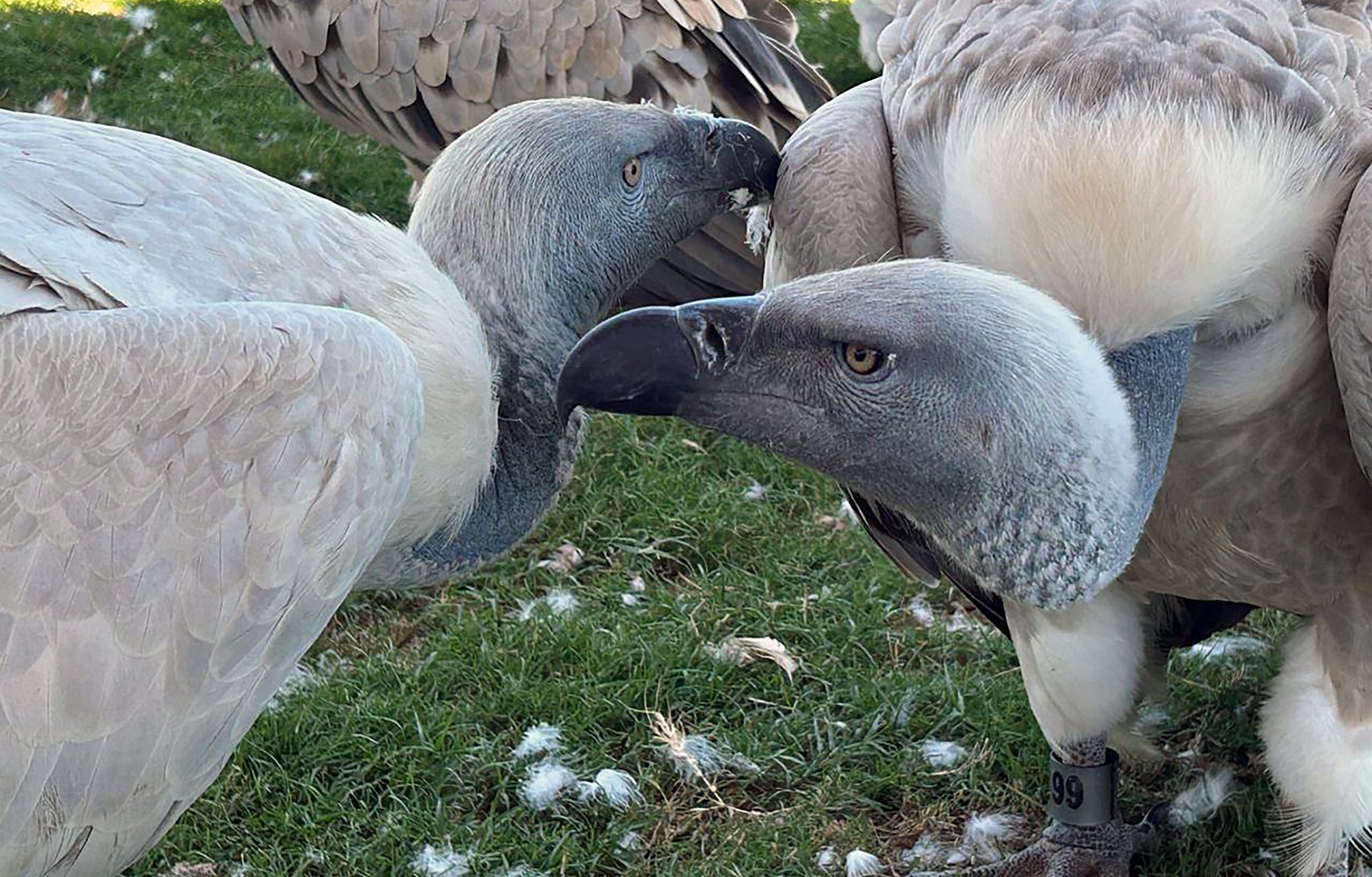
 Two bonded female Cape Vultures were separated when Vulpro moved its breeding programme from Hartbeespoort to Shamwari Private Game Reserve in a bid to strengthen conservation efforts. After two years apart, the birds were reunited — just in time for Valentine's Day. (Photo: Supplied / Kerri Wolter)
 Separated in the hope that they would pair with males and contribute to a threatened species, two bonded female Cape vultures refused every suitor presented to them.
But just in time for Valentine’s Day, at Shamwari Private Game Reserve in the Eastern Cape, the pair were finally reunited, and within moments it was clear their bond had never broken.
In 2024, Vulpro’s Captive Breeding Programme successfully relocated 160 birds across 1,042km from its Hartbeespoort facility to purpose-built enclosures at Shamwari. One of the bonded vultures was among those moved.
The two birds were originally captive-bred at Pretoria Zoo and bought by a private collector before being donated to Vulpro for breeding purposes. Both were the same age when they were purchased.
“They were the same age when they were purchased and they clearly formed a bond,” said Vulpro founder and CEO Kerri Wolter. “No matter what the sexes are, they bond for life.”
Read more: Flight plan — 23 vulture chicks hatch at Eastern Cape reserve, marking rewilding milestone
Read more: Fast-track solar plan crumbles as risks to endangered vultures come to light
Their bond, however, posed a challenge for a conservation breeding programme aimed at strengthening wild populations. As a same-sex pair, they repeatedly produced infertile eggs.
“There were two reasons why we separated them. One, obviously, was because we wanted them to form bonds with males. Being of the same sex, they kept producing infertile eggs, and it was not going to help the captive breeding programme,” Wolter said.
/file/attachments/orphans/Photo3_899809.jpeg "The pair was reunited at Shamwari Private Game Reserve on Valentine’s Day and immediately resumed their friendship, as if no time had passed. (Photo: Supplied / Kerri Wolter)")
The second reason was that the pair were also notoriously defensive because they were not afraid of people. Wolter said they showed more aggression towards people, especially during breeding season.
She said: “As we would enter the enclosure, they would basically charge at us because they were so protective over their nest that they did not want anyone coming close to their space – which meant the entire enclosure.”
When Vulpro moved its breeding operations from Hartbeespoort to Shamwari, the team made what Wolter described as an extreme, but necessary decision. One bird remained at Hartbeespoort while the other was relocated to the Eastern Cape facility.
“The reason we went to that extreme is because, obviously, if they could see each other, we thought that would be a little cruel and unfair. So we thought: out of sight, out of mind.”
Over the next two years, both birds were introduced to potential male partners. Neither formed a new bond.
“Vultures are monogamous,” Wolter said. “But they are also very much like people. If something in the world happens to one of their mates, sometimes they do find another mate – sometimes not.”
In this case, they did not.
With neither bird contributing to the breeding programme, Vulpro reassessed its options. With the birds not finding mates, Wolter said they did not want them simply caged.
“And we don’t hold vultures just because we can. We hold them so they can have a purpose and support their wild counterparts. No one really wants a bird just sitting in a cage,” Wolter said.
The solution lay in using them as a surrogate pair. Through a process known as double clutching, Vulpro can remove a first egg from a successful breeding pair for artificial incubation, stimulating the female to lay a second egg. That second egg can then be fostered to another pair to raise.
/file/attachments/orphans/Photo2_705598.jpeg "Both birds were introduced to male partners, but neither formed a new bond, repeatedly rejecting potential mates. (Photo: Supplied / Kerri Wolter)")
“By doing that, we can, on occasion, get two eggs per pair, which then allows us to give surrogate pairs – either those producing infertile eggs or same-sex pairs – the opportunity to raise a chick and contribute to the species’ conservation,” she said.
When the decision was made to reunite the females at Shamwari, one endured an 18-hour journey in a transport crate.
“The reunion was beautiful,” Wolter said. “Obviously, 18 hours in a crate is a long time, so the first thing she did was come out of the crate and open her wings. At that moment, her mate, who was already at Shamwari, walked up to her and straight away they knew.”
“They were back together, and they ran off together, and straight away they started mirroring each other’s preening.”
Vultures are meticulous in keeping their feathers in perfect condition. As the bird that arrived from Harties began preening, so did her mate.
“It was almost like they were never separated.”
Wolter said the birds paid no attention to the other vultures in the enclosure – they were just happy to be together again.
“Immediately after recognising one another, they started mirroring each other,” she said. “As one would preen, the other would do the same. If one put her head down, the other would do the same. It was beautiful. They walked around, never leaving each other’s side.”
Wolter said the reunited vultures are settling in well and gradually becoming used to each other again.
“They are definitely asserting themselves over their breeding spaces, which causes some commotion with the other birds. They are a very dominant pair, but otherwise are well settled and have already begun gathering nesting materials,” she said. DM