




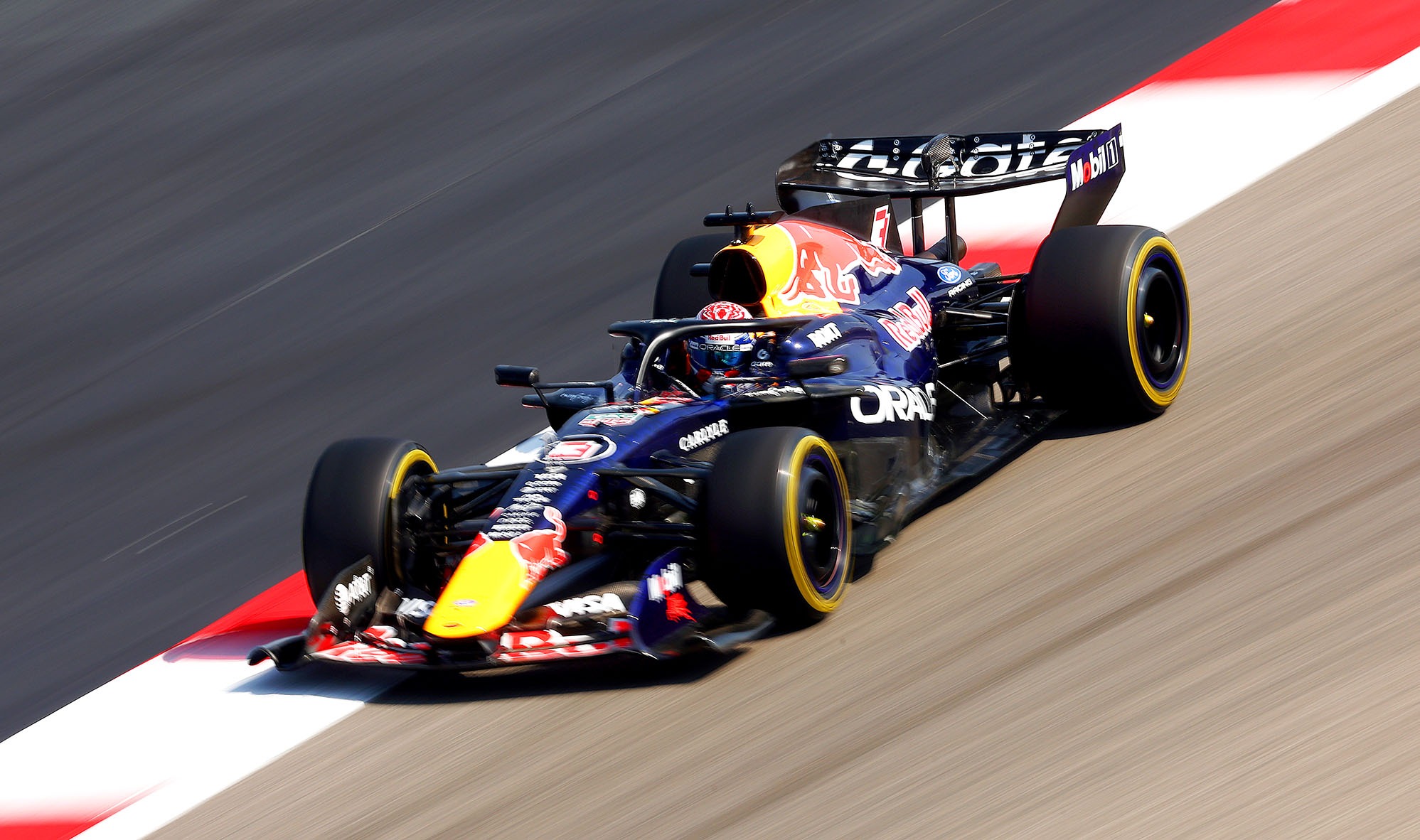
 Max Verstappen in his Oracle Red Bull Racing RB22 Ford during day three of F1 testing at Bahrain International Circuit on 13 February 2026. Verstappen described the new cars as ‘Formula E on steroids‘. (Photo: Joe Portlock / Getty Images)
 Four-time world champion Max Verstappen was very vocal last week about his dislike of the new regulations saying the increased demands for energy with the new hybrid engines are “just not Formula 1”.
The new engines have been described as “energy starved” because of the way the rules have been structured. They now require several kinds of recovery to ensure the battery has sufficient levels of charge for optimum lap times.
What stood out immediately was just how much the drivers were lifting and coasting through the corners. What were once flat-out corners in Bahrain, specifically turns 12 and 13, are now 60km/h slower, not because the cars lack grip, but because they are saving energy for the straight.
Veteran driver Fernando Alonso summed it up brutally, saying the team chef could take the corners at those speeds.
/file/attachments/orphans/2261424862_107937.jpg "Red Bull’s Max Verstappen during testing at Bahrain International Circuit. (Photo: Mark Thompson / Getty Images)")
“The right word is management,” said Verstappen. “But on the other hand, I also know how much work has been going on in the background. Also from the engine side, for the guys. So, it’s not always the nicest thing to say.
“But I also want to be realistic. As a driver, the feeling is not very Formula 1-like. It feels a bit more like Formula E on steroids.”
New regulations explained
In 2026, F1 will see a complete overhaul of technical regulations. The cars are shorter and lighter, with narrower tyres, in what the sport is promoting as the next generation of agile cars designed to encourage more wheel-to-wheel racing.
The regulation that has come under fire by Verstappen and a few other drivers concerns the new engines.
The new power units mark a major shift, with a 50-50 split between electric power and the internal combustion engine, and almost three times the previous electrical output.
/file/attachments/orphans/F1Regtimeline_605245.jpg "History of regulation changes in F1. (Graphic: Annemieke Thomaidis. Information: formula1.com)")
For Verstappen, who is the ultimate purist in terms of motorsport, it is not about performing terribly in the car, because he and any capable driver can adapt.
If it were up to him, Verstappen would be racing cars from the Nineties. The Red Bull driver’s point is that the lack of energy to run flat out all the time is taking the sport away from traditional racing.
“As a pure driver, I enjoy driving flat-out, and at the moment you cannot drive like that,” he said. “A lot of what you do as a driver, in terms of inputs, has a massive effect on the energy side of things. For me, that’s just not Formula 1.
“All the good drivers will be able to adapt to it. That’s not the problem, but it’s just the whole way of racing is changing, and I would say less pure. I just want normal driving, just how it should be.”
While the 50-50 split is a move towards increased efficiency and sustainability, this messaging could fall on deaf ears when all around the car, teams fly massive hospitality units across the world, race under floodlights in numerous night races and many take to the skies in private jets.
It takes time
It very rarely happens that rivals Lewis Hamilton and Verstappen agree on things, but the seven-time world champion told the media on the first morning of the test in Bahrain that the new rules are extremely complex and will be difficult for fans to understand.
“I sat in a meeting the other day and they’re taking us through it… it’s like you need a degree to fully understand it all,” the Brit said.
While Alonso did say the Aston Martin chef could take the corners, because that’s how slow they are, he did also urge caution before jumping to too many conclusions. It is still early days, there is also one more testing session between 18 and 20 February and Melbourne is still a month away.
“We still love motor racing, we still love competing and for the regs I understand there is less input by the driving skills,” said the Spaniard. “But I think after three or four races maybe we have a better idea.”
/file/attachments/orphans/2261438948_614093.jpg "Lewis Hamilton in the Ferrari SF-26 on day three of F1 Testing at Bahrain International Circuit. (Photo: Mark Thompson / Getty Images)")
False starts
One of the things drivers test during pre-season are race starts. However, in Bahrain teams and drivers discovered that race starts might prove to be particularly tricky.
The way they describe it, it is going to be lights out and away we go but the cars are still revving.
According to Gabi Bortoleto, who will be driving for Audi this year, the starts are “quite a mess”.
The complex process involves a number of demands, from spooling the turbo for up to 10 seconds, not overcharging the battery and getting the revs right from the start.
The result is inconsistent and fumbled starts. This could become a safety issue since cars are at risk of collisions should one car perfect the start and another fumble.
Compromised the thrill?
Despite Verstappen’s criticisms, he still managed the second-fastest time after the first day of testing.
However, testing can often be skewed and judging competitiveness in pre-season is difficult. There are so many variables at play and strategically, teams often do not reveal their full hand and in many cases may even try to deliberately fool people.
Nevertheless, the question remains: Is this simply the usual early-regulation discomfort or has F1 pushed so hard towards a technical objective that it has compromised what makes these cars so thrilling to watch in the first place?
The first race of the season is in Melbourne, Australia, on 8 March, at 6am South Africa time. DM