



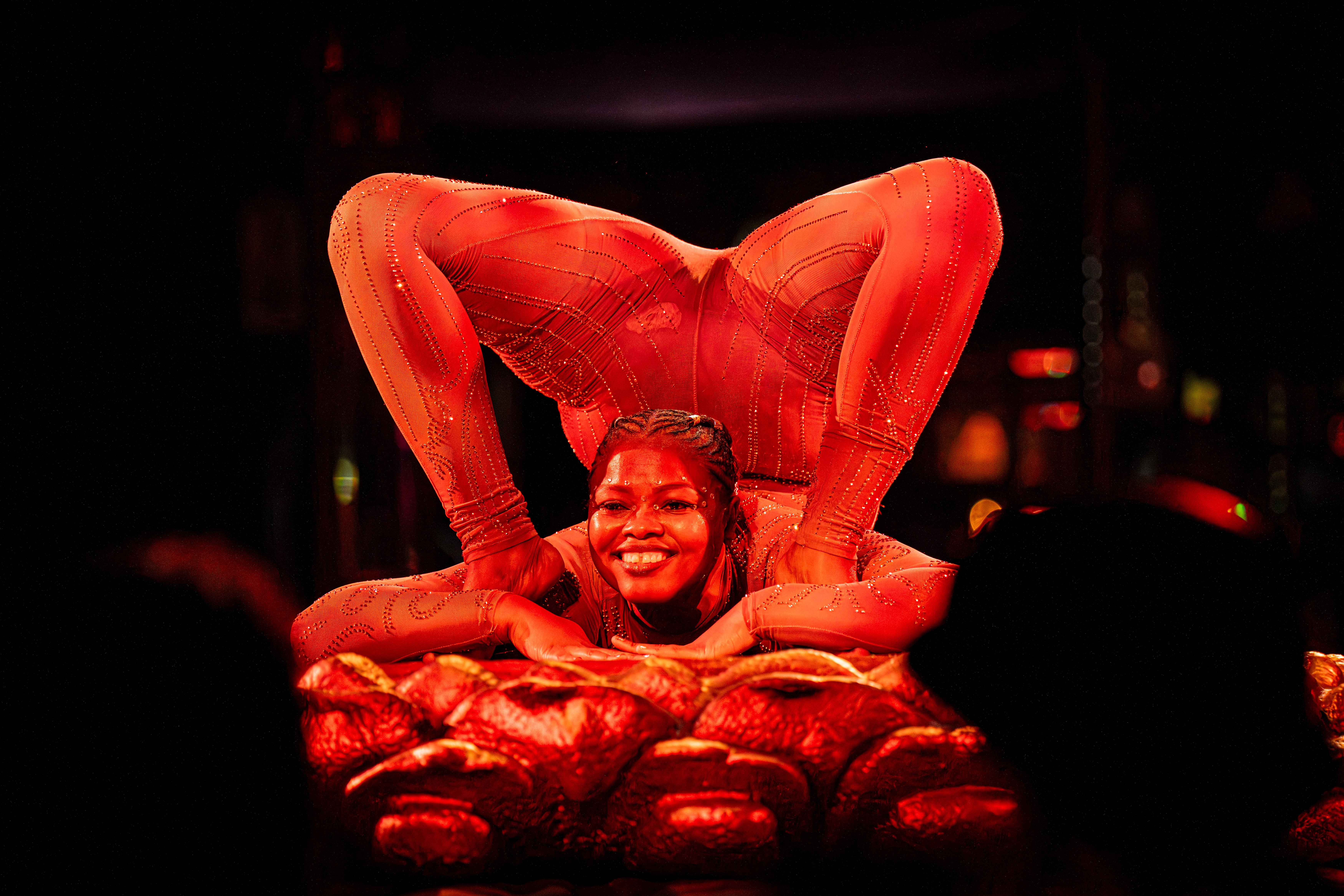
 Contortionist Lunga Buthelezi performs at the Royal Countess Zingara. (Photo: Daniel Rutland Manners)
 There were moments during the more acrobatic, edge-of-your-seat parts of the circus razzle-dazzle in the heart of the Belgian-crafted spiegeltent currently stationed at Century City in Cape Town, when I was entirely convinced that the man, apparently tipsy, who was seated at one of the tables nearest the performance area, would end up being part of the act.
Either he would have some off-balance artiste come crashing onto his lap, or he had in fact been planted there as part of a gag. At some point, I imagined, he’d rip off his party suit and transform into a high-wire trapeze performer or be stuffed into a cannon and shot through the air.
I was wrong. No one was injured, nobody in the show was pretending to be part of the audience.
On the other hand, there wasn’t a soul in that wood-and-canvas mirror tent who was not entirely immersed in the unfolding action, captivated by the sheer showmanship of the acts – and the dizzying excess of the night.
This, explains artistic director Craig Leo, is part of the magic of circus, that it’s not only visually thrilling but sensorily immersive, so you feel as though you are part of the action, close enough to the physical sensations, the adrenaline, the mental focus and the bodily stamina to become emotionally gripped. Spellbound!
/file/attachments/orphans/UkrainiantwinsMykolaandAndriiPysiuraperformingattheRoyalCountessZingara_DanielRutlandManners_457069.jpg "Ukrainian twins Mykola and Andrii Pysiura performing at the Royal Countess Zingara. (Photo: Daniel Rutland Manners)")
As you gawk in disbelief, you get a very real sense of what’s required – the strength, concentration, determination and sacrifice – to perform these elaborate acts with such incredible precision, flair, fearlessness and showmanship.
“All those human elements, combined with music, with lighting, costumes and the sheer theatricality of it all, ensure that you’re drawn into it, you’re part of it, and you get caught up in the show itself,” says Leo, who directs the show alongside his wife, Valentina. “Plus there’s the immersive nature of the tent. You’re not watching it from the outside, like you would in a typical proscenium arch theatre. You feel like you’re in it; there’s a sense of togetherness.”
Since bringing Africa its first Belgian-built spiegeltent – Victoria – in 2007, the Zingara team has been synonymous with audacious circus-style entertainment for grown-ups. There’s been a lengthy hiatus since the last iteration, however, a decade-long break during which the world itself has dramatically shifted off its axis.
If you’ve not yet seen the current version of the show, it’s either because you’ve been unaware of its existence, or you’re one of those Capetonians who leaves everything too late. Keep an eye on that calendar, though, because it will – in May – come to an end, whereafter it’ll transfer to Johannesburg for the winter.
Traditionally, the large wood and canvas tents, fitted with leaded glass, mirrors, brocade and plush velvet and pieced together without a single nail or screw, have always been decked out with the fantastical in mind.
It’s a monstrous undertaking, hinging on bravura performances, a military-precision kitchen, multiple bars and an army of staff to keeping things ticking over smoothly. Starting with the zany character who greets you at the entrance, every member of the Zingara crew is made up to resemble a cast of misfits. Waiters are costumed, some in drag, others looking like stars in their own miniature productions. And while everyone involved takes the theme of a bohemian circus tent to its extreme, it’s a roster of bewitching performances that ultimately holds the audience in awe.
“It’s witnessing with your own eyes the potential of the human body,” says Leo. “Seeing real flesh-and-blood people doing these incredible things. It’s why we watch sport or gymnastics – our pure fascination with the capability of the body. You’re witnessing the potential for human endeavour.”
/file/attachments/orphans/ContortionistLungaButheleziperformingattheRoyalCountessZingara_DanielRutlandManners2_775223.jpg "Contortionist Lunga Buthelezi performing at the Royal Countess Zingara. (Photo: Daniel Rutland Manners)")
At one point, a local contortionist named Lunga Buthelezi executed such sensationally terrifying acts of double-jointed impossibility that there were people in the audience producing audible groans, covering their eyes, quietly screaming. Some, I think, were hiding under their tables, such was their shock and simultaneous awe in the presence of a human being so pliable and malleable it seemed she might at any moment snap in half or pretzel herself to such a degree that she’d never get back to normal. What she did with her body was akin to something rendered by CGI for a Marvel movie about superhuman powers, utterly extraordinary. And terribly visceral. I felt it too: absolute panic. And yet, pro that Buthelezi is, she masterfully performed the entire unbelievable act with an enormous smile.
While Buthelezi might put a knot in your stomach, there’s comic relief in the guise of an incredibly entertaining hand balance act performed by dapper and delightful Ukrainian twins, Mykola and Andrii Pysiura. What sets them apart is their manner of injecting a traditionally very serious circus genre with “a gorgeous sense of comic timing, fun and playfulness”, says Leo.
The Pysiura twins – strong, muscular, toned and precise – embed their tough-guy balancing act with skilful physical comedy that adds a kind of story with an emotional edge to the routine. The twins, who also perform a second act involving straps, will step away from Zingara at the end of February, returning in June when the show reopens in Johannesburg for its winter season.
/file/attachments/orphans/UkrainiantwinsMykolaandAndriiPysiuraperformingattheRoyalCountessZingara_DanielRutlandManners2_993942.jpg "Ukrainian twins Mykola and Andrii Pysiura performing at the Royal Countess Zingara. (Photo: Daniel Rutland Manners)")
/file/attachments/orphans/ArgentiniansJuanPabloPalaciosandVictoriaPerezIaconoperformingtheiraerialcradleactattheRoyalCountessZingara_DanielRutlandManners_833677.jpg "Argentinians Juan Pablo Palacios and Victoria Perez Iacono performing their aerial cradle act at the Royal Countess Zingara. (Photo: Daniel Rutland Manners)")
Another performance designed to take your breath away is an “aerial cradle act” by Argentinian couple Juan Pablo Palacios and Victoria Perez Iacono. It’s delicate, dramatic and quite obviously dangerous. It is basically a dance performed high off the ground. For much of it, Palacios hangs upside down, creating a human cradle with his muscular arms in which Iacono swings, dances, performs somersaults in the air. It takes elements of trapeze but ramps up the strength requirement as well as the intimacy and attention to detail.
“We’ve never had anything like it before,” says Leo. “The scale of it is breathtaking, but the delicacy with which they work, the detail that they put into every single movement is captivating.”
At this all-human circus, such hair-raising feats of physical dexterity are interspersed with food and song, and by a ringmaster – “the Timekeeper” aka Andile Magxaki. His role as the evening’s MC has been toned down, his narration purposefully less risqué than what was heard at Madame Zingara a decade ago, when, pre-pandemic, pre-Trump 2.0, some pretty ribald, often salacious jibes and dirty jokes would come flying out of the mouth of a tall drag queen accompanied by a volley of bitchy remarks – often targeting folks from the northern suburbs.
Magxaki’s job, Leo explained, is to make the audience feel at home, bringing things down to Earth a bit, uniting the humans in the tent.
“He’s more human, a more personable character,” says Leo. “More thoughtful and more respectful, perhaps.”
/file/attachments/orphans/TheTimekeeperAndileMagxakiperformingattheRoyalCountessZingara_DanielRutlandManners_905161.jpg "The Timekeeper, Andile Magxaki, performing at the Royal Countess Zingara. (Photo: Daniel Rutland Manners)")
Leo says the show caters now to a more diverse audience, with a broader mix of sensibilities. That the tent itself is now stationed close to those northern suburbs is perhaps another factor – why offend your patrons?
The ringmaster’s other job is, to some extent, to help distil the world’s collective grief, to filter the current state of the world through a lens of hope. As much as it’s cloaked in the trappings of hedonism, fun, sexiness and even frivolity, the show’s guiding principle is to respond to this moment of global uncertainty by transforming mourning into meaning, sorrow into celebration.
“The last time that we did Madame Zingara was pre-Covid, so besides the terrible things that are happening in the world at the moment, we also had to weather a pandemic and a lot of the joy and I think the hope has kind of been leeched out of many of us,” says Leo.
As an acknowledgement of the “state of the world”, Leo says the show opens with “a ritual of empathy” centred on a hyperbolic Weeping Woman in black mourning garments, her skirt printed with prayers of hope in various languages including Arabic, Hebrew, isiXhosa and English.
Heralding the start of the performance, the Weeping Woman ritualistically transforms – “her skirt takes flight, symbolising humanity’s collective yearning for healing”.
And, thus out of a gloomy emotional substrate emerges a show that is full of dazzle – and about human creativity and endeavour.
That all of this can come together in such a vibrant and artful environment is a testament perhaps to the crazy ambitions and scallywag inventiveness of the show’s creators, headed up by creative director Richard Griffin, who is an absolute showman.
Hedonism and displays of physical prowess aside, Griffin says the show – essentially an evening spent in a tent with a conglomeration of people from multitudinous walks of life – is first and foremost about bringing people together.
“We’re in a world that no one knows, a world full of anxiety and pain,” he says. “Humanity is not capacitated to understand where we are or where we’re going. The world’s leaders have taken life’s rulebook and paged it back 50 years in terms of division, separation and war. There’s so much uncertainty.”
Griffin says that the world’s circus community has been closely affected by what’s happening in the world.
“The Klessens, who are our tent partners in Belgium, say that every day they [allegedly] see hundreds of Russian drones being flown over their small town. And, we’ve lost some of our best acrobats, some of the world’s top performing artists, young men being forced to go to wars that they don’t believe in. Families torn apart.”
He says that, with everything that’s happening in this difficult reality – political upheaval, economic decline, wars in Europe and the Middle East, climate change – “the tent is about coming to a place to escape”.
/file/attachments/orphans/UkrainiantwinsMykolaandAndriiPysiuraperformingattheRoyalCountessZingara_DanielRutlandManners3_928324.jpg "Ukrainian twins Mykola and Andrii Pysiura performing at the Royal Countess Zingara. (Photo: Daniel Rutland Manners)")
In an interview more than a decade ago, Griffin had said that “pain is the birthplace of creativity”, and that sentiment holds true.
Circus, as an artistic form, has always been a place for outsiders to gather, show off, celebrate and be themselves, and it is touching to find that simmering just below the surface of what is a glossy, exuberant and thoroughly indulgent evening of immersive entertainment, there’s a very real force of creative expression at work.
“As creatives, we feel strongly about what’s going on in the world. We want to stand up and protest. We want to shout and scream and wake people up.”
This is, after all, the purpose of artists: to hold a mirror up to society and prompt action – and change.
He says that, whether by happy accident or unconscious design, many of the acts in the current season are about balance.
This inadvertent theme is exemplified by Tatiana Babiy, a Russian artiste who lives in Ukraine, who performs an excruciatingly precise feather-on-palm balancing act.
“It’s an ancient act, one that maybe just four artists in the world are still doing,” says Griffin.
The terrible irony, he says, is that Babiy has created and rehearsed her act for Zingara while living with bombs going off around her. “And here she is balancing a feather on a palm branch, one breath of air and the whole delicately balancing tower falls down.”
But Griffin says much of the real magic goes unseen: “It was very, very difficult to communicate, to arrange visas, to get her here so that she has a job and can ensure her family has food on the table.”
And so, in quite sublime ways, a night at Zingara is a night of in-your-face exposure to the current reality of the world, albeit strongly tempered by its opposite.
Griffin hints that this Zingara is, in many ways, a protest of hope in a bleak world: “I told the team, we are going to behave in the opposite way. Where authoritarians are telling us to separate, we will come together. When they tell us to hate, we will love.”
“Now, watching the show and seeing the evenings unfold, my greatest joy is seeing the transformation of guests. How people from completely different walks of life will end the night hugging the table next to them. And when I look at our amazing staff I’m gratified to know that they are the most diverse, loved, embraced bunch of people.
“And the joy that they bring in the unity of diversity, you know, we brush it aside as a small thing. It’s not. Our diversity is our strength.
“We are so proud of the wide mix of people who are drawn to come and celebrate with us. Our audiences are Christian, Muslim, Jew, atheist… they’re young, old, abled, disabled, everyone. And that is what South Africa is.” DM
La Dolce Royal runs in Cape Town until May and will transfer to Johannesburg in June.