




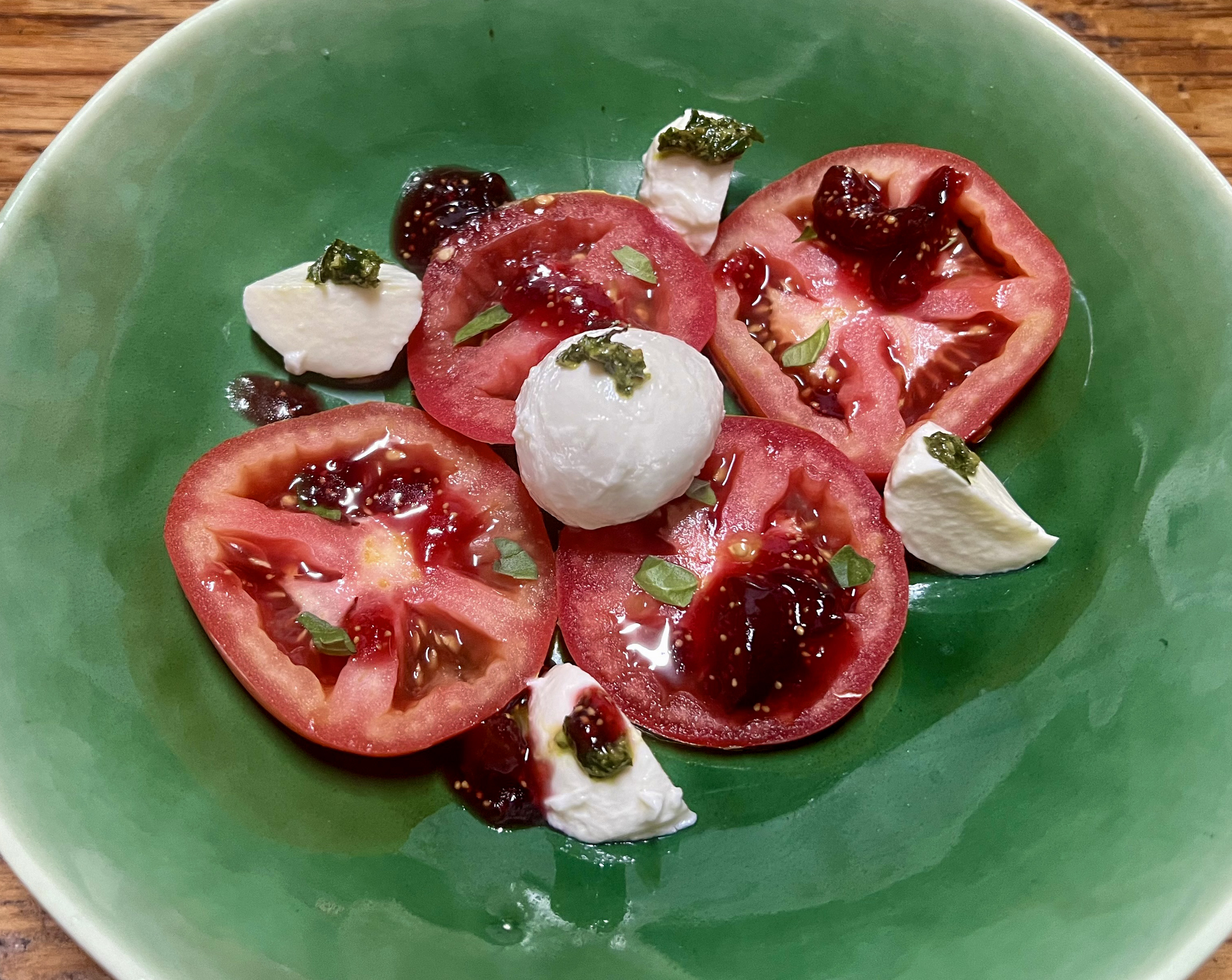
 karoocaprese
 Caprese literally means “of Capri”. The salad we call Caprese, or Insalata Caprese in Italian, originates on the Isle of Capri on the Tyrrhenian Sea where the Mediterranean meets the Bay of Naples, and where, once upon a time, a dish was served ostensibly to please a poet, futurist and co-author of the Fascist Manifesto, founded by Benito Mussollini, Il Duce himself.
Fitting, then, that just a glance at any Caprese salad brings to mind the country’s very flag, with its red for tomato, green for fresh basil, and white for mozzarella. It is thought to have been invented as a sandwich filling by an unnamed mason who, after the end of World War I hostilities in 1918, enclosed tomato, basil and mozzarella in bread, although the ever-cautious Wikipedia does not go there.
The Italy Heritage website does, however, saying it appeared on the menu at the Hotel Quisisana in the town of Capri in the early 1920s and where in 1924 (the website claims) Filippo Tommaso Marinetti, the founder of Futurism, “raged against pasta, calling it outdated”. In short, he wanted pasta abolished. Which makes me want to rush out and order a large plate of pasta which, of course, quickly faded into ignominy and has scarcely been heard of since.
But the La Cucina Italiana website offers a different perspective: “In 1932 Marinetti published a cookbook titled The Futurist Cookbook, which criticised much of Italy’s food traditions, particularly taking a swipe at pasta. so it’s said the hotel (Quisisana) created Caprese salad, a pasta-less dish in honour of these contrarians.” Since Marinetti’s Futurist Cookbook only appeared in 1932, the Italy Heritage date seems suspect.
Then again, Marinetti was a proponent of futuristic vegetarian cooking of lighter flavours without flour, and one theory has it that it was invented in honour of his “manifesto” of this approach to food; and in that, of course, his futurism was wildly on the mark. Except for vegans who, I’m sure, will have issues with that cheese right there. Anyway, he tried.
In the 1950s, so the (possibly apocryphal) story goes, King Farouk of Egypt and the Sudan apparently demanded something light after a day on the beach and was served some mozzarella with tomatoes and basil, ensuring the future worldwide popularity of a dish that could easily have remained in obscurity.
There are rules. The mozzarella must be large, weighing “at least half a kilo”, and small mozzarelle “are therefore not suited”. Quite what calamity will befall the offending chef who fluffs it up is not explained.
The second factor likely to get you into trouble is choosing tomatoes that are neither unripe or overripe. The colour of the tomatoes should be “ramato”, a sort of copper red.
Basil leaves must be torn by hand, but most of us know that anyway.
Finally, if it’s a good quality mozzarella, the cheese will squeeze out a little milk, and this also helps to moisturise the salad on the plate.
Recently, I fiddled with a caprese considerably, including slices of ripe fig and red fig jam.
I include tomato and fresh basil, but dressed (second time around) the Karoo Caprese with basil pesto (as well as fresh), red fig syrup, olive oil, and lovely creamy lumps of bocconcini, the smaller rounds of buffalo mozzarella.
I also included a drizzling of balsamic reduction, this being a relatively recent addition to many Caprese salads. Strictly traditionally, though, it would only need those tomato juices and extra virgin olive oil (and some purists don’t even want that), and not too much of it.
Once assembled, the Caprese Insalata should be left to rest for 15 minutes, and only then consumed.
(Quantities adaptable to your needs)
Ingredients
Tomato slices
Buffalo mozzarella, or bocconcini, or pearl mozzarella
Red fig preserve
Basil pesto sans cheese (use the pesto part of this recipe but leave out the Parmesan)
Red prickly pear syrup
Olive oil
Balsamic reduction
Fresh basil garnish
Method
In a small bowl or jug, mix some red prickly pear syrup with extra virgin olive oil and balsamic vinegar reduction, in equal quantities, but enough for the number of portions you need it to dress.
Lay out tomato slices attractively with the form of mozzarella you’re using, basil leaves (either inter-layer them or arrange bits of the leaves here and there), and drop blobs of red figs around. Dab teaspoon tips of basil pesto on the mozzarella. Drizzle the dressing over. DM
Follow Tony Jackman on Instagram @tony_jackman_cooks.
This dish is photographed on a plate by Mervyn Gers Ceramics.