




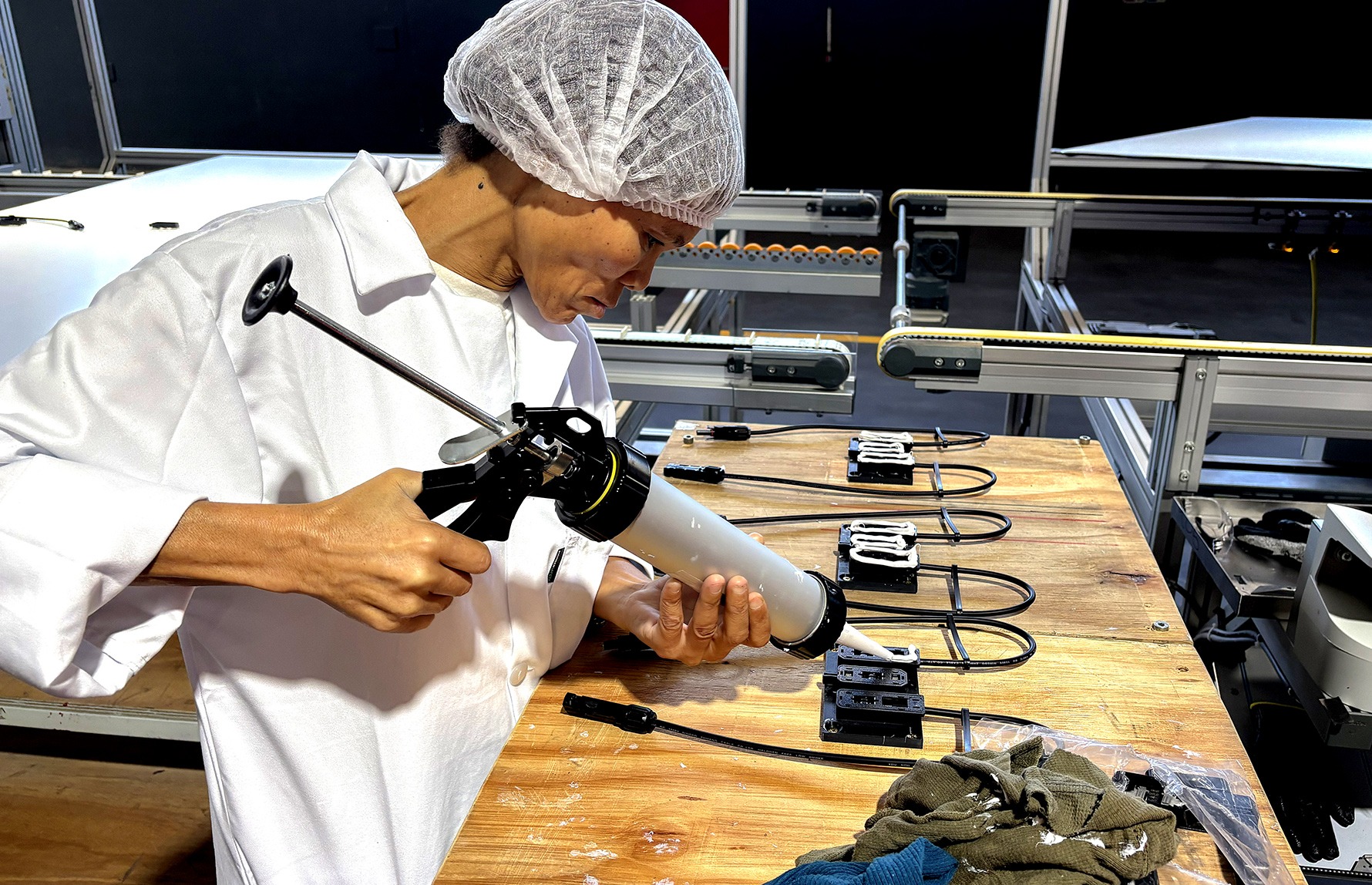
 Junction boxes are installed on the solar panels and potted with a waterproof substance at Ener-G-Africa’s new solar assembly plant in Paarl, Western Cape. (Photo: Kara le Roux)
 While the world’s energy prices are largely dictated by the sprawling industrial hubs of China, the view from a warehouse floor in Paarl looks decidedly different this week.
Ener-G-Africa (EGA) officially cut the ribbon on its new solar panel assembly facility on 17 February 2026. According to Chris Yelland, energy analyst and managing director at EE Business Intelligence, the company is effectively “treading where angels fear to tread” in a market where China controls over 80% of global production.
Read more: The seemingly impossible task of competing with China
By focusing on specialised local needs and a custom-trained workforce, the assembly plant aims to carve out a niche that massive, slow-moving import tankers simply cannot fill.
The facility does not aim to challenge manufacturing on sheer, commoditised volume. Instead, EGA is trading on local responsiveness and a specialised all-female assembly workforce. Their strategy focuses on the “prosumer” market, a segment that global giants often struggle to serve with the same level of precision.
The Paarl value proposition
The facility houses an assembly line with an annual manufacturing capacity of roughly 150 megawatts (MW), capable of producing various solar PV dimensions that contrast the one-size-fits-all approach of international competitors.
/file/attachments/orphans/Image3_999844.jpg "Finishing touches are applied to solar panels in Ener-G-Africa’s assembly line in Paarl, Western Cape. (Photo: Kara le Roux)")
Ener-G-Africa CEO André Moolman told Daily Maverick that the plant can manufacture anything from a 5W panel all the way up to a 620W panel, which adds high-capacity production to the smaller units the company has traditionally supplied to African markets.
The plant opens as the grip of state-led procurement over the energy sector continues to loosen. While South Africa has historically relied on the Renewable Energy Independent Power Producer Procurement Programme (REIPPPP) for utility-scale growth, a report by the then Department of Mineral Resources and Energy (DMRE) notes that private projects accounted for roughly 60% of operational solar PV in 2023.
/file/attachments/2988/Screenshot2026-02-17at134418_453031.png "Private participation in the energy sector has been enabled through regulatory changes over the last four years, such as amendments to the Electricity Regulations Act of 2006. (Graph: GreenCape)")
“To compete with China who make 90% or more of the world’s solar PV modules, already built, exported from China, is a tall ask,” Yelland told attendees at the launch.
However, he believes that value is not solely defined by the lowest price per watt. “You don’t want to wait for five containers of solar PV modules to come out from China just to get your 10 solar PV panels for your roof. If you’re an installer, delivery time is critical, and flexibility is vital,” Yelland said.
The women on the assembly floor
The all-female team running the assembly floor sets the Paarl facility apart from its industrial peers. According to Moolman, the decision to hire only women “evolved” naturally over time rather than being a pre-planned corporate mandate.
“I just don’t think there’s enough opportunities,” Moolman said regarding the employment strategy. “This is very detailed work, and women are very good at doing that. We sort of evolved in it. It wasn’t a decision that we made. One day we realised, well, they’re all women, so let’s keep it that way.”
Read more: New Cape Town solar panel plant gives power to the ‘true agents of change’ — women
The facility has functioned as a high-tech classroom for the women on the floor, many of whom started with no background in electronics. “This is so empowering because none of us, not a single one of these ladies that is currently working here could work with a power tool or a soldering iron. We knew nothing,” Rene Salmon, production manager at EGA, told Daily Maverick.
/file/attachments/orphans/Image41_965982.jpg "The all-female team running the assembly floor at Ener-G-Africa’s Paarl-based solar panel facility sets it apart from its industrial peers. (Photo: Supplied / Ener-G-Africa)")
According to Salmon, the group trained together to overcome an industry that she said “has always been excluding females”. She said the work requires a specific aptitude for detail, noting that operators must be able to spot microscopic cracks in a PV wafer or ensure polarities are exactly right.
While Salmon acknowledged that “it takes a certain type of person” to master these skills, she maintained that the team’s success comes down to the rigorous preparation they received.
The assembly process
Salmon outlined the steps involved in transforming individual PV cells into weather-proof solar panels at the Paarl facility, which produces 120 panels in a 9-hour shift:
👩🏭 Stringing: A machine connects the individual solar cells together in one line, or “string”.
👩🏭 Layering: The team creates a “sandwich” of materials: first tempered glass, then a layer of special glue, followed by the string of solar cells.
👩🏭 Connecting: A machine uses thicker copper strips to connect the strings of cells together so that they can carry a heavier electrical current.
👩🏭 Backing: Workers add a second layer of glue and a final back sheet to cover and protect components.
👩🏭 Lamination: The panel goes into a large machine that heats and presses the layers together to seal everything.
👩🏭 Trimming: Excess material is trimmed off the edges and taped up to prepare the panel for its frame.
👩🏭 Framing and boxing: The metal frame is attached and the electrical connection box (junction box) is glued to the panel.
👩🏭 Testing: The panel is tested under a sun simulator. The electric box is potted with a waterproof substance to protect it from rain.
👩🏭 Packing: Lids and stickers are added, and the finished panels are stacked on pallets for shipping.
No red tape here
The launch arrives as South Africa transitions from a coal-heavy monopoly towards a diversified energy mix. The DMRE research suggests that while South Africa is rich in raw materials such as silica and manganese, it lacks the midstream processing to turn these into electronics-grade components, leaving assemblers like EGA reliant on imported cells.
Read more: ‘Packaging problem’ leaves green energy billions idle in SA
Western Cape Premier Alan Winde sent a message of encouragement to EGA, saying that he views the facility as a catalyst for a broader industrial ecosystem.
“I’m sure that solar panel manufacturing leads to looking at the first, second and third phases of chemical beneficiation, so that we can start manufacturing batteries here as well. We need to look at how we get that whole value chain,” he said.
/file/attachments/orphans/Image2_293817.jpg "The connected cells of a solar panel after the ‘stringing’ process at the Ener-G-Africa facility in Paarl. (Photo: Kara le Roux)")
Yelland said the company’s real advantage is its refusal to lean on the unpredictable nature of national policy. He noted that the company has avoided “handouts” or protective tariffs that could be scrapped if political priorities shift. “If you rely on government for tariff protection [...] you are playing with fire,” he said, emphasising that the firm is focused on building a value proposition independent of government support.
A bright future
Moolman’s goal is not to become a global titan, but a local specialist. “I don’t think we want to be the biggest solar manufacturer in the world. I think we want to be the best,” he said. “We want to custom-make panels for what the market needs and make sure that we can have availability and quality.”
By targeting the residential and commercial (C&I) sectors – what Yelland refers to as the “prosumer” market – EGA is positioning itself where the growth is most explosive. Yelland’s analysis suggests that while utility-scale solar is vital, the behind-the-meter market is often underestimated.
/file/attachments/orphans/Image5_430045.jpg "Ener-G-Africa produces anything from 5 Watt solar panels all the way up to 620W at its new facility in Paarl, Western Cape. (Photo: Kara le Roux)")
As the Paarl facility ramps up to its 150MW potential, it serves as a litmus test for South African re-industrialisation. While the facility currently relies on imported components to assemble its modules, Moolman said that the hope is for enough local capacity emerging to manufacture these parts within South Africa.
For now, the operation in the shadow of the Drakenstein mountains serves as proof that local assembly can take root and scale. Its success will ultimately depend on whether South African businesses and homeowners decide that a local stamp of origin is enough to keep the lights on – both in the factory and in the homes it serves. DM