



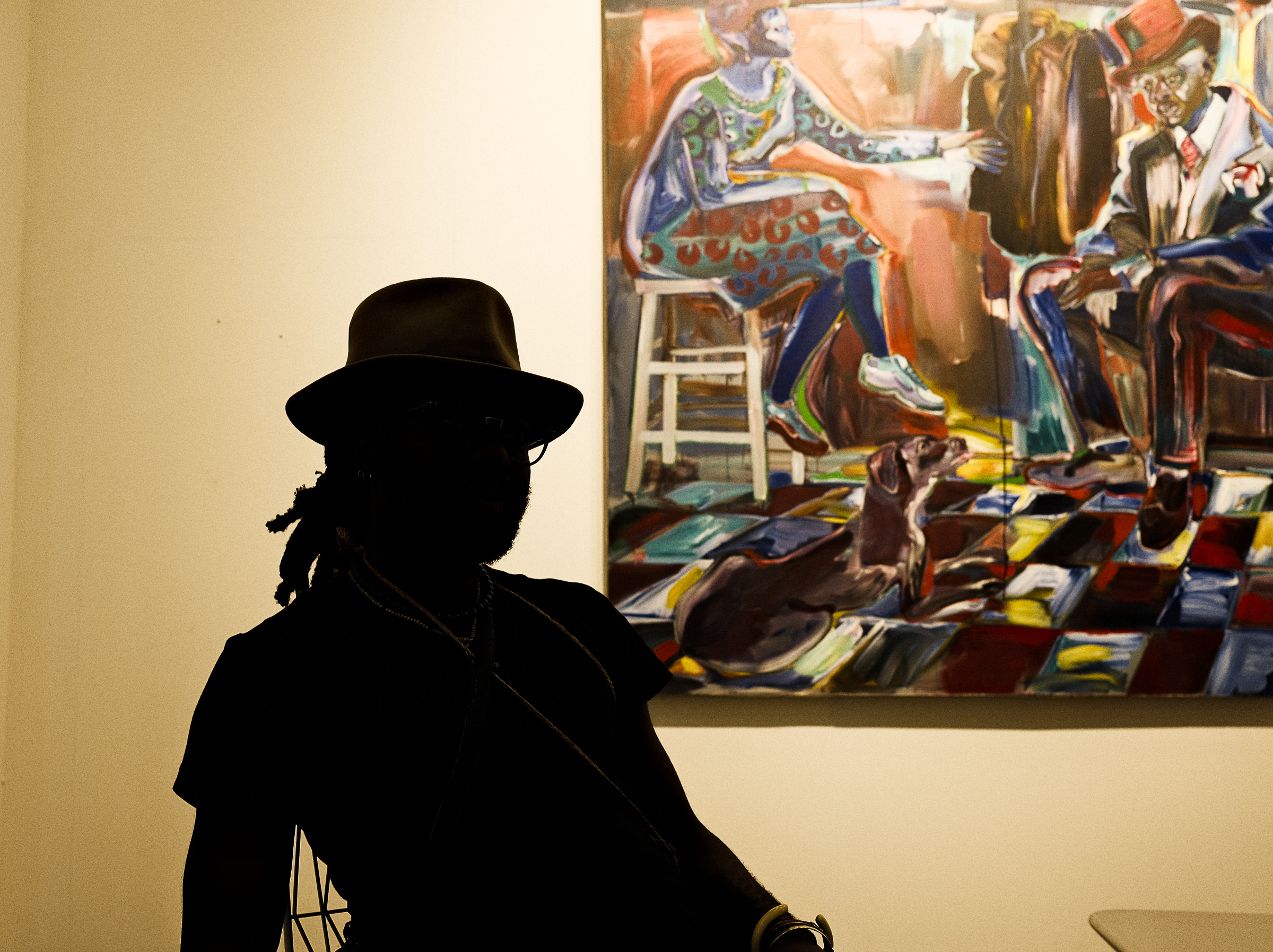
 A guest looks at an artwork at the Investec Cape Town Art Fair in 2023, in Cape Town, South Africa. (Photo: Dave Harker)
 This year’s fair comes in the turbulent wake of art and censorship from within our country. Artist Gabrielle Goliath is currently suing Minister of Sports, Arts and Culture, Gayton McKenzie, for “acting unlawfully and violating the right to freedom of expression” by withdrawing Goliath’s work, Elegy, from the South African pavilion at the 61st Venice Biennale.
There’s a chance that only a few attendees at the fair will have any knowledge, or interest, in the role or the background of art fairs, art galleries or art pop-ups. For many, an art fair is something one does annually, while gallery visits depend on your level of interest and pop-up galleries are often reserved for First Thursday jols.
Art fairs are often reduced to being occasions to meet and greet, eyeball some (in Gen Z slang) “main characters”, check out who’s who at the zoo (and what they are wearing) and quaff some bubbly.
Art fairs are often a tick on the list of events to attend, which can be mentioned nonchalantly at a dinner or occasion to enhance one’s status. Of course there are those for whom it’s a professional outing, making business connections, visibility and sales, and not forgetting the serious art lover.
The portrait of an art fair
The number of art fairs has exploded from just a handful in the 1970s to currently more than 300 annually.
Two hundred years newer than the earliest gallery, the prototype for the contemporary art fair was the Art Cologne held in Germany in 1967; three years later came Art Basel in Switzerland, which is regarded as the first dedicated contemporary art fair. Its claim to fame was its invention of the modern gallery-booth model that remains essential to art fairs.
They were then followed by Art Basel Miami Beach (Miami, US) and Frieze (London, New York, Los Angeles, Seoul) known for more youthful and adventurous programming.
Later important fairs include Art Dubai with a focus on the Middle East and Africa, Art Basel Hong Kong, and many regional ones including KIAF Seoul and Art Fair Philippines.
Art galleries vs art fairs
Galleries are about sustained artist ecosystems, whereas art fairs create shorter, sharper bursts of market action.
Art fairs often serve as both mirrors and amplifiers of wider societal and political trends.
Recently, art fairs have become more diverse and inclusive through the increased representation of black artists, a greater focus on women artists and gender equity. That said, many in the art world believe this change to be incomplete rather than truly transformative.
Current protests and boycotts, colonialism, sustainability and geopolitical discussions regularly bleed into or around art fairs and are regarded as an indication of art’s role in public discussion.
Art fairs may focus on wealth and influence, but through the offering of public days, media, and social buzz expose art to wider audiences, thus stimulating wider cultural conversations.
The Cape Town Art Fair
While the Cape Town Art Fair isn’t in direct competition with the Basel/Frieze tier of global fairs, it often ranks in “top 50” lists. But in essence its seen as being much closer to “boutique international” fairs like Art Dubai or Zona Maco, which all have a great deal of cultural clout.
I managed to arrange 30 minutes with the uber busy director of Investec Cape Town Art Fair, the down-to-earth Laura Vincenti.
An architect by profession, she’s been in the art fair game for the past 27 years. When Vincenti first moved to Cape Town, the art fair was a local fair with a bunch of galleries. True to her architectural profession, the set-up of the fair was vital and her first step was to align it with international standards.
Putting together a fair is always “nothing short of a miracle”, Vincenti says. Her walk around the art fair the night before it opens with no one else present is a very emotional experience for her. And she’s always surprised at its actual manifestation.
“Listen” is the chosen theme for the 13th art fair. It arose from lots of brainstorming and deep questioning round the state of the planet.
“Everyone has an opinion,” says Vincenti, “but no one is ready to listen to each other.”
And she’s right. Given the global social and political environment, she points out that the idea of the act of listening could be regarded as “quite a radical act”.
For Vincenti, to listen is “like adding a layer to the obvious act of looking at art”. She believes that while actively listening is very strong and very powerful, it’s also very subtle. For her, it’s less evident than the act of looking or speaking. The theme Listen “is more intimate, more reflective and it is exactly what we want to communicate with this new tradition”.
When asked about how the fair reflects our current reality – civil war in Sudan, the Palestinian genocide, Trumpism, the rise of fascism and white supremacism, racism and the million-tentacled Epstein’s reach all on our sixth extinction horizon – Vincenti responded that while many regard art fairs as “commercial platforms”, for her “it’s more like a meeting point where important encounters happen”. Or a “melting pot of different cultures”.
For Vincenti, “the magic of this environment is that you can exchange your own experience, your own background with someone who doesn’t have any point of reference with you. And that’s why (the theme) Listen is important.”
Tradition and culture
What surprised Vincenti about this art fair was the many works around the theme of the past – ancestral memories and the need for spirituality.
“It is the first time that we have had such a variety of representations with this identical theme,” she said. She suggests that this may be “linked to the uncertainty” of our current times, and possibly seeing the past as an anchor and looking for answers from memories, tradition and culture.
Another visual surprise for the visitor is the booth-free photographic-type exhibition positioned at the entrance of the fair. Curated by Beata America, Assistant Curator at Zeitz MOCAA, one can listen to the memories and lives of the artists.
This year’s art fair will have lots of video and 3D installations that immerse and absorb the viewer.
Regarding outreach and inclusivity, Vincenti explains that “one of our missions and visions for the future is to become much more of an educational hub for ordinary people, rather than limited to just art professionals”.
The aim is to inform and educate them about art and provide greater accessibility to the art world. Also to provide facilitation for schools from disadvantaged areas. This is ongoing work that is not limited to the fair.
An ongoing concern for Vincenti is first-time visitors to SA who expect the art of Africa to be uniform, when its actually incredibly diverse – a misconception that leads them to misunderstand the fair.
Finally, how would Vincenti like visitors to respond to the art fair?
She says she’d like them to be blown away by the experience of seeing so many different artistic expressions under one roof. The richness, the variety and the encounters.
Another perspective
Moved by the freshness, insightfulness and honesty of his Instagram posts on the art world, I asked Noah Becker for his take on art fairs.
Becker wears many hats: he’s an artist, founder of leading art mag White Hot, author of The Best Art in the World: 20 years of Noah Becker's White-Hot Magazine of Contemporary Art.
Early in the conversation, and setting the tone, Becker reminds me that James Murdoch, the younger son of media mogul Rupert Murdoch, owns a major stake in the parent company of the Basel Art Fair (Art Basel).
For Becker its “not about naming specific people”; instead he is about “focusing on the situation” rather than “personalising it”, in an attempt “to assist people who are not able to understand why the art world is so mysterious and bizarre”.
“But if you want to zero in on art fairs,” he says, “I would say they’re predominantly about sales. They’re not only about activism.” But he points out that “when art is more ideologically driven, it has a tendency to be a bit more honest than when it is market driven”.
Which led into how different art fairs would be if they were sponsored by grants, rather than commercial incentives. Becker suggests that any time art relies on the capitalist kind of collector, artist, collector-dealer dynamics, it’s going to move further away from being something that has a squarely political element to it.
He believes it’s naïve to assume that just because one happens to love art, art fairs are going to be inclusive, kind and loving. The reality is very different, he says.
One needs to recognise that there are very diverse belief systems and ideologies at play. He also believes that there should be an agreement that certain elements and certain people could get together and either sell art or show art without it turning into a political debate. And in the process, he feels “it moves the conversation in a positive direction” because art for Becker is about beauty and “about expression”.
In terms of art fairs and inclusivity, he suggests that while they are not necessarily central to the conversation, the increase in black artists and and in gender-related issues is certainly an important trend over the past decade.
On activism and art fairs, Becker notes that the work itself doesn’t have to be activist, rather recognising that for an artist in the minority just to get a painting on the wall becomes almost like a political act itself, given how hard they would have had to fight against their circumstances. But Becker doesn’t see a lot of political protest art at art fairs any more.
From under its umbrella theme of Listen, this year’s art fair claims much. The exhibition as a whole is really a second artwork made collectively by artists, gallerists and in this case the director, Laura Vincenti.
And like the post-production of a movie or photograph, it’s just as vital to the success or failure of the work.
So just go, take a gander. It doesn’t matter what your motivation is. If you are lucky, you may encounter a game-changer that brings you to your knees, or be moved by its beauty, or laugh out loud or rage against the machine. DM