



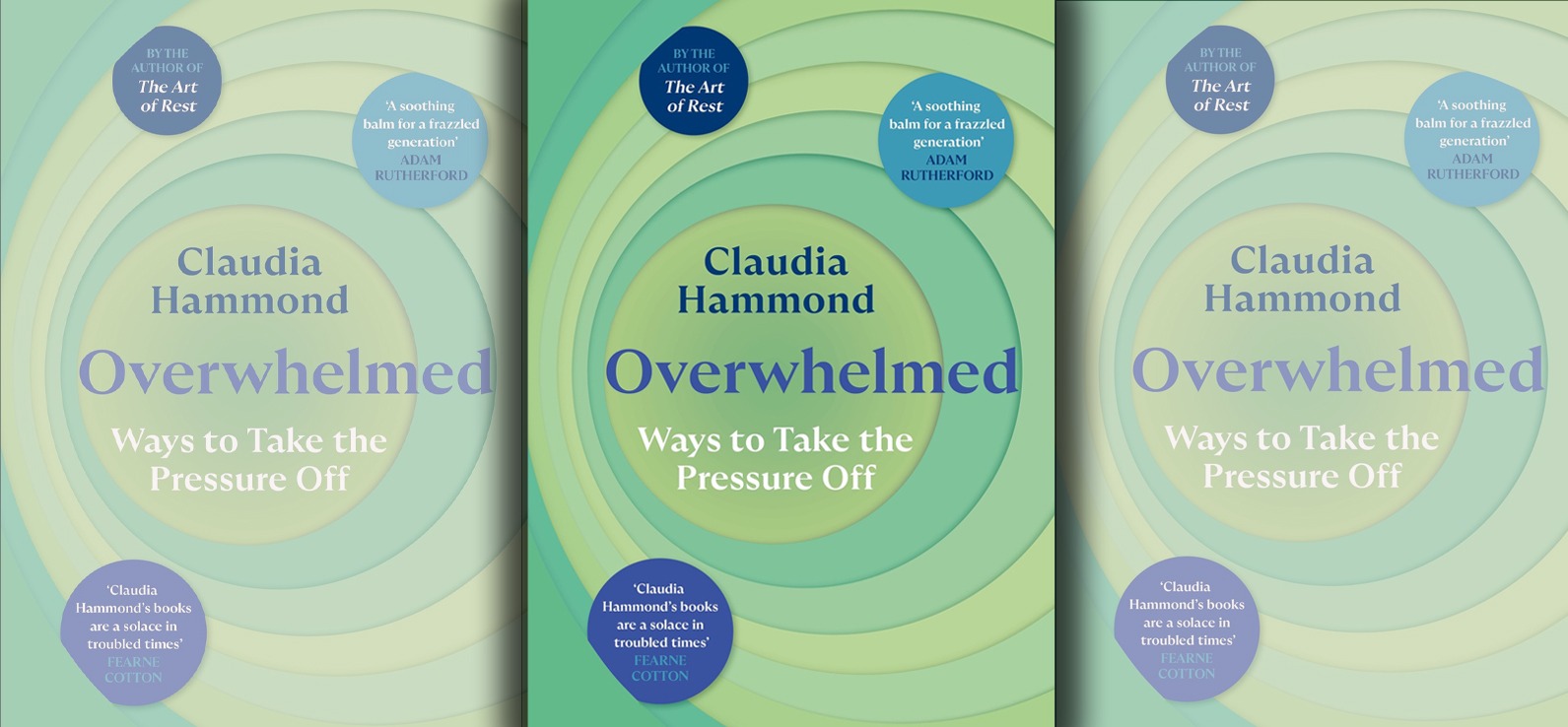
 Overwhelmed by Claudia Hammond is published by Canongate and distributed by Jonathan Ball Publishers. (Publisher: Canongate)
In Claudia Hammond’s new book Overwhelmed, each chapter addresses a particular problem related to the sensation of being overwhelmed – from procrastination to the fear of regret, imposter syndrome, perfectionism and a seemingly never-ending to-do list – and offers a way out. Here is an extract.
***
Some years ago, my husband got a new job as the director of communications for a major charity. Having spent more than a decade as a journalist, he understood the media side of the job well, but after many months in the role he still felt out of his depth when it came to another part of his remit: running campaigns. True, he was picking things up as he went along, and his colleagues didn’t appear to notice that he was busking it, but he was worried that in the end he’d be found out. So he decided to skill up, to go on a course where he could learn from experienced professionals how to really do campaigning. He found a day of sessions which looked ideal and was just about to book a place when he saw that among the list of speakers was… him.
I suspect you know how he felt – like an imposter. Somehow, at a time when his self-confidence was unduly high – perhaps in the first flush of getting the job – he’d been persuaded by the organisers of the course to share his newfound “expertise” with others in the field. In the meantime, having forgotten that he’d signed up as a speaker, he’d come to a truer realisation of his level of skills and how much he had still to learn. Fearing you’re an imposter is a feeling that is widespread; research has established that as many as 82% of us experience it at some point in our lives. The clinical psychologists Pauline Clance and Suzanne Imes first coined the term “imposter phenomenon” back in the 1970s, defining it as “an internal experience of intellectual phoniness which appears to be particularly prevalent and intense among a select sample of high-achieving women”. This conclusion was based on their clinical observations of 178 female students, postgraduates and professionals, all of whom were bright and successful, but who nonetheless found “innumerable means of negating any external evidence that contradicts their belief that they are, in reality, unintelligent”.
As a result of Clance and Imes’ pioneering work, it was initially thought that the imposter phenomenon – or imposter syndrome, as it tends to be referred to in day-to-day life – was largely confined to women, particularly those working in male-dominated fields. But it’s now clear that anyone can experience it. When 33 academic papers on this topic were reviewed, sixteen found it was more common in women than in men, but 17 found no difference. A profound sense of self-doubt and fear of exposure is not just confined to young people either. It can persist throughout life, though for most people it appears to lessen with age, as we accumulate skills and experience.
Yet even the most successful people in the world are not immune. David Bowie, Michelle Obama, Emma Watson, Maya Angelou and Albert Einstein have all talked about feeling like an imposter – talk which can have the effect of making us lesser mortals feel even more inadequate. That’s another thing about imposter syndrome: sufferers tend to suffer alone. We think we’re the only true imposter; everyone else is just a fake imposter.
It should be said that imposter syndrome is not an official diagnostic category within the field of mental health. And, as ever, we should guard against pathologising an essentially normal human feeling. But, still, imposterism can have true emotional consequences, not least when it comes to feeling overwhelmed, stripping some people of their confidence to deal with situations they could otherwise cope with. It causes others to put artificial limits on their lives, not applying for a deserved promotion, for example, for fear of exacerbating their feelings of inadequacy. Persistent and extreme self-doubt can also lead people to feel so anxious and stressed that normal situations come to feel like emergencies or crises. If this happens repeatedly there’s evidence that it can put people at higher risk of burnout. To question yourself constantly is exhausting and can leave you feeling there’s no point in work or study. This in turn leads you to stop caring about your performance or how you come across to colleagues.
Others go in the opposite direction and push themselves harder and harder to make up for the deficiencies they perceive in themselves. While this might help with the immediate challenge, it doesn’t help with imposterism, because it only reinforces the idea you’ve succeeded not through your own ability, but through graft and luck, something others don’t need because they appear to survive on brilliance alone. The fact that people who feel like imposters often work extra hard means they can achieve a lot.
But this doesn’t break the cycle, because the more they achieve, and the more opportunities they are offered, and the higher they get in their field, the more out of their depth they feel and the greater the fear that they’ll be found out. Again, there’s a risk of feeling overwhelmed and experiencing burnout.
There are three truths inherent in imposter syndrome and all three are good news. The first is that evidence clearly shows that those who suffer from it know just as much about a given subject, have just as much aptitude and ability, and perform just as well, as those who don’t. For example, in a paper nicely entitled “I must have slipped through the cracks somehow”, Richard Gardner from Brigham Young University in the US described a study he conducted with elite students in 2019 in which he found that the presence or absence of imposterism bore no relation to the students’ actual achievements. The second truth is that those who appear to know what they’re doing, don’t really. Or at least not entirely. Finally, the vast majority of us are “slip-through-the-cracks” types some of the time, and “striding-up-the-pavement” types at other times, and here’s the rub – in both cases we’re notoriously poor at assessing our true performance.
To understand why, we need to consider the well-evidenced psychological phenomenon known as the self-serving attributional bias. This tendency leads us to take excessive personal credit for our successes, while over-attributing our failures to outside factors. So, if you pass your driving test, for example, you tell yourself that you passed because you are an excellent driver, but if you fail, you blame your instructor’s advice, other motorists or an unfair examiner. At least, that’s what you do if you’re feeling bullish about yourself.
If you’re gripped by imposter syndrome, you react in the opposite way, and assume it was sheer luck and that you winged it, when a true assessment of who or what should take the credit or the blame lies somewhere in the middle, of course.
It doesn’t help that, as well as dealing with our own assessments of our abilities and achievements, we are also faced by the assessments of others – and these can be wrong and unfair too. Sometimes we find ourselves in situations where others assume that we know less than we do, based on our identity. Certainly, I’ve sat in many a meeting when I or other women have been talked over by men, or faced mansplaining, or had a good idea ignored only for a man to be lauded when he suggests essentially the same thing. It’s a demoralising experience. And I say this as a white, able-bodied, middle-class woman with many advantages. Others have a far harder time than me.
The fact is that some people still feel more entitled to be in the room and to have their contributions heard, while others face repeated, though often subtle, signals that they’re not valued. Not surprisingly, this treatment can chip away at levels of confidence and self-esteem. Dr Kelly Cawcutt, from the University of Nebraska Medical Center, has investigated the complex links and interactions between bias, imposter syndrome and burnout in staff working in health care. She outlines a negative cycle in which feelings of self-doubt among certain doctors are exacerbated by a sense of exclusion due to ethnicity or gender, which pushes these doctors towards burnout, which in turn reinforces the sense that they are out of their depth. In this case, prevailing stereotypes about a group’s competence play into an individual’s personal misgivings about their performance in pernicious ways not faced by other groups.
While prejudice is a deep-seated problem, and removing all discrimination from society is not within an individual’s gift, there are steps we can all take to help others to feel included rather than excluded. The steps involve some personal sacrifice and significant self-awareness, but in the long run they will benefit us all.
- Take the trouble in all settings, whether professional or social, to ensure that everyone has a voice and that no one is marginalised.
- Truly listen when others speak and don’t allow people to be talked over.
- Remember that although it might not always feel like it, there are situations in which you have privilege and others don’t. Is it time to dial down your contribution?
- Acknowledge that although you sometimes feel self-doubt, it can be much worse for others. Be active in showing support for others. Amplify their points when you can.
Another way of reducing imposter syndrome is to embrace the notion that most people are improvising their way through life, acting the roles assigned to them or – to put it more bluntly – faking it. Even the most experienced and accomplished people are often unsure about what to do in a particular situation. What they’ve learnt over the years is to try something, to hope it works out and not worry too much if it doesn’t, to learn constantly from successes and failures – and all the while to exude confidence.
I’ve met people who’ve worked at the heart of government, for prime ministers, and they’ll admit that the atmosphere inside Whitehall or Number 10 is much closer to the chaos and panic of the TV comedy series The Thick of It than it is to the well-oiled machine portrayed in the drama The West Wing. Likewise the eminent neurosurgeon Henry Marsh has admitted that doctors, particularly when starting out, “must pretend to their patients that they are more experienced and competent than they really are… you have to inflate your self-confidence, to deceive yourself, to enable you to cut into a fellow human being’s body”. Surgeons even have a phrase, “watch one, do one, teach one”, which caricatures the way that medical knowledge is spread through their profession. It all sounds rather alarming, until you remember that most of the time things work out okay. Sub-optimally perhaps, but good enough. Certainly, disasters in governments and hospitals, and indeed in any walk of life, are the exception, not the norm.
Although, as we’ve seen, imposter syndrome is on the whole not gendered, there are some situations where self-confidence is unevenly distributed among men and women. Over the years I’ve hosted hundreds of events and radio shows in front of live audiences, and invariably men ask more questions in the Q&A sessions than women. My experience is borne out by the research on this topic: one study found that women were two-and-a-half times less likely than men to ask a question at an academic conference, despite there being almost equal ratios of women to men in attendance. This phenomenon has led some in academia to dub Q&As “question-and-manswer” sessions. DM
Overwhelmed is published by Canongate and distributed by Jonathan Ball Publishers. To be released in March 2026.