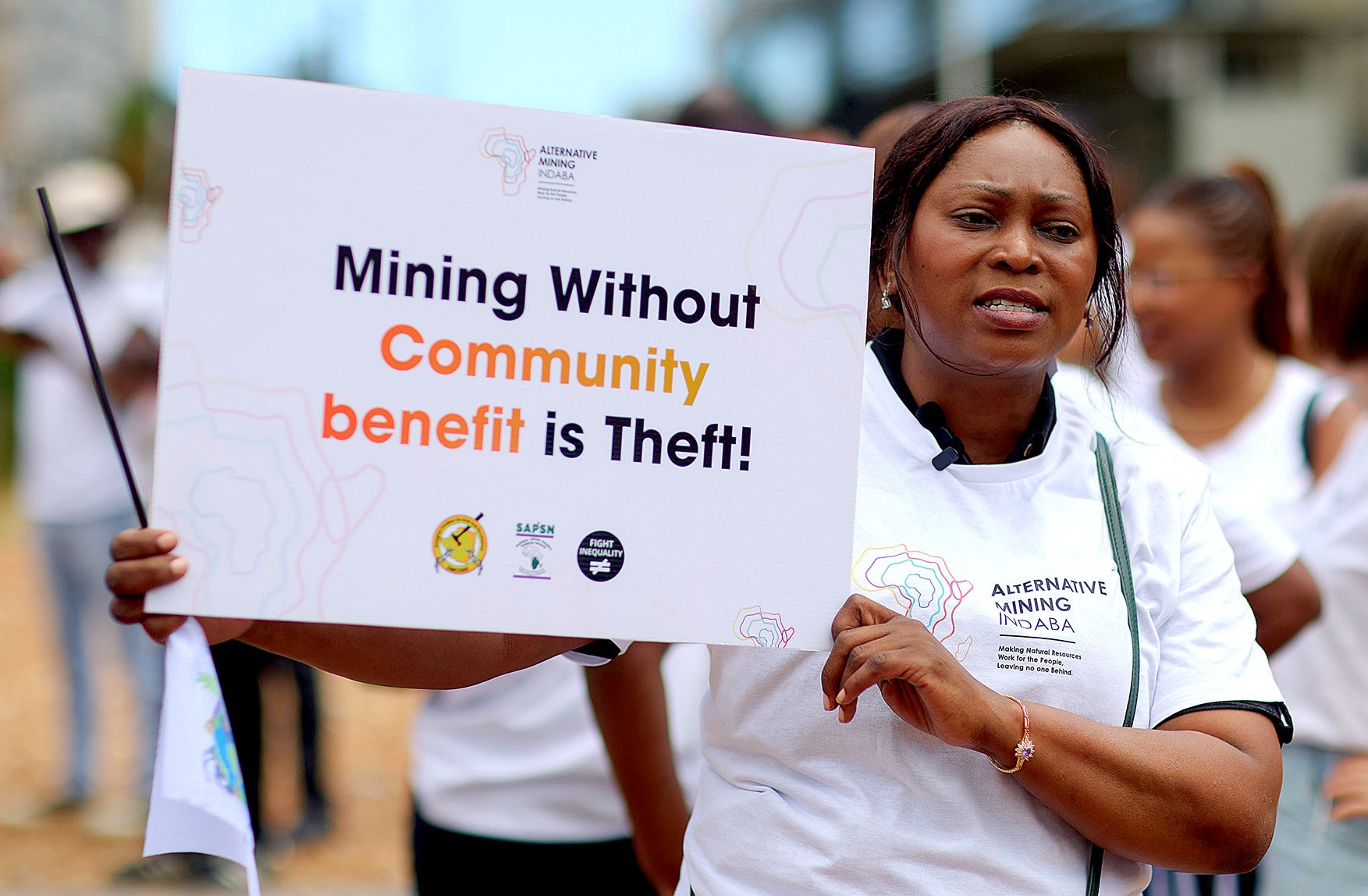
 Social justice activists want a seat at the mining decision-making table, and to be heard. (Photo: Alternative Mining Indaba)
 Nestled between Vogelstruisfontein, Mooifontein 225-IQ and Valkfontein 238-IQ are the Soweto townships of Meadowlands and Diepkloof. You could refer to it as a Golden Ghetto, but completely opposite to the trappings of opulence. No, dear reader, this Kasi (and many like those formed around the mine dumps of the Witwatersrand) is a victim of the golden rush.
Read more: Strategic is the new critical for minerals in Africa
And when the wind blows, the dust ghosts of the past 140 years come to choke communities in their beds and coats the streets in toxic waste. Those clouds have become thicker with time as the current custodians re-mine the ancient tailings for valuable minerals.
Redress, unfortunately, is a pipe dream. And the pipe – often made from a beer bottle – is white, because what else were the forgotten mineworkers to do when the robots took over the dangerous work? Zero harm, mos.
Sobering reality
“Where I come from, we are affected by post mining, which is the legacy of gold mining... mine owners left these dumps like that. So they have been causing a lot of environmental degradation with a lot of [negative] health impacts,” Thokozile Mntambo, a Meadowlands resident and activist, explained to Daily Maverick at the Alternative Mining Indaba.
Mntambo had joined a protest from the Alternative Mining Indaba venue at St George’s Cathedral, down to the Cape Town International Convention Centre to hand over a memorandum to the organisers of Mining Indaba.
Inside the convention centre, the conversation among industry leaders had shifted from mere compliance to what they call “holistic value frameworks”. The logic is simple: safety, production and community impact can no longer be treated as separate line items.
/file/attachments/orphans/083A0519_350975.jpg "Alternative Mining Indaba finished with a march down Adderley Street to hand over a memorandum to the organisers of Mining Indaba on 11 February 2026, in Cape Town, South Africa. (Photo: Supplied / Alternative Mining Indaba)")
Marco Pagnini, Europe, the Middle East and Africa managing director for DSS+, spoke openly about the sector’s struggle to translate well-meaning pledges into operational reality.
“The problem is not the pledge. The problem is translating that into something concrete that can drive a step change in performance, whether it is the safety angle or the environmental angle,” he told Daily Maverick in an interview.
For Pagnini, the industry’s failure to reach zero harm is rooted in a failure of organisational culture.
“The fundamental root causes are mostly organisational, which span from culture, oversight, board, executive and capabilities,” he said.
What we lose when streamlining
His proposed solution is a radical integration of topics that mining houses traditionally keep apart.
“It’s about having a holistic value framework. You can’t silo topics. Mining companies have that responsibility to create value... in their communities... [and] in the suppliers that work and come to work every day.”
This holistic view faces a harsh stress test against financial reality. Merel van der Lei, the CEO of Wyzetalk, issued a sharp warning to the gathered executives: the industry’s desperate need to stabilise the national balance sheet must not erode the hard-won safety gains of the past decade.
“The long-term viability of this sector depends on our ability to scale up without losing sight of the people who underpin its success,” Van der Lei said in a post-Indaba statement. She cautioned that while financial wins were needed, “it cannot come at the expense of those hard-won gains in safety... the cost is, after all, measured in lives”.
Secondary abuse
For communities living in the shadow of the mine dumps, the industry’s strategy is not experienced as value creation, but as secondary abuse.
Hassen Lorgat, a mining industry veteran and spokesperson of the Alternative Mining Indaba, told Daily Maverick that while the industry streamlined operations (often using automation to remove workers from danger, as Pagnini suggests) it was externalising the true costs onto the lungs of the poor.
“First they suffer ill health as cancers... then it’s dusty [from re-mining].”
The health implications of disturbing these sleeping giants of toxic dust are wild. Mntambo shared a chilling account of the intergenerational damage in her community:
“We have children who are born with deformities because when you are pregnant and you inhale this toxic uranium dust... there’s a possibility for you to give birth to a child with deformities.”
And therein lies the disconnect.
Pagnini argues that “mining companies have that responsibility to create value in their communities”, yet the communities feel systematically excluded.
Call for accord
Lorgat, meanwhile, says that when companies talk about “streamlining”, they often “leave out the obligations to consult... [and] default to the lowest common denominator”.
The Alternative Mining Indaba’s 2026 Declaration demands that the value Pagnini speaks of be codified into law, not just left to voluntary frameworks. It is calling for transparency to be treated as a spiritual discipline, demanding that the holistic view extend to the water, air and economic survival of the surrounding townships.
Until the zero harm mantra leaves the boardroom and lands in the dusty streets of Meadowlands, the industry and its host communities will remain worlds apart – separated only by a glass wall, but divided by a century of dust. DM